Finland Bearing Suppliers: Compare Genuine SKF, FAG & NSK Wholesale Options
Selecting Bearing Suppliers in Finland requires evaluating cross-brand compatibility and genuine traceability rather than just comparing brand names. Verify internal clearance standards against operating temperatures and ensure full documentation for customs. Mixed-brand consolidation optimizes logistics costs while preventing premature failure through technical validation.
 Written by
author
- Published on
- 7 min read
- Updated

Finland Bearing Suppliers: Compare Genuine SKF, FAG & NSK Wholesale Options
Brand loyalty does not prevent premature failure.
Selecting bearing suppliers in Finland requires evaluating cross-brand compatibility, genuine traceability, and condition-driven selection rather than just comparing brand names. The most reliable partners provide mixed-brand consolidation, verify internal clearance standards against specific operating temperatures, and offer full documentation for customs and quality assurance.
I still remember the smell of burnt grease in a Saudi quarry during a summer that hit fifty degrees Celsius. I had sourced deep groove ball bearings from two different premium European brands to meet a tight budget. On paper, both were top-tier. In reality, I had failed to align their internal clearances. One batch was standard C3, the other drifted toward C4 due to inconsistent manufacturing tolerances from different production lines. Within three months, the main shaft seized. The cost of replacement was not just the price of the bearings; it was the lost production time and the reputational damage with the client. That mid-six-figure loss forced me to stop looking at logos and start looking at specifications. Today, when I advise regional distributors and MRO operators on how to navigate Bearing Suppliers in Finland, I focus on technical validation over brand prestige.
What Defines a Reliable Bearing Supplier in Finland?
Inventory depth means nothing without technical support capabilities.
A warehouse full of boxes is not a supply chain solution. For industrial buyers in heavy-duty sectors like mining or steel production, a reliable supplier must offer more than just stock availability. They must provide the technical infrastructure to validate that the parts match the application. This includes verifying batch consistency and ensuring that mixed-brand orders do not introduce compatibility risks.
Many buyers assume that sourcing from a single brand eliminates risk. However, this approach often leads to stockouts for less common sizes or excessive lead times for specialized units. A robust supplier offers mixed-brand consolidation, allowing you to fill a container with SKF spherical rollers, FAG cylindrical units, and NSK angular contact bearings based on actual equipment needs rather than arbitrary brand quotas. This optimizes logistics costs and reduces the frequency of emergency air freight shipments.

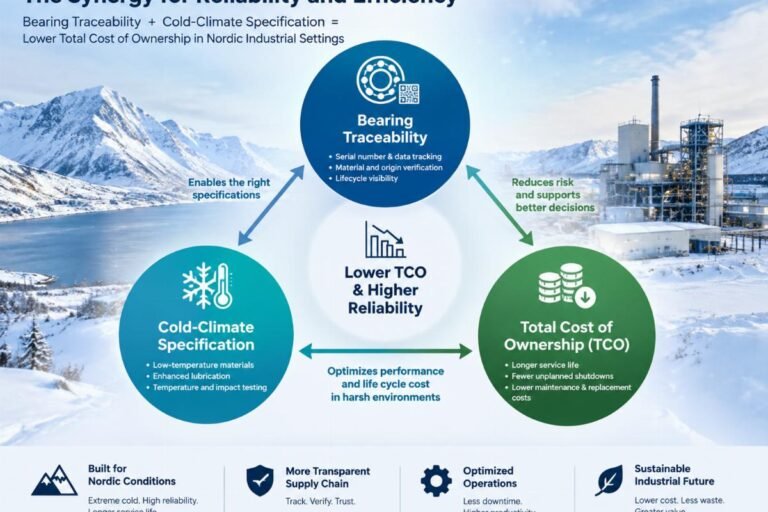
The key differentiator is traceability. In the wholesale market, counterfeit or refurbished bearings sometimes enter the supply chain disguised as new stock. A trustworthy partner provides complete documentation linking each bearing to its original manufacturer’s batch number. This is not just about customs clearance; it is about liability. If a bearing fails prematurely, you need to prove it was genuine and stored correctly. Without this paper trail, you bear the full cost of the failure. When evaluating Bearing Suppliers in Finland, ask for their process for verifying authenticity before shipment. Do they inspect the packaging integrity? Do they check the laser-etched codes against the manufacturer’s database? These steps separate professional distributors from simple box movers.
How to Compare SKF, FAG, and NSK for Your Specific Application?
Load capacity ratings are meaningless if the internal clearance mismatches your operating temperature.
Comparing major brands requires a matrix that goes beyond basic dimensions. While SKF, FAG, and NSK all produce high-quality bearings, their strengths vary by application environment. Below is a qualitative comparison to guide your selection process. Note that specific performance metrics depend on the exact series and manufacturing batch, so always consult the technical datasheet for the specific part number.
| Feature | SKF (Sweden) | FAG (Germany) | NSK (Japan) |
|---|---|---|---|
| Primary Strength | Sealing technology & lubrication systems | Precision grinding & high-speed stability | Material purity & noise reduction |
| High-Temp Performance | Robust, but requires correct clearance selection | Excellent thermal stability in precision grades | Good, with specialized heat-resistant steels |
| Load Capacity | High dynamic load ratings in roller types | Superior static load handling in large diameters | Balanced dynamic/static ratings |
| Traceability | Strong global batch tracking | Detailed factory-level documentation | Comprehensive serial number tracking |
| Best For | Harsh environments with contamination risk | High-speed spindles & precision machinery | Low-noise applications & automotive sectors |
[NEED_CITE: comparative analysis of bearing brand strengths per industry application guidelines]
Consider a case involving a European wind farm operator. They initially standardized on one brand for all gearbox bearings. However, they faced repeated failures in the high-speed stage. After switching to a mixed-brand strategy, they used FAG for the high-speed planetary stages due to their precision grinding capabilities, while retaining SKF for the main shaft bearings where sealing against moisture was critical. This condition-driven approach extended the service life meaningfully compared to the previous single-brand setup.
When you work with Bearing Suppliers in Finland, use this matrix to request specific recommendations. Do not just ask for “an SKF equivalent.” Ask for a bearing that matches the load rating and speed requirements of your current unit, regardless of the brand. A competent supplier will analyze your operating conditions and suggest the best fit, even if it means mixing brands in a single order.
Why Condition-Driven Selection Beats Brand Loyalty?
Internal clearance mismatch causes more failures than material defects.
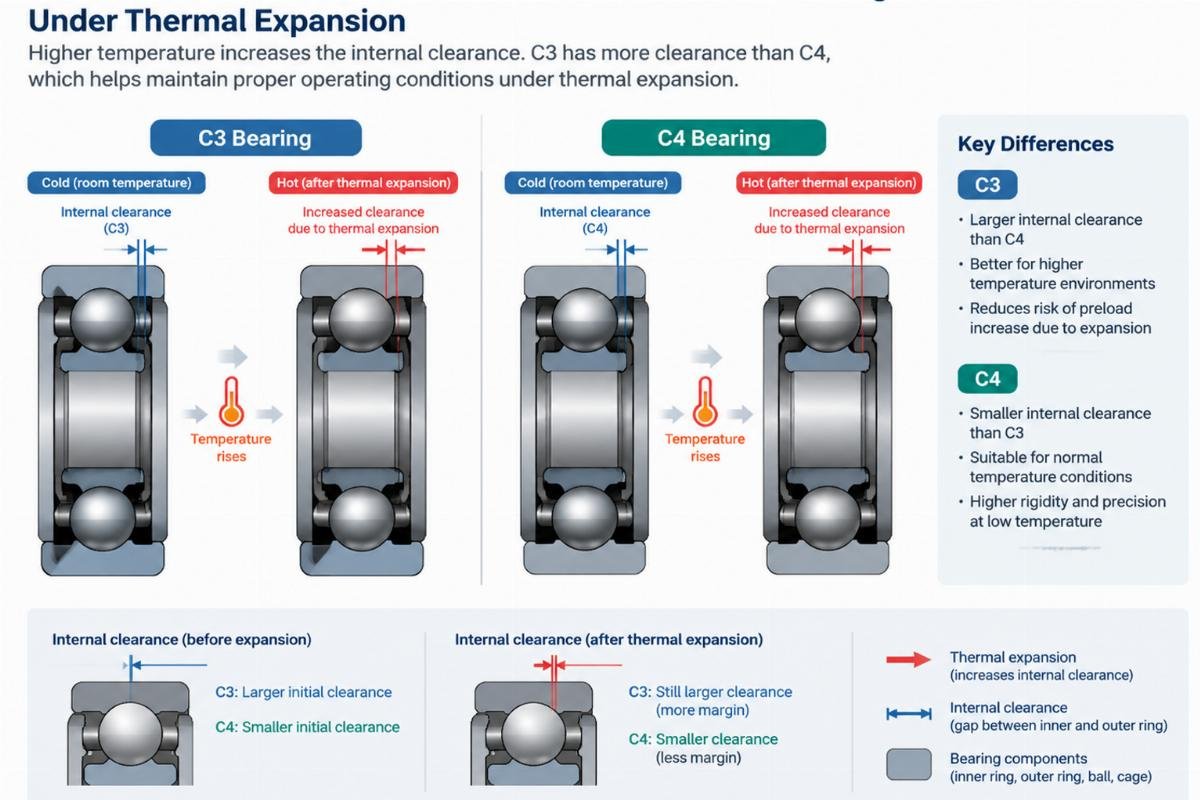
Most buyers think premium brands equal best performance. Reality is mismatched internal clearances cause premature failure. Bearings are not static components; they expand and contract with temperature changes. If you install a bearing with standard clearance in a high-heat environment, the inner ring expands faster than the outer ring, reducing the internal gap. If this gap disappears, the rolling elements bind, generating excessive heat and leading to rapid seizure.
This is why understanding ISO internal clearance standards is crucial. Common designations include C2 (tighter than normal), C3 (normal), and C4 (looser than normal). [NEED_CITE: ISO 5753-1 standard for radial internal clearance] In hot climates or high-friction applications, C3 or C4 is often required. However, not all brands label these consistently, and some batches may vary within the tolerance band. A professional supplier checks these values against your specific工况 (operating conditions) before shipping.
I once consulted for a cement plant in the Middle East that kept replacing crusher bearings every few months. They were buying top-tier brands but ignoring the ambient dust and heat. We switched to a condition-driven selection process, choosing bearings with enhanced sealing and C4 clearance to accommodate thermal expansion. The result was a substantial extension in service life. The brand did not change; the specification did.

For MRO operators, this means moving away from “we always buy Brand X” to “we need a bearing that handles X load at Y temperature.” When you engage with Bearing Suppliers in Finland, provide them with your operational data. Ask them to verify that the proposed bearings have the correct clearance class for your environment. This technical consultation is far more valuable than a simple price quote. It prevents the costly cycle of premature replacement and unplanned downtime.
How to Verify Authenticity and Traceability in Wholesale Orders?
Certificates are only useful if they match the physical product.
Verifying authenticity in wholesale orders requires a multi-step process. First, check the packaging. Genuine bearings come in high-quality boxes with clear printing, holographic seals, and batch numbers. Second, inspect the bearing itself. Look for laser-etched codes on the side face, not just ink-jet printed marks which can be wiped off. Third, and most importantly, cross-reference the batch number with the manufacturer’s documentation.
A reliable supplier provides a traceability document matrix that links the shipping invoice to the original factory certificate. This document should include the manufacturing date, batch number, and quality inspection results. [NEED_CITE: best practices for bearing supply chain traceability] If a supplier cannot provide this level of detail, consider it a red flag. Counterfeit bearings often lack this granular data or provide forged documents that do not match the physical codes on the products.

In one instance, a distributor in Southeast Asia received a shipment of bearings that looked perfect externally. However, upon testing, the steel hardness was below the standard range. The traceability documents provided were generic templates, not specific to the batch. By demanding batch-specific certificates, buyers can filter out such risks. When sourcing from Bearing Suppliers in Finland, insist on seeing sample documentation before placing a large order. Verify that the format matches the official templates from SKF, FAG, or NSK.
Additionally, check for consistency across the batch. In a genuine order, all bearings in a box should have consecutive or logically related batch numbers. Random variations suggest mixed sources or refurbishment. A professional supplier ensures batch consistency to maintain uniform performance across your equipment. This attention to detail is what separates a strategic partner from a transactional vendor.
Conclusion
Technical validation outweighs brand reputation in heavy-duty applications.
Selecting the right partner involves more than comparing prices. It requires a focus on internal clearance, traceability, and condition-driven selection. By prioritizing these factors, you reduce the risk of premature failure and optimize your maintenance budget.
When evaluating Bearing Suppliers in Finland, look for those who offer mixed-brand consolidation and detailed technical support. Verify authenticity through batch-specific documentation and ensure the bearings match your specific operating environment. This approach ensures reliability and long-term value for your industrial operations.
Tags

About the author
author
Editor covering global sourcing, supplier verification, and industrial product knowledge. Content is compiled from manufacturer specifications, industry standards, and hands-on experience with international B2B buyers. Every article is fact-checked before publishing to help procurement professionals make informed decisions.
More articles by author