Spare Bearings for Nordic Winters: Genuine SKF FAG NSK Wholesale Supplier
Prevent winter equipment downtime with precise bearing storage winter protocols for Nordic climates. Store spares at 15-20°C with humidity below 60% and use C3/C4 clearances with synthetic low-temperature grease to avoid seizure. Acclimate units for 24-48 hours before installation to ensure long-term reliability.
 Written by
author
- Published on
- 8 min read
- Updated

Spare Bearings for Nordic Winters: Genuine SKF FAG NSK Wholesale Supplier
Storing bearings in a dry room is not enough to survive a Nordic winter.
To prevent seizure and premature failure in extreme cold, spare bearings must be stored at a stable 15-20°C with humidity below 60%, equipped with C3 or C4 internal clearance, and lubricated with synthetic low-temperature grease. Standard mineral greases will solidify, and tight clearances will contract further under thermal shock, leading to immediate operational failure upon startup.
The biting wind off the Baltic Sea does not forgive engineering oversights. I remember standing in a timber mill in northern Sweden, watching a maintenance crew struggle with a seized spindle. The ambient temperature was minus thirty degrees Celsius. The plant manager was convinced he had received counterfeit SKF bearings because the units locked up within minutes of startup. He pointed to the pristine packaging and the holographic labels as proof of authenticity, yet the machinery remained silent. It was not a issue of brand integrity. The bearings were genuine. The failure lay in the storage protocol. The spare units had been kept in an unheated warehouse adjacent to the production floor. When moved into the heated assembly area for installation, microscopic condensation formed inside the sealed units. More critically, the standard mineral grease had turned into a solid block, and the standard C2 clearance had contracted to near zero due to the thermal differential. This incident shifted my perspective entirely. Supplying industrial components to cold climates is not just about logistics; it is about understanding tribology and thermal dynamics. As a bearing storage winter specialist, I have seen too many operations fail because they treated cold storage as merely “keeping things dry.”
Understanding why these failures occur requires looking beyond the ambient temperature. The primary culprit is not the cold itself, but the rapid change in temperature and the physical properties of the lubricant. When a bearing moves from a freezing storage environment to a warmer assembly area, or vice versa, the metal rings expand and contract at different rates than the rolling elements. If the internal clearance is insufficient, this thermal movement eliminates the necessary running gap. Simultaneously, the base oil in standard greases loses its fluidity. The dropping point becomes irrelevant if the grease never flows in the first place. [NEED_CITE: tribology research on low-temperature lubrication viscosity limits]
Why Do Bearings Fail in Nordic Winters?
Thermal shock and grease solidification are the primary culprits, not just ambient cold.
Most operators assume that if a bearing is kept dry, it will survive. This is a dangerous misconception. In cold climates, the air holds less moisture, but when that cold air enters a slightly warmer storage space or when a cold bearing is brought into a warm room, the relative humidity spikes locally. This leads to micro-condensation inside the bearing seal. Over time,*s corrosion, even if the bearing is not in use.
Consider the case of a wind farm operator in Norway. The pitch bearings failed repeatedly during the winter months. The investigation revealed that the bearings were stored outdoors under tarps. While protected from rain, the daily temperature fluctuations caused repeated condensation cycles inside the seals. The grease emulsified, losing its lubricating properties. When the turbine attempted to adjust the blade pitch in high winds, the friction coefficient skyrocketed, leading to catastrophic wear. [NEED_CITE: ISO standards for bearing storage environmental controls]
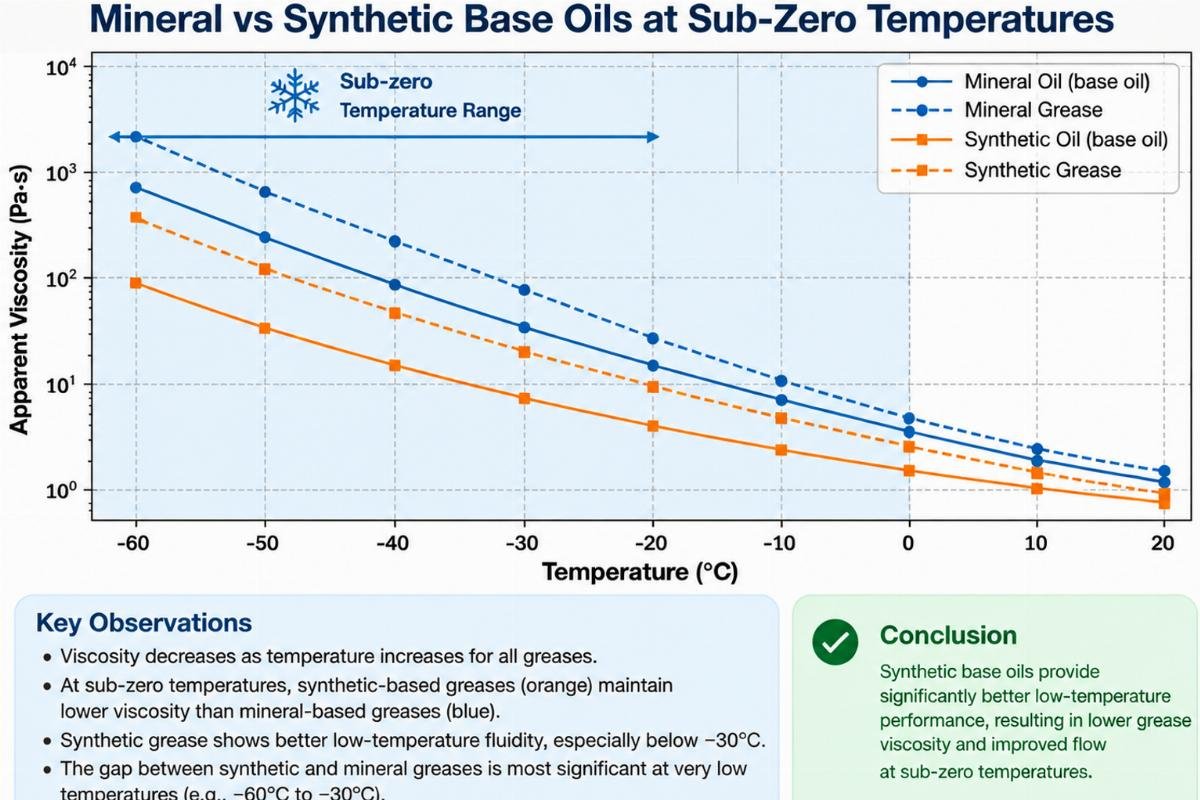
Another critical factor is the behavior of the lubricant. Mineral-based greases, which are common in general-purpose applications, have a high pour point. At minus twenty degrees Celsius, they can become semi-solid. This increases the starting torque dramatically. The motor struggles to overcome the initial resistance, leading to lubrication starvation as the grease fails to distribute across the raceways. The bearing runs dry until it heats up enough to melt the grease, by which time significant damage has already occurred. This is why selecting the right grease is as important as selecting the right bearing.

How to Select the Right Clearance and Grease?
Standard C0/C2 clearances and mineral greases will freeze; C3/C4 and synthetic low-temp greases are mandatory.
Selecting the correct components for cold weather requires a departure from standard specifications. In temperate climates, a standard internal clearance (C0 or C2) is often sufficient. However, in Nordic winters, the metal contracts. If you start with a tight clearance, the operating clearance becomes negative once the temperature drops. This causes pre-loading, excessive heat generation, and eventual seizure.
| Parameter | Standard Temperate Spec | Nordic Winter Spec | Reason for Change |
|---|---|---|---|
| Internal Clearance | C0 or C2 | C3 or C4 | Compensates for thermal contraction of steel rings |
| Grease Base Oil | Mineral Oil | Synthetic PAO or Ester | Maintains fluidity at low temperatures |
| Grease Consistency | NLGI 2 | NLGI 1 or 0 | Reduces starting torque and improves flow |
| Seal Material | Standard NBR | Low-temp NBR or FKM | Prevents seal hardening and cracking |
For heavy-load applications, such as mining conveyors or crushers, C4 clearance is often preferred. The extra space allows for the thermal expansion of the inner ring during operation without creating excessive preload. [NEED_CITE: C3/C4 clearance selection matrices for cold climates]
The choice of grease is equally critical. Synthetic base oils, such as Polyalphaolefin (PAO) or ester-based fluids, have much lower pour points than mineral oils. They remain fluid at temperatures well below minus forty degrees Celsius. Additionally, the consistency of the grease should be softer. An NLGI 1 or 0 grade grease offers less resistance to the rolling elements during startup. Using a thick NLGI 2 or 3 grease in cold weather is counter-intuitive for many buyers who associate thickness with protection. In reality, it causes lubrication starvation because the grease cannot pump into the contact zone quickly enough. [NEED_CITE: Bearing manufacturer technical bulletins on low-temp grease selection]
When sourcing these specialized components, verification is key. Many suppliers claim to offer “cold weather” bearings but ship standard units. Ensuring that the bearings are genuine SKF, FAG, or NSK products with verified C3 or C4 clearance documentation is essential. This is where technical selection support becomes vital. Cross-referencing part numbers to ensure they match the low-temperature specifications prevents costly mistakes.
What Are the Step-by-Step Storage Protocols?
Maintain stable 15-20°C, control humidity below 60%, and avoid direct floor contact to prevent condensation.
Proper storage is the first line of defense against winter failure. Even the best-selected bearing will fail if stored incorrectly. The goal is to maintain a stable environment that minimizes thermal shock and moisture ingress.
- Temperature Control: Keep the storage area between 15 and 20 degrees Celsius. Avoid large fluctuations. A stable temperature prevents the cyclical expansion and contraction that draws moisture into the packaging. [NEED_CITE: ISO standards for bearing storage temperature stability]
- Humidity Management: Maintain relative humidity below 60%. Use dehumidifiers if necessary. High humidity promotes corrosion, especially on the polished surfaces of the raceways.
- Elevation: Never store bearings directly on the concrete floor. Concrete is cold and can transmit moisture. Use pallets or shelving to keep the packages elevated. This also improves air circulation around the stock.
- Packaging Integrity: Keep bearings in their original vapor-corrosion inhibitor (VCI) packaging until the moment of installation. Do not open the package prematurely. If the packaging is damaged, re-wrap the bearing immediately with VCI paper.
- Rotation: For large spherical roller bearings, rotate the outer ring periodically to redistribute the grease. This prevents the grease from settling and separating, which can lead to dry spots.
A mining operation in Canada learned this the hard way. They stored their spare idler bearings in a damp basement. Despite using high-quality TIMKEN bearings, the units developed surface rust within months. The rust particles contaminated the grease, acting as an abrasive paste when the bearings were finally installed. The result was a series of premature failures that halted production for days. [NEED_CITE: Case study on storage humidity and condensation cycle impact]

How to Acclimate Bearings Before Installation?
Cold-stored bearings must rest in the operational environment for 24-48 hours to prevent thermal shock during mounting.
The final step in the process is often the most overlooked. Moving a bearing from a cold storage area directly to a warm machine housing creates immediate thermal stress. The inner ring expands faster than the outer ring, potentially altering the fit and clearance. To prevent this, bearings must be acclimated.
Remove the bearing from its cold storage location and place it in the installation area. Allow it to sit for 24 to 48 hours. This gradual temperature equalization ensures that the metal stabilizes before it is mounted. It also allows any surface condensation to evaporate safely outside the sealing interface.
During installation, use induction heaters or oil baths to expand the inner ring for mounting. Never use an open flame, as this can damage the steel structure and the temper of the material. Ensure the heating temperature does not exceed the manufacturer’s recommended limit, typically around 120 degrees Celsius for standard bearings. [NEED_CITE: Bearing manufacturer installation guidelines for thermal mounting]
This acclimation period is crucial for maintaining the integrity of the C3 or C4 clearance. If a cold bearing is forced onto a shaft, the interference fit can become excessively tight, leading to high hoop stresses and potential cracking of the inner ring. By allowing the bearing to reach ambient temperature, you ensure that the fit is achieved under controlled conditions.

Conclusion
Surviving Nordic winters requires more than just genuine parts; it demands precise technical alignment.
Proper bearing storage winter protocols involve controlling temperature and humidity, selecting C3/C4 clearances, and using synthetic low-temperature greases. Acclimating bearings before installation prevents thermal shock and ensures long-term reliability. By focusing on these technical details, operators can avoid the hidden costs of downtime and premature failure.
Tags

About the author
author
Editor covering global sourcing, supplier verification, and industrial product knowledge. Content is compiled from manufacturer specifications, industry standards, and hands-on experience with international B2B buyers. Every article is fact-checked before publishing to help procurement professionals make informed decisions.
More articles by author

