22228 Bearing Specs & Paper Mill Applications Wholesale Supplier
Stop premature 22228 bearing specs failures in paper mill dryer sections caused by thermal expansion. Standard clearance units seize rapidly, but C3 internal clearance and high-temperature seals accommodate heat growth effectively. Select the right configuration to prevent catastrophic downtime and ensure reliable long-term performance.
 Written by
author
- Published on
- 7 min read
- Updated
22228 Bearing Specs & Paper Mill Applications Wholesale Supplier
Standard clearance bearings fail in paper mill dryer sections not because of load, but because of thermal expansion.
The correct specification for a 22228 spherical roller bearing in high-temperature paper mill applications requires C3 internal clearance and high-temperature resistant seals to accommodate thermal growth and prevent premature cage disintegration. Selecting standard clearance units to save upfront costs typically results in catastrophic seizure within months due to the extreme heat and humidity of dryer sections.
Having sourced equipment for heavy industry in Southeast Asia, I witnessed firsthand how environmental factors dictate component longevity. In regions with high ambient temperatures and humidity, such as Indonesia, the operational envelope for industrial machinery narrows significantly. A batch of standard-specification bearings installed in a paper machine’s dryer section failed rapidly, causing a complete line stoppage. The root cause was not excessive load or poor lubrication practices, but a mismatch between the bearing’s internal clearance and the thermal expansion of the shaft and housing under operating conditions. This experience underscores that technical selection criteria must override initial procurement cost considerations in harsh environments. [NEED_CITE: ISO standards for spherical roller bearing internal clearance and thermal expansion compensation]
What Are the Core Specs of a 22228 Bearing?
Understanding the dimensional and structural fundamentals of the 22228 series is the prerequisite for any successful application.
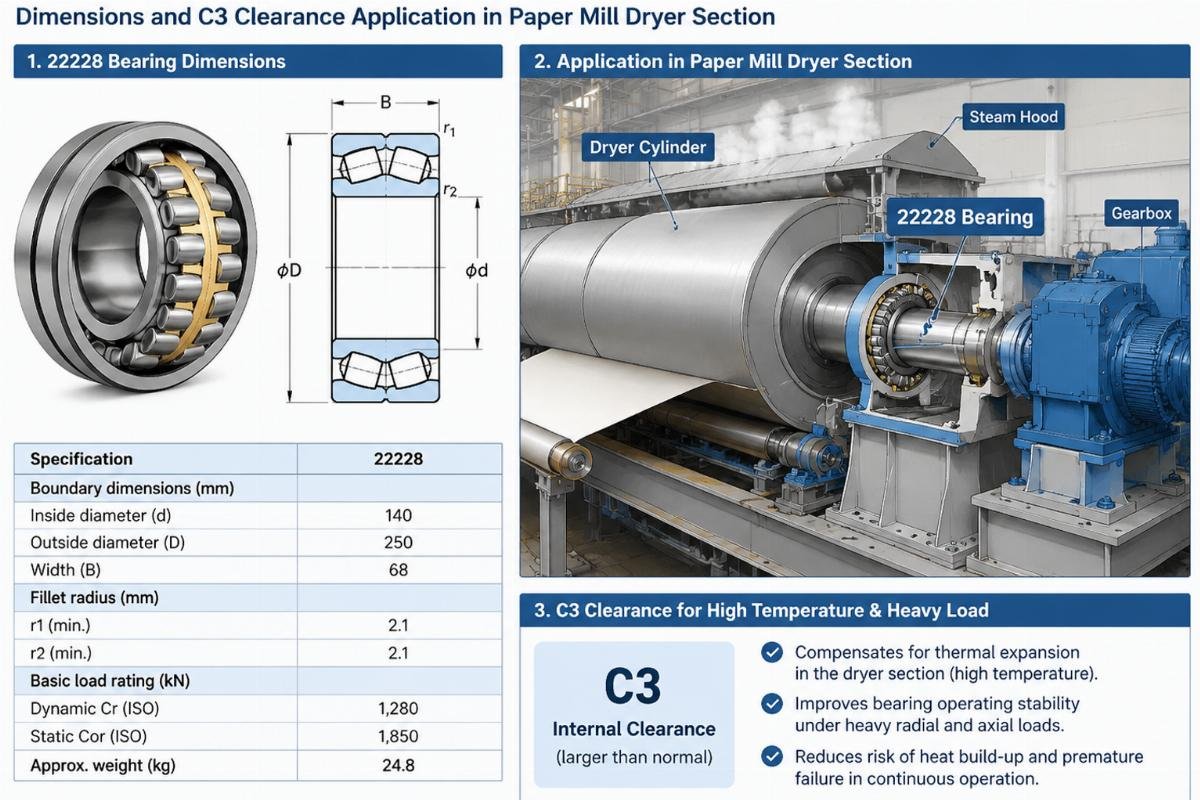
The 22228 designation refers to a specific series of spherical roller bearings characterized by their ability to accommodate misalignment and heavy radial loads. The core specifications include a bore diameter of 140 mm, an outside diameter of 250 mm, and a width of 68 mm. These dimensions are standardized across major manufacturers, ensuring interchangeability for maintenance purposes. However, dimensional consistency does not imply performance uniformity. The critical differentiators lie in internal clearance, cage material, and seal design.
| Specification Parameter | Standard Value / Option | Application Note |
|---|---|---|
| Bore Diameter | 140 mm | Fixed standard dimension |
| Outside Diameter | 250 mm | Fixed standard dimension |
| Width | 68 mm | Fixed standard dimension |
| Internal Clearance | C3 (Recommended for high temp) | Accommodates thermal expansion |
| Cage Material | Steel or Brass | Brass preferred for high speed/temp |
| Seal Type | High-Temp NBR or FKM | Resists heat degradation |
In paper mill applications, the 22228 bearing is frequently subjected to continuous rotational stress and elevated temperatures. The choice of cage material becomes significant here. Steel cages offer robustness, but brass cages often provide better performance in high-speed, high-temperature scenarios due to their lower density and superior heat dissipation properties. [NEED_CITE: Bearing manufacturer technical bulletins on cage material performance] Furthermore, the internal clearance class is not a minor detail. A C3 clearance provides greater internal space than standard clearance, allowing the rolling elements to move freely even when the inner ring expands due to heat. Without this allowance, the bearing operates under pre-load, leading to rapid fatigue and failure.

Why Do Standard 22228 Bearings Fail in Paper Mills?
Thermal expansion in dryer sections turns standard clearance bearings into ticking time bombs.
Paper machine dryer sections operate in an environment defined by high heat and steam. The cylinders are heated to evaporate moisture from the paper web, creating ambient temperatures that far exceed normal industrial conditions. When a standard clearance 22228 bearing is installed in such an environment, the inner ring heats up and expands radially. Since the shaft also expands, the net effect is a reduction in the bearing’s internal clearance. If the initial clearance is standard, this thermal growth can eliminate the clearance entirely, causing the rolling elements to bind against the raceways.
This binding generates excessive friction, which in turn produces more heat, creating a positive feedback loop known as thermal runaway. The result is often the disintegration of the cage or seizure of the rolling elements. In one observed case, a facility experienced repeated failures of dryer section bearings every few months. The maintenance team initially suspected lubrication issues, but analysis revealed that the bearings were running at temperatures where standard clearance was insufficient. The lack of C3 clearance meant the bearing had no room to breathe thermally. [NEED_CITE: Paper industry machinery maintenance guidelines on thermal failure modes]
Additionally, standard seals often degrade under these conditions. Typical nitrile rubber seals have temperature limits that may be exceeded in dryer sections, leading to hardening, cracking, and loss of sealing effectiveness. Once the seal fails, contaminants such as steam condensate and paper dust enter the bearing, accelerating wear and corrosion. The combination of thermal preload and contamination makes standard-specification 22228 bearings unsuitable for this specific application.

How to Select the Right 22228 for Harsh Environments?
Mandating C3 clearance and high-temperature seals is non-negotiable for reliability in paper mills.
Selecting the correct 22228 bearing for harsh environments involves a deliberate deviation from standard procurement habits. The primary requirement is specifying C3 internal clearance. This clearance class is designed to compensate for the differential thermal expansion between the shaft and housing. By starting with extra internal space, the bearing maintains optimal operating clearance even when temperatures rise significantly. This simple specification change can extend bearing life substantially by preventing thermal preload.
The second critical factor is seal material. Standard nitrile seals are often inadequate for sustained high-temperature operation. Instead, bearings equipped with high-temperature resistant seals, such as those made from fluorocarbon rubber (FKM), should be selected. These materials maintain their elasticity and sealing integrity at higher temperatures, effectively blocking contaminants while retaining lubricant. [NEED_CITE: ISO standards for sealing material temperature ratings]
Lubrication compatibility is another consideration. The grease used must have a high dropping point and excellent oxidation stability to withstand the heat without breaking down. In some cases, solid lubricants or specialized high-temperature greases are recommended to ensure consistent performance. When sourcing these components, it is essential to verify the authenticity of the specifications. Genuine products from reputable manufacturers will clearly indicate the clearance class and seal material in their part numbers and documentation.
Our inventory includes genuine multi-brand 22228 C3 bearings with high-temperature seals, sourced directly from premium global brands. We provide traceability documentation to ensure that every unit meets the specified technical requirements. For MRO operators facing urgent replacements, our spot inventory allows for rapid deployment, minimizing downtime. Technical selection support is available to confirm that the chosen bearing matches the specific thermal and load conditions of your machinery.

What Is the Real Cost of Wrong Bearing Selection?
Unplanned downtime and secondary damage far outweigh the initial savings of cheap bearings.
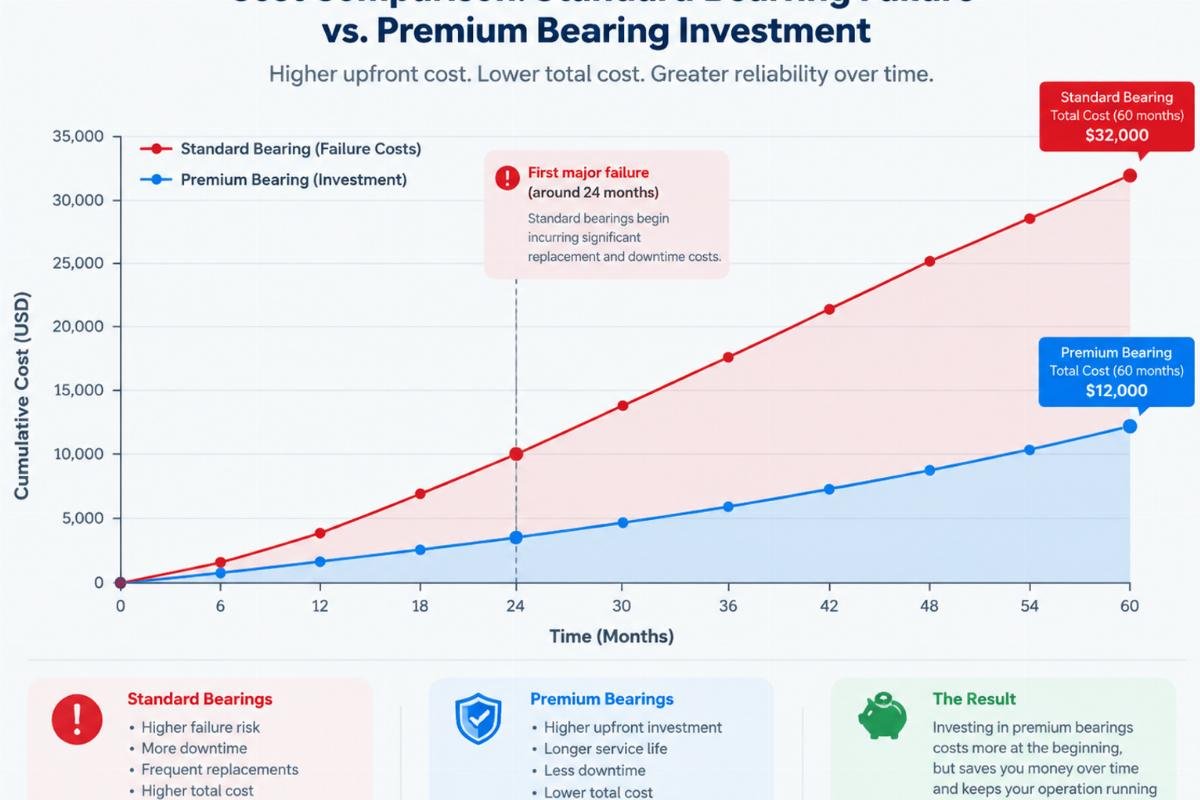
The temptation to select standard-clearance 22228 bearings based on lower upfront cost is understandable, but the financial implications of failure are severe. A bearing failure in a critical section of a paper machine does not just require a replacement part; it halts production. The cost of unplanned downtime includes lost revenue, overtime labor for emergency repairs, and potential penalties for missed delivery deadlines. In many cases, the cost of a single hour of downtime exceeds the annual budget for bearing replacements.
Furthermore, a seized bearing can cause secondary damage to the shaft, housing, and adjacent components. Repairing or replacing these larger assets adds significant expense to the incident. In contrast, investing in correctly specified C3 clearance bearings with high-temperature seals prevents these failures. The extended service life of properly selected bearings reduces the frequency of replacements and maintenance interventions. [NEED_CITE: Industrial maintenance cost analysis comparing preventive vs. reactive maintenance]
A regional distributor once reported that a client switched from standard to C3-spec 22228 bearings after experiencing repeated failures. The initial cost increase was marginal compared to the total maintenance budget, but the reduction in downtime-related losses was substantial. The bearings lasted significantly longer, and the number of emergency call-outs dropped noticeably. This shift in strategy transformed bearing procurement from a cost center into a reliability investment.
Conclusion
Correct specification prevents thermal failure and protects production continuity.
Selecting the right 22228 bearing for paper mill applications requires prioritizing technical suitability over initial price. C3 internal clearance and high-temperature seals are essential features that accommodate thermal expansion and resist environmental degradation. Ignoring these specifications leads to premature failure, costly downtime, and secondary damage. By adhering to rigorous selection criteria and sourcing genuine components, operators can ensure reliable performance and minimize operational risks in harsh industrial environments.
Tags

About the author
author
Editor covering global sourcing, supplier verification, and industrial product knowledge. Content is compiled from manufacturer specifications, industry standards, and hands-on experience with international B2B buyers. Every article is fact-checked before publishing to help procurement professionals make informed decisions.
More articles by author

