6014 Bearing Specs & Applications: Wholesale Supplier for Bulk Orders
Stop sourcing failures by matching 6014 bearing specs to exact operating conditions, not just dimensions. Learn how suffixes like ZZ, 2RS, and C3 impact heat and contamination protection in motors and pumps. Avoid costly 6014 versus 6214 mix-ups with our verification guide for reliable bulk orders.
 Written by
author
- Published on
- 7 min read
- Updated
6014 Bearing Specs & Applications: Wholesale Supplier for Bulk Orders
A sealed bearing is not always the superior choice. In high-speed motor applications, a double-shielded 6014 ZZ can generate excessive heat due to friction, leading to premature grease breakdown and failure.
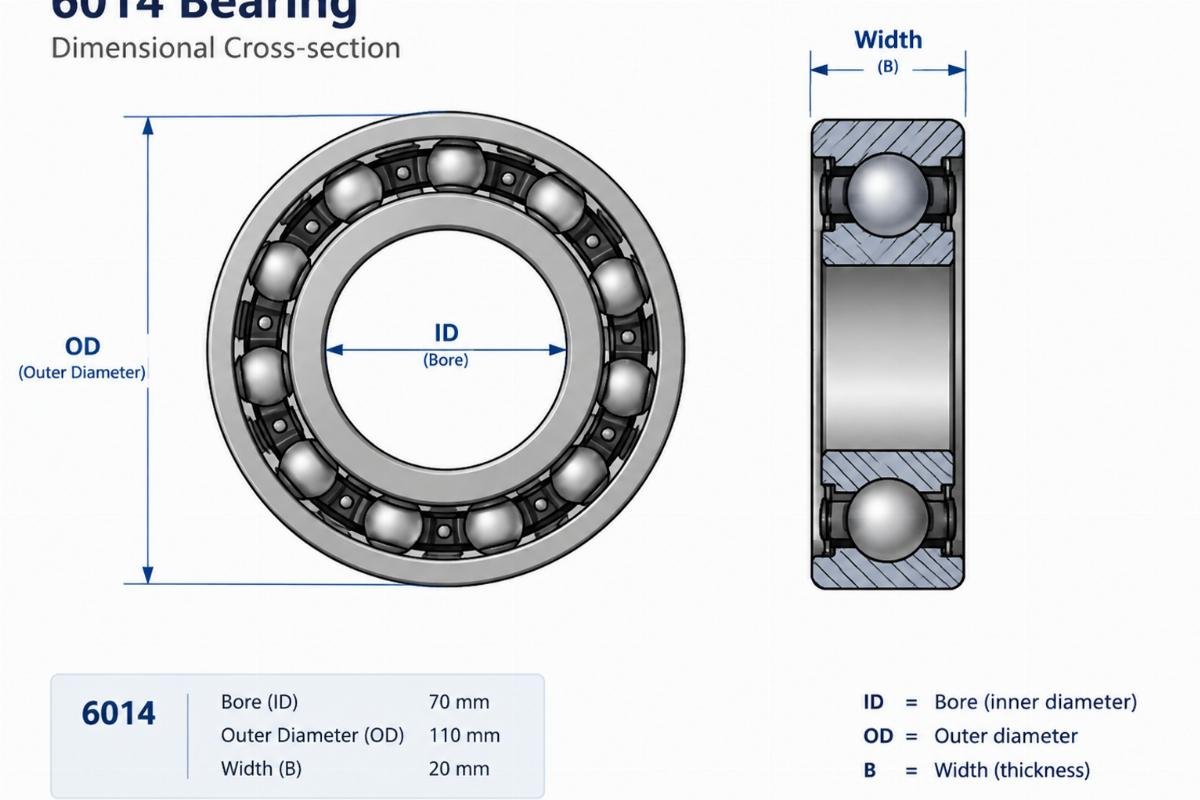
The 6014 deep groove ball bearing is defined by its 70mm bore, 110mm outer diameter, and 20mm width, but its operational reliability hinges entirely on selecting the correct suffix for internal clearance and sealing type rather than basic dimensions alone.
I still remember the humidity in that warehouse in Qingdao, watching a container bound for Brazil being loaded with agricultural replacement parts. The packaging for the 6014 bearing and the 6214 looked nearly identical from a distance. A quick glance at the box label wasn’t enough; the suffix code was the only differentiator between an open bearing suitable for a dusty gearbox and a sealed unit meant for a protected motor housing. The mix-up resulted in days of downtime for the end-user, a cost far exceeding the price of the components. This incident reinforced a critical lesson: sourcing these components requires verifying the specific application environment against the manufacturer’s suffix codes, not just matching the bore size. [NEED_CITE: ISO 15243 failure mode classification related to contamination and lubrication]
Understanding the precise specifications and suffix variations is essential for distributors and MRO buyers who need to prevent assembly failures and ensure long-term equipment reliability.
What Are the Core Specs of a 6014 Bearing?
Dimensions are the starting point, but load ratings determine survival. A 6014 bearing may fit the shaft, but if the dynamic load rating is insufficient for the application, it will fail prematurely under stress.
The 6014 series belongs to the deep groove ball bearing family, designed to handle radial loads and moderate axial loads in both directions. Its popularity stems from its versatility across various industrial sectors, from electric motors to pump assemblies. However, relying solely on the physical dimensions without considering the load capacity and speed limits is a common sourcing error.
| Parameter | Specification | Note |
|---|---|---|
| Bore Diameter (d) | 70 mm | Standard metric size |
| Outer Diameter (D) | 110 mm | Critical for housing fit |
| Width (B) | 20 mm | Determines axial space requirement |
| Dynamic Load Rating (Cr) | ~30-35 kN | Varies by brand and material [NEED_CITE: ABMA standard load rating calculations] |
| Static Load Rating (Cor) | ~20-25 kN | Relevant for stationary heavy loads |
| Limiting Speed (Grease) | ~4,000-5,000 rpm | Depends on cage type and lubrication |
| Limiting Speed (Oil) | ~6,000-7,000 rpm | Higher thermal dissipation capability |
These values are general references based on standard steel compositions and manufacturing tolerances compliant with ISO 492. Different manufacturers may offer slight variations in load ratings due to differences in steel purity and raceway geometry. For high-precision applications, verifying the specific tolerance class (such as P0 or P6) is necessary. [NEED_CITE: ISO 492 dimensional and running accuracy standards]

For buyers, this matrix serves as a baseline. When replacing a failed unit, simply matching the 70x110x20mm dimensions is insufficient. One must also confirm that the new bearing meets or exceeds the original equipment manufacturer’s load and speed requirements.
How Do Suffixes Change 6014 Performance?
The suffix is not just a label; it is a functional specification. Changing from an open 6014 to a 6014-2RS alters the thermal characteristics and contamination protection of the entire assembly.
The suffix system indicates the type of sealing, internal clearance, and cage material. Misinterpreting these codes is a frequent cause of premature bearing failure. For instance, a sealed bearing protects against dust but restricts heat dissipation, while an open bearing allows for better cooling but requires external sealing solutions.
| Suffix | Sealing Type | Internal Clearance | Application Suitability |
|---|---|---|---|
| None | Open | Standard (CN) | High-speed, clean environments, external sealing available |
| ZZ | Double Metal Shield | Standard (CN) | Moderate contamination, higher speed than rubber seals |
| 2RS | Double Rubber Seal | Standard (CN) | High contamination, low to moderate speed, moisture protection |
| C3 | Open/Sealed | Greater than Standard | High-temperature operations, thermal expansion compensation [NEED_CITE: ISO 5753 internal clearance classes] |
| C4 | Open/Sealed | Greater than C3 | Extreme temperature variations, heavy interference fits |
A common mistake observed in tropical climates involves using standard clearance (CN) bearings in high-temperature environments. As the operating temperature rises, the inner ring expands more than the outer ring, reducing the internal clearance. If the initial clearance is not sufficient (e.g., C3), the bearing can seize. Conversely, using a C3 clearance in a cold, precision application might lead to excessive vibration and noise.

Distributors should advise clients to specify the suffix based on the operating temperature and contamination level. For example, in agricultural gearboxes exposed to dust and moisture, a 6014-2RS is often preferred. However, in high-speed spindle applications, an open 6014 with C3 clearance might be required to manage thermal expansion and maintain precision.
What Are the Common Applications for 6014 Bearings?
Context dictates configuration. A 6014 bearing in a water pump faces different challenges than one in an electric motor, requiring distinct suffix selections to ensure longevity.
The 6014 deep groove ball bearing is widely used across various industries due to its balanced performance profile. Understanding the specific demands of each application helps in selecting the right variant.
In electric motors, the 6014 is frequently employed as a non-drive end bearing. Here, the primary concerns are electrical insulation and high-speed stability. An open bearing with a polyamide cage is often chosen to reduce weight and handle centrifugal forces. However, if the motor operates in a humid environment, a 6014-2RS with nitrile rubber seals provides necessary protection against moisture ingress. [NEED_CITE: IEC standards for motor bearing insulation and protection]

In pump applications, particularly in the Middle East region, 6014 bearings are subject to continuous radial loads and potential misalignment. Cases have been reported where mixing up 6014 and 6214 bearings led to clearance mismatches and early rejection. The 6214 has a larger outer diameter and width, offering higher load capacity but requiring a different housing bore. Using the wrong series can cause improper fit and catastrophic failure.
Agricultural machinery in Latin America presents another challenging environment. Dust and debris are constant threats. While a 6014-2RS offers good protection, heavy-duty applications might require additional external sealing. In some instances, farmers have reported downtime due to dust ingress through damaged seals, highlighting the need for regular maintenance and correct initial selection.
For OEMs in Southeast Asia producing industrial fans, high-temperature operation is a key factor. Selecting a 6014 with C3 clearance ensures that the bearing can accommodate thermal expansion without preloading, which would otherwise shorten its lifespan significantly.
How to Avoid Costly Sourcing Mistakes?
Verification prevents rejection. A single character difference in the part number can render a bulk order useless for the intended application.
Sourcing errors often stem from overlooking suffix details or confusing similar part numbers. To mitigate these risks, buyers should implement a rigorous verification process.
First, always cross-reference the full part number, including suffixes, with the original equipment manual. Do not assume that a “standard” 6014 is suitable for all applications. Check the required internal clearance and sealing type explicitly.
Second, beware of the 6014 vs. 6214 confusion. Although both share the same 70mm bore, their outer diameters and widths differ. A 6214 will not fit in a housing designed for a 6014, and vice versa. Visual inspection of the packaging and the bearing itself is crucial before acceptance.

Third, consider the supply chain’s verification capabilities. Reliable suppliers perform strict suffix-verification processes to ensure that the physical product matches the documentation. This is particularly important for mixed-container consolidations where multiple part numbers are shipped together. A robust quality control system checks each batch for correct markings and packaging integrity.
Finally, request technical datasheets for critical applications. These documents provide detailed information on load ratings, speed limits, and material specifications, allowing for informed decision-making. Engaging with suppliers who offer cross-brand equivalent model consultation can also help identify suitable alternatives when specific brands are unavailable, ensuring continuity of supply without compromising performance.
Conclusion
Precision in specification ensures reliability in operation. The 6014 bearing is a versatile component, but its performance is directly linked to the correct selection of suffixes and clear understanding of application demands.
By focusing on dimensional accuracy, load requirements, and environmental conditions, buyers can avoid common pitfalls such as seal mismatch or clearance errors. Partnering with suppliers who prioritize detailed verification and technical support further reduces the risk of costly downtime and ensures the long-term efficiency of industrial machinery.
Tags

About the author
author
Editor covering global sourcing, supplier verification, and industrial product knowledge. Content is compiled from manufacturer specifications, industry standards, and hands-on experience with international B2B buyers. Every article is fact-checked before publishing to help procurement professionals make informed decisions.
More articles by author

