QJ 312 Four-Point Contact Bearing Specs & Uses Wholesale Supplier
Master the QJ 312 four-point contact bearing by understanding its axial-dominant load capacity and 35-degree contact angle. Select correct C3 or C4 clearance to prevent thermal binding in high-temperature applications. Verify authenticity through traceable batch codes to avoid costly refurbished units and ensure spindle reliability.
 Written by
author
- Published on
- 7 min read
- Updated
QJ 312 Four-Point Contact Bearing Specs & Uses Wholesale Supplier
Most buyers assume a four-point contact bearing handles radial and axial loads equally. It does not.
The QJ 312 four-point contact bearing is designed primarily for high axial rigidity in one direction, with radial capacity significantly lower than its axial rating. Selecting the correct clearance class, typically C3 or C4 based on thermal conditions, and verifying authenticity through traceable batch codes are the only ways to prevent premature spindle failure. This guide details the technical specifications, industrial applications, and verification methods required for safe sourcing.
Having spent years navigating the complexities of industrial procurement, I learned early on that specifications on paper rarely match the reality inside a warehouse box. The difference between a smoothly running machine tool spindle and a catastrophic vibration failure often comes down to micrometer-level deviations in clearance or a refurbished unit repackaged as new. Understanding the mechanical logic behind the QJ 312 four-point contact bearing helps buyers avoid these costly pitfalls.
What Are the Core Specs of QJ 312?
Dimensions and geometry define load capacity, not just brand reputation.
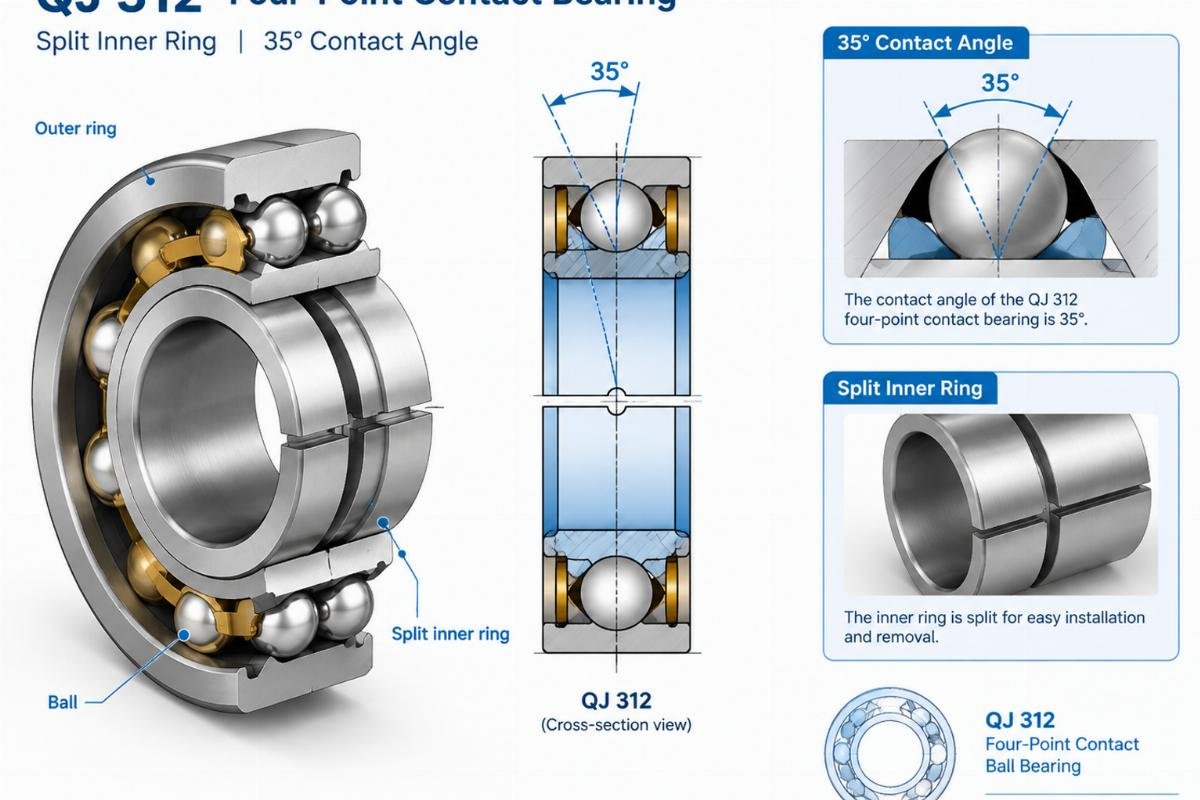
The QJ 312 follows ISO dimension standards, featuring a 60 mm bore, 130 mm outer diameter, and 31 mm width. However, the critical specification lies in its internal geometry. Unlike standard deep-groove bearings, the QJ 312 utilizes a split inner ring and a 35-degree contact angle. This design allows it to accommodate axial loads in both directions while maintaining high rotational speed capabilities. [NEED_CITE: ISO standard dimensions for QJ series bearings]
The split inner ring is a distinctive feature that enables the installation of more balls, increasing the load-carrying capacity. Yet, this design also makes the bearing sensitive to mounting errors. If the housing bore is not perfectly cylindrical or if the shaft alignment is off, the split ring can deform, leading to uneven load distribution and early fatigue.
| Feature | Specification Detail | Functional Impact |
|---|---|---|
| Contact Angle | 35 degrees | Optimized for high axial load capacity in both directions |
| Inner Ring | Split design | Allows higher ball count and easier assembly |
| Load Ratio | Axial dominant | Radial capacity is a fraction of axial rating |
| Precision Class | P0 to P5 available | Higher classes reduce vibration in high-speed spindles |
A common misconception is that the QJ 312 can replace a standard angular contact bearing in all radial-heavy applications. In reality, its radial load capacity is only a specific percentage of its axial load rating. Using it in a predominantly radial application without proper support bearings will lead to rapid cage wear and failure. [NEED_CITE: Load ratio analysis for four-point contact bearings]
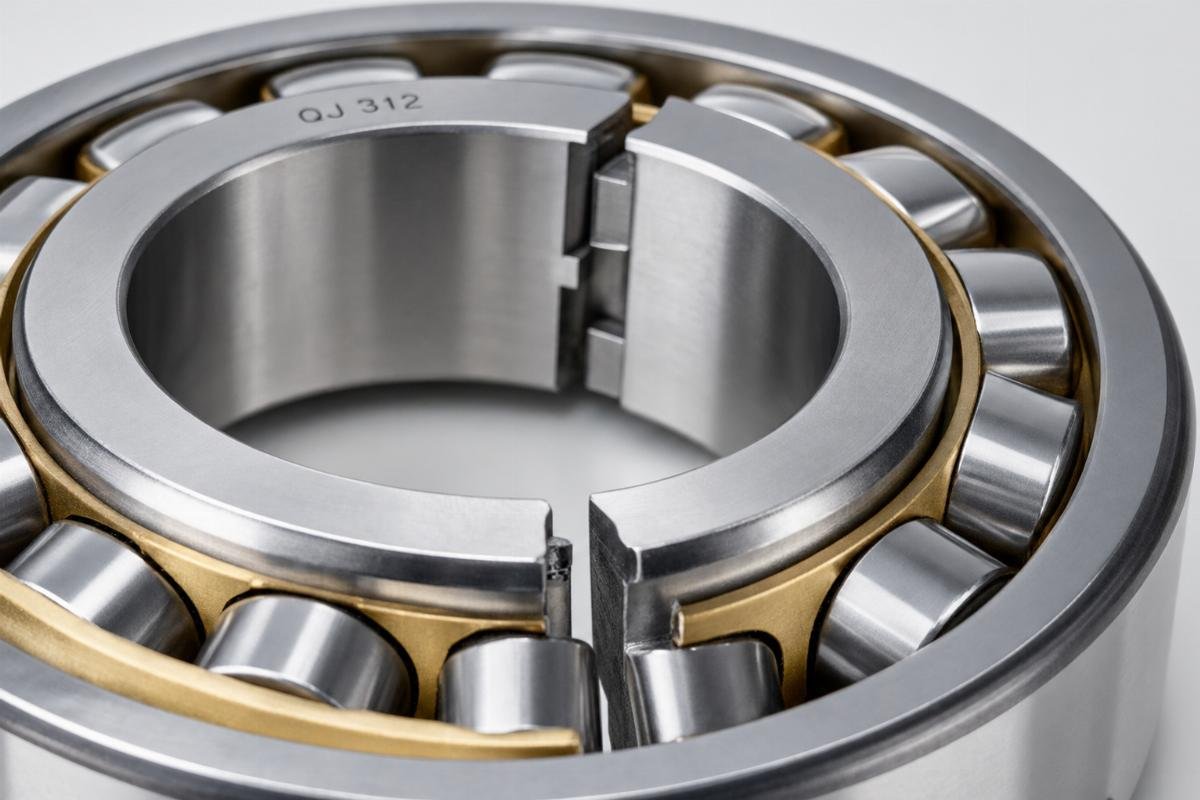
When evaluating a QJ 312 four-point contact bearing for your application, focus on the axial load requirements first. If the primary load is radial, consider a cylindrical roller bearing instead. For applications requiring high axial rigidity, such as slewing rings or extruder screws, the QJ 312 is an ideal choice, provided the mounting conditions are precise.
How to Select the Right Clearance for QJ 312?
Clearance selection is a thermal management decision, not just a fit preference.
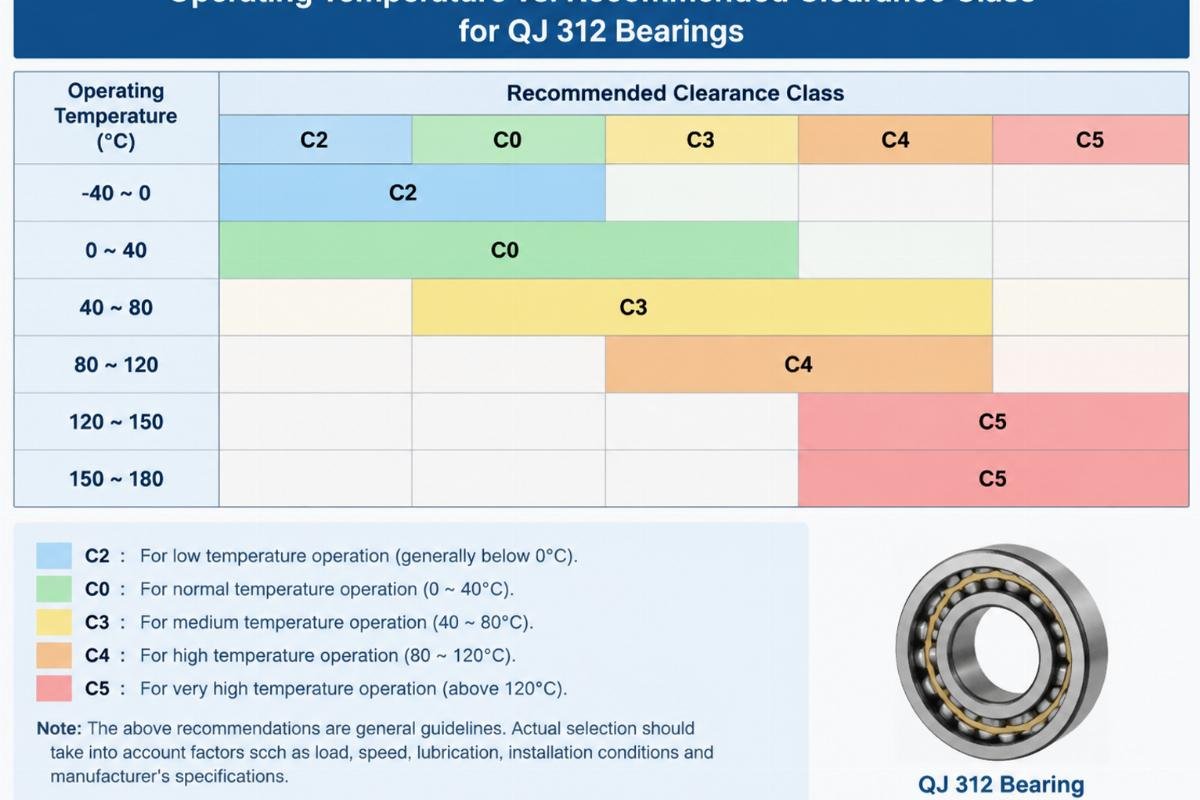
Choosing the wrong clearance class is a frequent cause of bearing failure in high-temperature environments. The QJ 312 is often used in applications where thermal expansion is significant, such as in steel mills or heavy-duty gearboxes. Standard clearance (CN) may lead to thermal binding, where the inner ring expands faster than the outer ring, eliminating the internal clearance and causing seizure. [NEED_CITE: Thermal expansion effects on bearing clearance]
For most industrial applications involving the QJ 312 four-point contact bearing, C3 or C4 clearance is recommended. C3 clearance provides a moderate increase over standard, suitable for applications with moderate temperature rises. C4 clearance offers a larger internal gap, essential for high-temperature operations or where the outer ring is mounted in a housing with poor heat dissipation.
| Clearance Class | Typical Application Context | Thermal Suitability |
|---|---|---|
| CN (Standard) | General purpose, low speed | Low thermal expansion environments |
| C3 | Electric motors, pumps | Moderate temperature rise |
| C4 | Steel mills, extruders | High temperature, poor heat dissipation |
I recall a case where a mining client experienced repeated failures in their crusher main shafts. The initial diagnosis pointed to lubrication issues, but a deeper analysis revealed that the bearings were installed with CN clearance in a high-heat environment. Switching to C4 clearance resolved the thermal binding issue, extending the service life noticeably. This highlights the importance of matching clearance to operating conditions rather than defaulting to standard options.
Selecting the correct clearance for a QJ 312 four-point contact bearing requires understanding the operating temperature and the material properties of the shaft and housing. Always consult the manufacturer’s technical catalog for specific recommendations based on your application’s thermal profile. [NEED_CITE: Manufacturer guidelines for clearance selection]
What Are the Primary Industrial Uses?
Axial rigidity drives application suitability, not just availability.
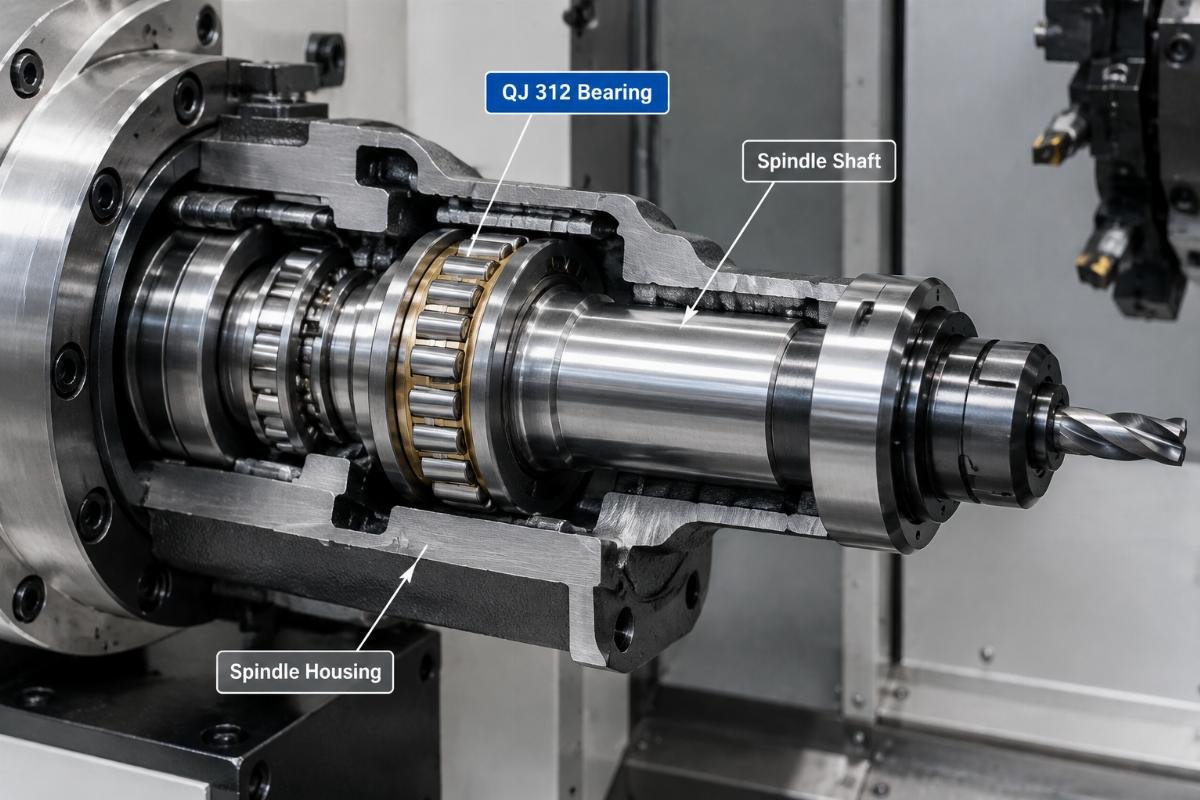
The QJ 312 four-point contact bearing excels in applications requiring high axial rigidity and the ability to handle reversible axial loads. Its design makes it particularly suitable for machine tool spindles, where precision and stability are paramount. In these settings, the bearing must maintain strict positional accuracy under varying load conditions, a task for which the 35-degree contact angle is well-suited.
Beyond machine tools, the QJ 312 is widely used in slewing rings for cranes and excavators. Here, the bearing must support heavy axial loads from the weight of the boom while allowing smooth rotation. The split inner ring design facilitates easier installation in large assemblies, reducing maintenance downtime. [NEED_CITE: Applications of four-point contact bearings in heavy machinery]
Extruders in the plastic and food processing industries also rely on the QJ 312. The scr*eration, and the bearing must withstand this force without excessive deflection. The high axial load capacity of the QJ 312 four-point contact bearing ensures consistent product quality and reduces the risk of process interruptions.
| Industry | Application | Key Requirement |
|---|---|---|
| Machine Tools | Spindle support | High precision, low vibration |
| Construction | Slewing rings | High axial load, reversible direction |
| Plastics | Extruder screws | High axial thrust, thermal stability |
| Mining | Crusher main shafts | Heavy load, durability |
It is crucial to note that while the QJ 312 is versatile, it is not a universal solution. In applications with high radial loads and low axial requirements, other bearing types may offer better performance and longevity. Understanding the specific load profile of your machinery is essential for selecting the right bearing.
How to Verify Authenticity and Avoid Refurbished Risks?
Traceability documents are non-negotiable for MRO buyers.
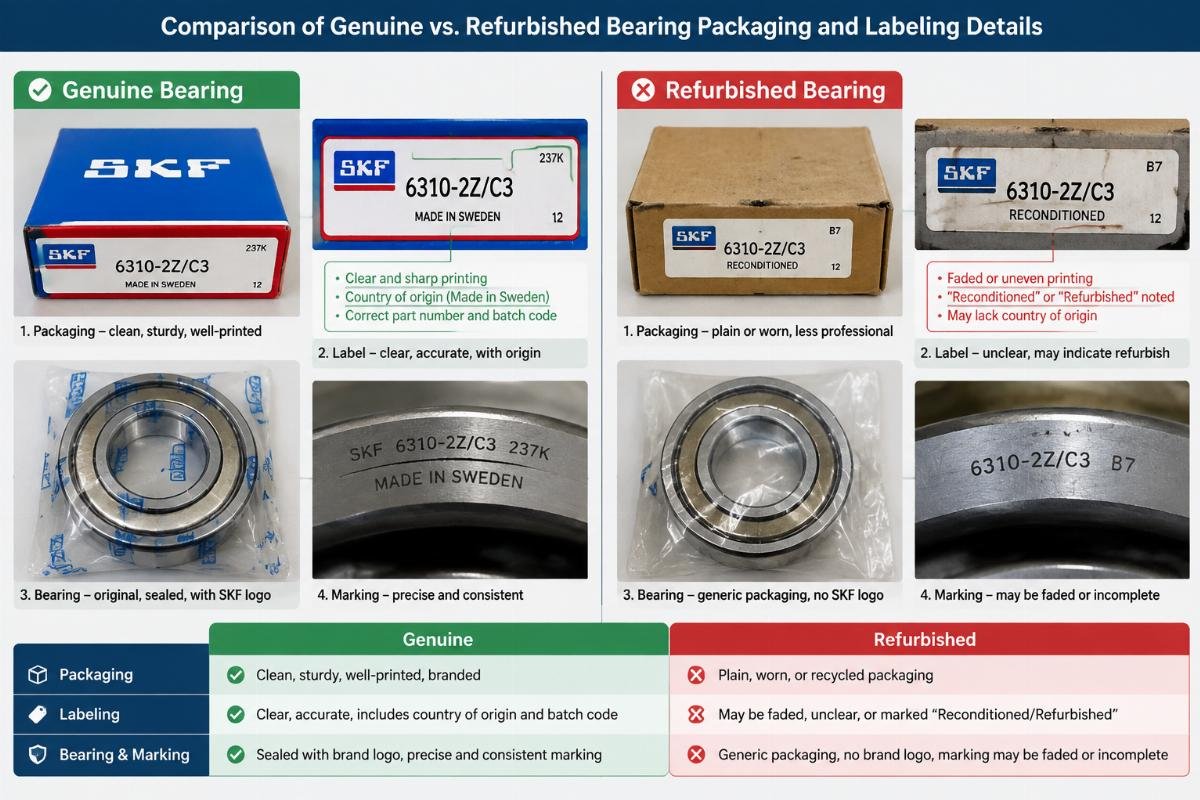
The market for industrial bearings is fraught with refurbished units repackaged as new. These bearings may look pristine on the outside but lack the internal integrity required for high-performance applications. For a QJ 312 four-point contact bearing, verifying authenticity is critical to avoiding catastrophic failures.
Start by requesting full traceability documentation from your supplier. Genuine bearings come with batch codes that can be verified against the manufacturer’s records. Check the packaging for signs of tampering, such as resealed boxes or mismatched labels. Authentic SKF, FAG, or NSK products have specific holographic seals and printing quality that are difficult to replicate. [NEED_CITE: Guidelines for identifying counterfeit bearings]
Inspect the bearing itself for signs of refurbishment. Look for discoloration on the raceways, which may indicate previous use or improper heat treatment. The cage should be securely riveted and free from damage. Any roughness or irregularity in the rolling elements is a red flag.
| Verification Step | Action | Indicator of Authenticity |
|---|---|---|
| Documentation | Request batch traceability | Valid manufacturer certificate |
| Packaging | Check seals and labels | Intact holographic seals, correct printing |
| Visual Inspection | Examine raceways and cage | No discoloration, secure rivets |
| Supplier Reputation | Verify authorized status | Listed distributor, positive reviews |
I once encountered a batch of QJ 312 bearings that appeared genuine but failed within weeks. Upon investigation, we found that the batch codes did not match the manufacturer’s records, and the internal clearance was inconsistent. This experience reinforced the importance of rigorous verification processes. Buying from a reputable supplier who prioritizes transparency and traceability is the best defense against counterfeit products.
When sourcing a QJ 312 four-point contact bearing, do not compromise on verification. The cost of a failed bearing far exceeds the savings from a cheaper, unverified source. Ensure your supplier provides the necessary documentation and supports independent verification if needed.
Conclusion
Correct specs and verified authenticity prevent expensive downtime.
The QJ 312 four-point contact bearing offers superior axial rigidity for demanding industrial applications, but its performance depends on precise clearance selection and authentic sourcing. By understanding its geometric limitations, matching clearance to thermal conditions, and rigorously verifying supplier documentation, buyers can ensure reliable operation and avoid the risks associated with refurbished or counterfeit products.
Tags

About the author
author
Editor covering global sourcing, supplier verification, and industrial product knowledge. Content is compiled from manufacturer specifications, industry standards, and hands-on experience with international B2B buyers. Every article is fact-checked before publishing to help procurement professionals make informed decisions.
More articles by author

