3310 Double Row Angular Contact Bearing Wholesale Supplier
Master 3310 Double Row Angular Contact Bearing specs by matching precise contact angles and clearance classes to prevent thermal binding. Verify suffixes for cage material and load capacity to avoid premature failure in heavy industry. Ensure exact technical alignment for reliable wholesale sourcing.
 Written by
author
- Published on
- 7 min read
- Updated

3310 Double Row Angular Contact Bearing Wholesale Supplier
A higher load rating does not guarantee survival if the contact angle is wrong.
The correct 3310 double row angular contact bearing specification requires matching the precise contact angle, internal clearance class, and cage material to the specific axial load direction and operating speed. Selecting a standard clearance unit for high-temperature applications or ignoring the suffix code for cage type leads to premature binding or catastrophic failure, regardless of the brand’s reputation.
Standing in front of a silent rolling mill in Monterrey, the heat radiating from the stopped equipment told the story before the maintenance log did. The bearing had seized. On paper, the replacement part was a premium brand 3310 series unit, identical in dimensions to the original. In reality, the procurement team had ordered a standard clearance bearing for a roll neck application that experienced significant thermal expansion. The lack of C3 or C4 clearance meant that as the steel heated up, the inner ring expanded faster than the outer, eliminating the internal play and causing the balls to lock up. This was not a quality issue; it was a specification mismatch. Years earlier, a similar oversight at a port in Santos led to a container being held for weeks because the customs declaration listed only the basic model number without the critical suffixes defining the contact angle and cage material. These experiences highlight that sourcing a 3310 double row angular contact bearing is not about finding the lowest price for a generic part number, but about verifying the technical suffixes that define its operational limits. [NEED_CITE: ISO 15243 failure mode classification for thermal binding]
What Are the Core Dimensions of the 3310 Bearing?
Physical envelope consistency is the baseline, but tolerance class defines fit.
The 3310 bearing follows standardized dimensional boundaries, but the precision of these dimensions determines whether it fits a tight housing or a loose shaft application. Distributors often assume that all 3310 units are interchangeable based on bore and outer diameter alone, ignoring the radial and axial runout tolerances that affect high-speed stability.
| Parameter | Standard Value (ISO 492) | Tolerance Class Impact |
|---|---|---|
| Bore Diameter | 50 mm | P0 vs P6 affects shaft fit interference |
| Outer Diameter | 110 mm | Housing clearance requirements vary by class |
| Width | 47.6 mm | Axial space constraint in compact designs |
| Internal Clearance | C0 (Standard) | Must upgrade to C3/C4 for thermal expansion |
The bore diameter of 50 mm and outer diameter of 110 mm are fixed by international standards, ensuring that a 3310 from one manufacturer will physically fit into the housing designed for another. However, the width dimension and the internal clearance are where variations occur. A standard C0 clearance may suffice for general industrial motors, but in heavy machinery like crushers or mills, the heat generated during operation expands the metal components. If the bearing does not have sufficient initial clearance, this expansion eliminates the necessary play, leading to excessive preload and rapid fatigue. [NEED_CITE: ISO 492 radial bearing tolerance tables]
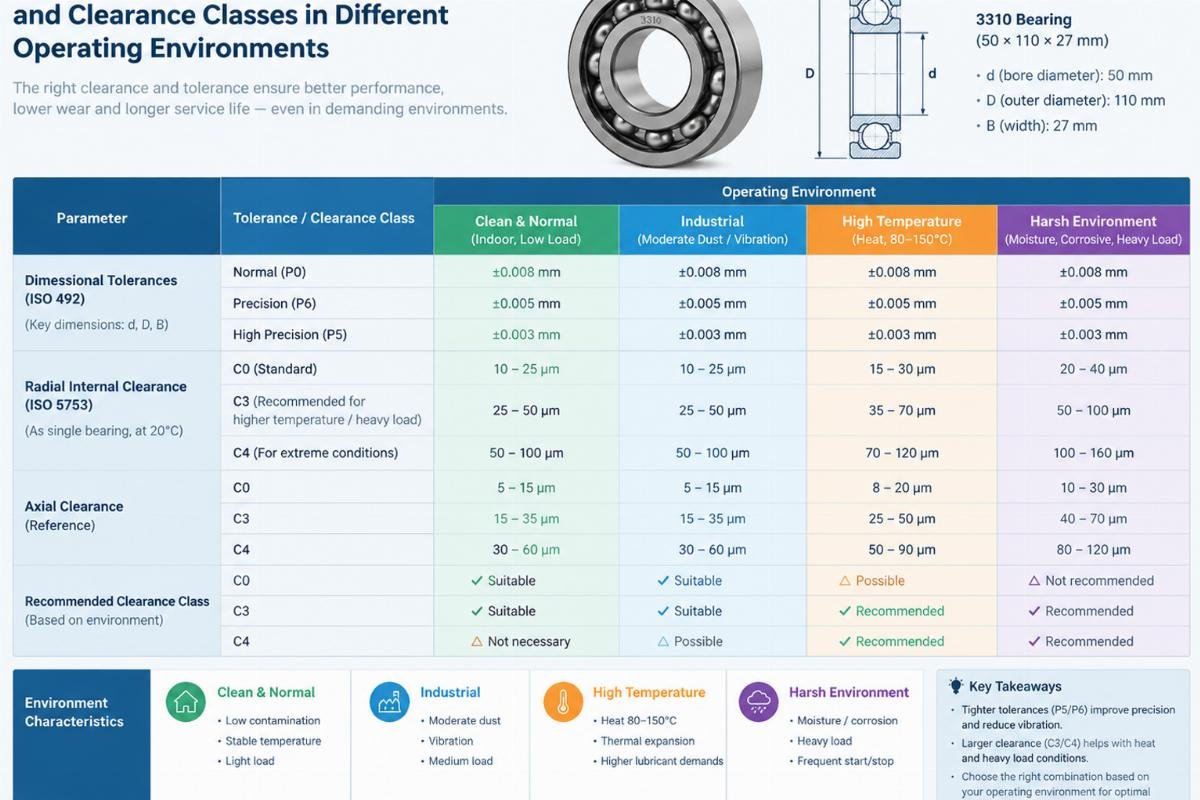
When evaluating a 3310 double row angular contact bearing wholesale supplier, buyers must request the specific tolerance class certificate. A P0 class bearing is suitable for general purposes, but precision applications requiring minimal vibration demand P6 or higher. Ignoring this distinction can result in noisy operation and reduced service life, even if the bearing never fails catastrophically. The weight of the unit, typically around 1.5 kg, also matters for shipping calculations in bulk orders, but it is the micron-level precision of the raceways that dictates performance.
How Do Suffixes Change 3310 Performance?
The suffix code is not optional metadata; it is the operational manual.
A bare “3310” designation is incomplete for industrial procurement. The suffixes appended to the model number define the contact angle, cage material, and sealing options. Misinterpreting these codes is a common source of error in global trade, where language barriers and abbreviated catalogs lead to incorrect substitutions.
| Suffix | Meaning | Application Impact |
|---|---|---|
| A | Modified internal geometry | Higher load capacity, optimized contact angle |
| ATN9 | Glass fiber reinforced polyamide cage | High speed, low friction, lightweight |
| W64 | Solid oil filling | Corrosion resistance, maintenance-free |
| C3 | Greater than normal internal clearance | Suitable for high temperature or interference fits |
The “A” suffix indicates a modified internal geometry with a specific contact angle, usually 30 degrees, which enhances the bearing’s ability to handle axial loads in one direction. Without this suffix, the bearing may have a different contact angle, reducing its axial load capacity significantly. For high-speed applications, the cage material is critical. Steel cages are robust but heavy, limiting maximum RPM due to centrifugal forces. Polyamide cages, denoted by TN9 or similar codes, are lighter and allow for higher speeds but may degrade in extreme chemical environments. [NEED_CITE: Manufacturer technical catalog cage material limits]

In a recent case involving a pump manufacturer in Southeast Asia, the failure of several high-speed units was traced back to the use of steel-caged bearings where polyamide was specified. The increased mass of the steel cage caused instability at operating speeds, leading to cage fracture. The buyer had selected the 3310 double row angular contact bearing based on load ratings alone, overlooking the speed limitation imposed by the cage material. Verifying the suffix ensures that the bearing’s physical construction matches the dynamic requirements of the application, not just its static load capacity.
Load Ratings & Speed Limits: How to Calculate?
Dynamic load ratings are theoretical; actual life depends on lubrication and alignment.
Calculating the expected life of a 3310 bearing involves more than plugging numbers into the L10 life formula. The dynamic load rating provided in catalogs assumes ideal conditions: perfect alignment, adequate lubrication, and clean operating environments. In real-world heavy industry, these conditions are rarely met, making the static load rating and limiting speed equally important considerations.
The dynamic load rating indicates the load a bearing can withstand for one million revolutions. However, for oscillating applications or slow-moving heavy equipment, the static load rating is the critical factor. Exceeding the static limit causes permanent deformation of the raceways, leading to immediate noise and vibration. For the 3310 series, the double row design provides high rigidity, making it suitable for applications with combined radial and axial loads. Yet, if the axial load exceeds a certain proportion of the radial load, the effective load calculation changes dramatically. [NEED_CITE: ISO 281 dynamic load rating calculation methodology]

Speed limits are determined by the cage design and lubrication method. Grease-lubricated bearings have lower speed limits than oil-lubricated ones due to churning losses and heat generation. In a wind turbine gearbox application, using a grease-lubricated 3310 unit at speeds near its theoretical limit resulted in overheating and grease breakdown. Switching to an oil-mist lubrication system extended the service life noticeably, demonstrating that the bearing’s speed capability is system-dependent. Buyers must consult the specific speed ratings for the chosen suffix variant, as a sealed unit will have a lower maximum RPM than an open design.
Common Selection Mistakes in Heavy Industry
Standard clearance is a trap in high-temperature environments.
The most frequent error in selecting a 3310 double row angular contact bearing is assuming that standard internal clearance is universally safe. In environments with significant thermal gradients, such as steel mills or cement plants, standard clearance bearings are prone to binding. As the shaft heats up, it expands more than the housing, reducing the internal clearance. If the initial clearance is not sufficient to accommodate this expansion, the bearing operates under preload, generating excess heat and accelerating fatigue.
Another common mistake is ignoring the direction of axial load. Double row angular contact bearings can handle axial loads in both directions, but the magnitude may differ depending on the internal geometry. Installing a bearing with an asymmetric load capacity in a position where the dominant axial load exceeds its rating leads to premature spalling. In a mining crusher application, repeated failures were traced to the installation of bearings with insufficient axial capacity for the downward force exerted by the crushing chamber. [NEED_CITE: Industry application guidelines for axial load distribution]

Corrosion is also a silent killer in marine and agricultural applications. Standard steel bearings rust quickly when exposed to moisture and chemicals. Selecting a variant with corrosion-resistant features, such as stainless steel components or solid oil filling, is essential for these environments. A distributor in Latin America reported a high return rate for standard 3310 units used in port cranes, where salt spray accelerated wear. Switching to a corrosion-resistant variant reduced returns significantly, proving that environmental factors must dictate material selection as much as load and speed.
Conclusion
Precision in specification prevents downtime.
Selecting the right 3310 double row angular contact bearing requires a holistic view of the application, including thermal conditions, load directions, and speed requirements. Relying solely on basic dimensions or brand reputation ignores the critical details encoded in suffixes and clearance classes. By prioritizing technical verification over simple part number matching, buyers can ensure reliability and longevity in demanding industrial operations.

About the author
author
Editor covering global sourcing, supplier verification, and industrial product knowledge. Content is compiled from manufacturer specifications, industry standards, and hands-on experience with international B2B buyers. Every article is fact-checked before publishing to help procurement professionals make informed decisions.
More articles by author

