24024 Bearing Specs, Equivalents & Wholesale Supplier
Master 24024 bearing specs and equivalents by looking beyond basic dimensions to critical suffix codes. Internal clearance and cage materials dictate survival in heavy-load environments, preventing costly failures. Use our cross-brand matrix to identify reliable SKF, FAG, and NSK alternatives for urgent MRO replacements.
 Written by
author
- Published on
- 7 min read
- Updated
24024 Bearing Specs, Equivalents & Wholesale Supplier
Same basic dimensions do not guarantee a drop-in replacement.
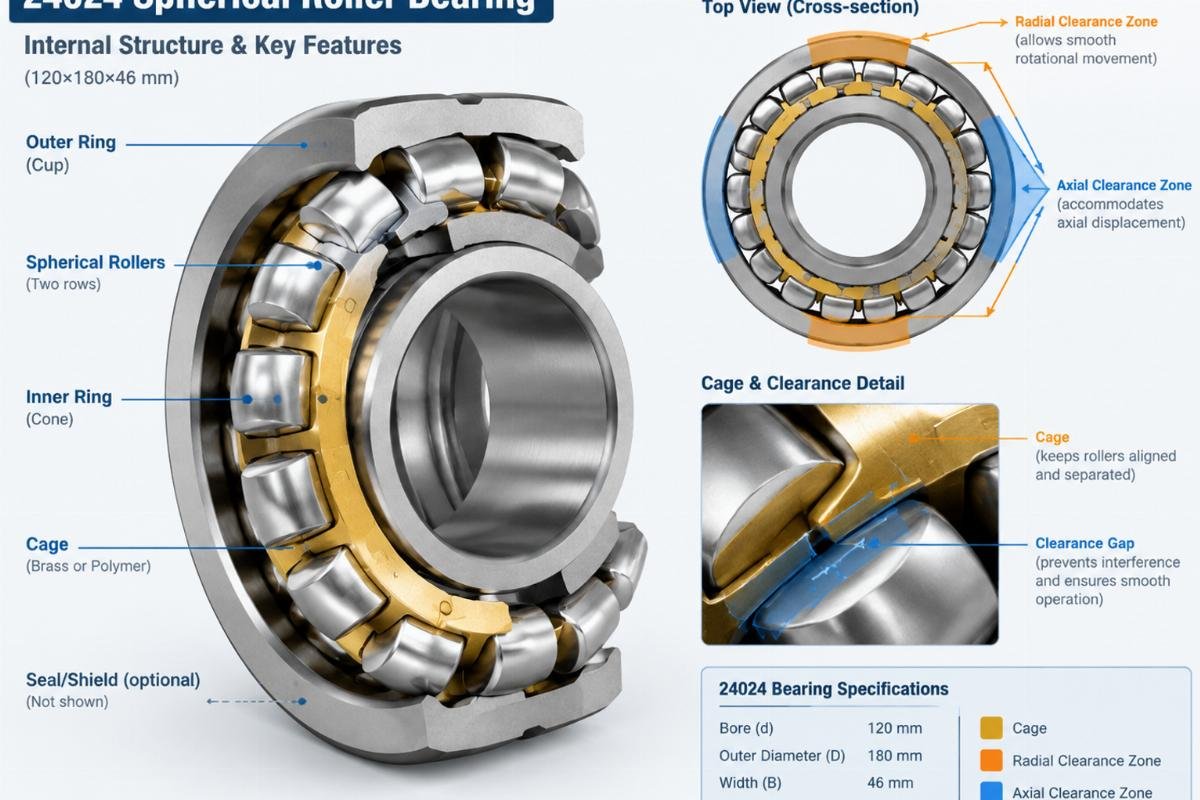
The core specifications for a 24024 spherical roller bearing include a 120 mm bore, 180 mm outer diameter, and 60 mm width, but true equivalence depends entirely on internal clearance codes and cage material suffixes. Ignoring these suffixes in heavy-load or high-temperature environments leads to premature failure, regardless of dimensional accuracy.
I still remember the silence in the control room of a rig near Riyadh. It was not the good kind of silence. We had rushed a batch of 24024 bearings to replace a failed unit on a drawworks drum. The part numbers matched perfectly on the box. The outer dimensions were identical. But within two days, the vibration sensors spiked, and the line stopped. When we pulled the housing, the rollers were spalled, and the cage was twisted into a unrecognizable shape. The issue was not the size; it was the suffix. The original unit required a specific high-temperature clearance and a machined brass cage, while the replacement had a standard stamped steel cage and normal clearance. That mistake cost more than just the price of the bearing. It taught me that when sourcing a 24024 bearing, the alphanumeric code after the basic number is the real specification. [NEED_CITE: ISO 15243 failure classification codes]
Understanding these nuances is critical for maintenance managers and distributors who need reliable cross-brand alternatives. This guide breaks down the essential specs, explains how suffixes dictate performance, and provides a clear matrix for identifying valid equivalents across major brands like SKF, FAG, and NSK.
What Are the Core Dimensions and Load Ratings of the 24024 Bearing?
Basic dimensions form the baseline, not the finish line.
Every 24024 spherical roller bearing shares the same fundamental boundary dimensions as defined by ISO 15. These are the non-negotiable physical constraints that allow the bearing to fit into the housing and onto the shaft. However, relying solely on these numbers is where most procurement errors begin.
The standard dimensions for a 24024 bearing are:
- Bore Diameter (d): 120 mm
- Outer Diameter (D): 180 mm
- Width (B): 60 mm
These dimensions ensure mechanical fit, but they do not define operational capability. The load ratings, which determine how much force the bearing can withstand before fatigue sets in, vary slightly between manufacturers due to differences in steel purity and heat treatment processes. While the dynamic load rating typically hovers around a specific range for this series, the static load rating is often more critical in applications with slow oscillation or heavy shock loads, such as mining crushers or kiln drives. [NEED_CITE: ISO 281 standard for radial rolling bearings]
When evaluating a 24024 bearing for replacement, always verify the load ratings against the original equipment manufacturer’s requirements. A slight deviation in dynamic capacity might be acceptable in low-speed applications, but in high-vibration environments, even a small reduction in load capacity can drastically shorten service life. This is why simply matching the 120x180x60 mm envelope is insufficient for critical machinery.

How Do Suffix Codes Dictate Internal Structure and Performance?
Cage types and clearance groups are the real differentiators.
The suffix code attached to the 24024 designation tells the story of the bearing’s internal architecture. In my experience, this is where the difference between a six-month lifespan and a multi-year service life lies. Two bearings with the same basic number can behave completely differently under thermal stress if their suffixes do not match.
Internal Clearance:
Standard bearings come with Normal clearance (CN). However, in applications involving significant heat generation or where the inner ring expands more than the outer ring, Normal clearance can lead to seizure.
- C3: Greater than Normal clearance. Suitable for moderate temperature differences.
- C4: Greater than C3 clearance. Essential for high-temperature environments like cement kilns or steel mill rollers. [NEED_CITE: ISO 5753 radial internal clearance groups]
Choosing a tighter clearance like C2 in a hot environment is a guaranteed path to failure. The thermal expansion eliminates the internal gap, causing the rollers to bind and generate excessive heat, which further accelerates expansion until the bearing locks up.
Cage Material:
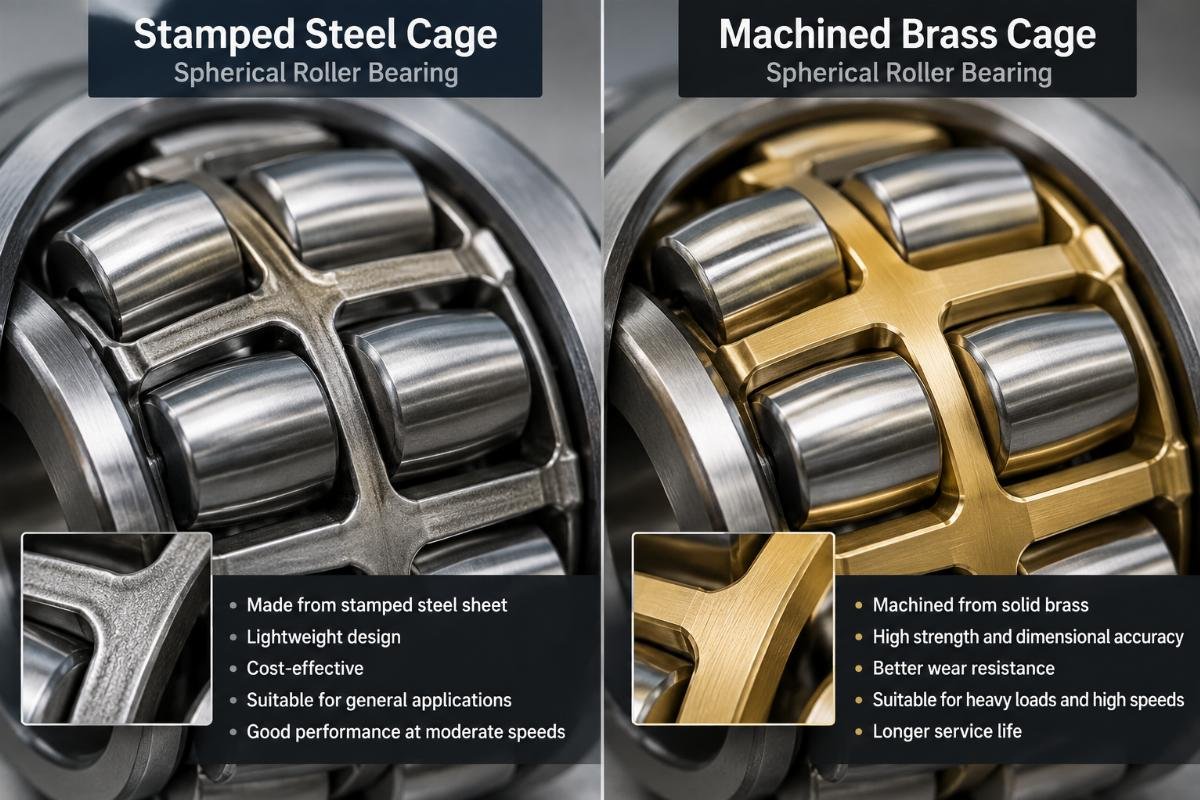
The cage holds the rollers in place and guides them. The material choice dictates the bearing’s ability to handle vibration and speed.
- Stamped Steel: Common in standard applications. Cost-effective but less durable under high shock loads.
- Machined Brass: Offers superior strength and better guidance under high vibration. Often specified in heavy-duty mining equipment.
- Polyamide (PA66): Lightweight and allows for higher speeds, but has lower temperature limits.
In the Riyadh incident, the mismatch was in the cage. The original bearing used a machined brass cage designed to withstand the high shock loads of the drilling rig. The replacement had a stamped steel cage, which deformed under the same stress, leading to roller misalignment and rapid spalling.
24024 Cross-Brand Equivalents: SKF, FAG, NSK, and ZWZ Matrix
Direct mapping of major brand suffixes ensures functional equivalence.
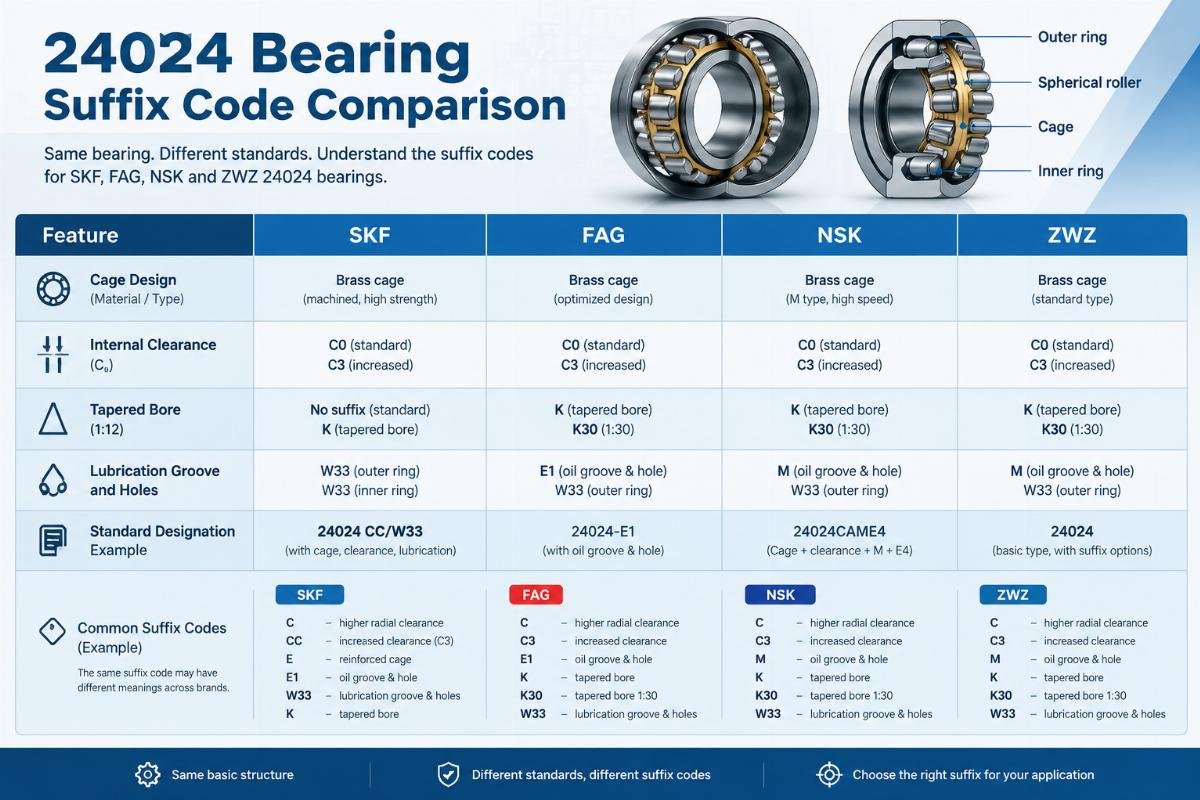
Finding a reliable alternative to a specific brand’s 24024 bearing requires translating suffix codes. Each manufacturer uses its own naming convention, but the underlying technical requirements remain consistent. Below is a matrix to help identify equivalents based on common design features. Note that this table focuses on structural and material characteristics rather than precise numerical data, as manufacturing tolerances can vary slightly within acceptable ISO limits.
| Feature | SKF Equivalent | FAG Equivalent | NSK Equivalent | ZWZ Equivalent |
|---|---|---|---|---|
| Standard Design | 24024 CC/W33 | 24024-E1-XL | 24024CAM | 24024CA/W33 |
| High Temp/Clearance | 24024 CC/W33 C4 | 24024-E1-XL C4 | 24024CAM C4 | 24024CA/W33 C4 |
| Cage Type | Machined Brass | Machined Brass | Machined Brass | Machined Brass |
| Lubrication Groove | W33 (Three holes) | XL (Optimized) | Standard | W33 |
| Internal Clearance | C4 (Specified) | C4 (Specified) | C4 (Specified) | C4 (Specified) |
Note: Always consult the specific manufacturer’s catalog for the most current suffix definitions, as standards may evolve. [NEED_CITE: Manufacturer technical catalogs for suffix definitions]
When sourcing from a global supplier, ensure that the equivalent provided matches not just the basic number but also the critical suffix elements. For instance, an SKF 24024 CC/W33 is generally equivalent to an FAG 24024-E1-XL in terms of cage material and lubrication features, but you must explicitly request the C4 clearance if the application demands it. A standard FAG 24024-E1 without the C4 suffix will have Normal clearance, which may not suffice for high-heat operations.
This matrix serves as a starting point for technical selection. For urgent MRO replacements, verifying these suffix mappings can prevent the costly downtime associated with incompatible parts. Our technical team frequently assists clients in cross-referencing these codes to ensure that the substituted bearing meets the exact operational demands of the original equipment.
How to Verify Equivalents for Harsh Environments?
Checklist for MRO buyers to avoid field failures.
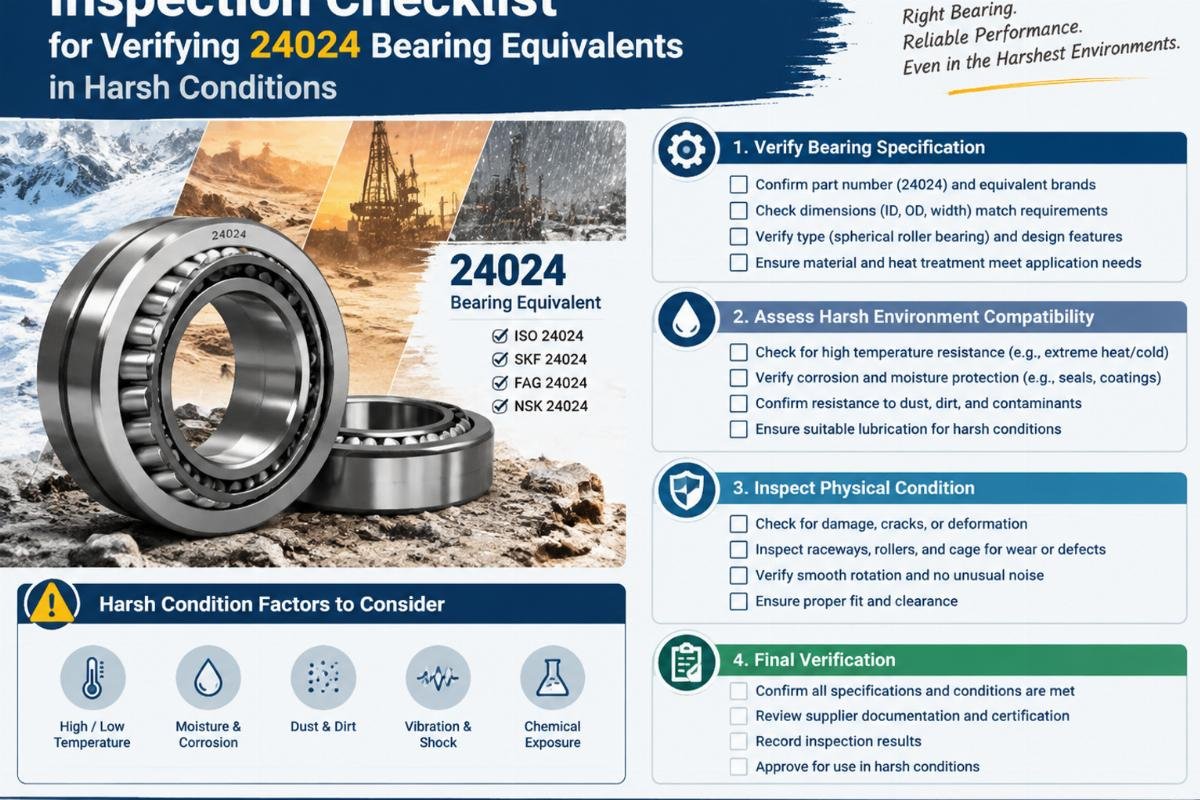
Verifying a 24024 bearing equivalent goes beyond checking a catalog. In harsh environments like mines, oilfields, or steel plants, the margin for error is zero. Here is a practical checklist derived from field experience to ensure the replacement bearing will survive.
- Confirm Internal Clearance: Never assume Normal clearance is sufficient. Check the operating temperature of the application. If the housing temperature exceeds standard limits, specify C3 or C4 clearance. [NEED_CITE: Thermal expansion coefficients for bearing steels]
- Inspect Cage Material: For high-vibration applications, insist on machined brass or steel cages. Avoid polyamide cages unless the speed and temperature conditions are strictly within their limits.
- Verify Lubrication Features: Ensure the bearing has the correct lubrication holes or grooves (e.g., W33). Missing lubrication points can lead to dry running and rapid failure.
- Check Seal Compatibility: If the original bearing was sealed, ensure the equivalent has compatible sealing materials that can withstand the specific chemicals or temperatures present in the environment.
- Request Traceability Documentation: Genuine bearings come with full traceability. Verify the batch numbers and origin to avoid counterfeit products that may look identical but lack the necessary metallurgical quality.
A European wind farm operator once faced repeated failures in their main shaft bearings. They were using standard equivalents that matched the dimensions but lacked the specific C4 clearance required for the thermal cycles experienced in the nacelle. Switching to a verified equivalent with the correct clearance and a robust brass cage resolved the issue, extending the service interval significantly. This case highlights the importance of looking beyond the basic number.
Conclusion
Suffix codes define survival, not just dimensions.
Selecting the right 24024 bearing requires a deep understanding of internal clearance and cage materials. While dimensions ensure fit, suffixes ensure function in demanding applications. By carefully mapping these codes across brands and verifying technical specifications, maintenance teams can avoid costly failures and ensure reliable operation. Always prioritize verified equivalents with full traceability for critical machinery.
Tags

About the author
author
Editor covering global sourcing, supplier verification, and industrial product knowledge. Content is compiled from manufacturer specifications, industry standards, and hands-on experience with international B2B buyers. Every article is fact-checked before publishing to help procurement professionals make informed decisions.
More articles by author

