32222 Tapered Roller Bearing: Specs, Uses & Wholesale Supplier
The 32222 tapered roller bearing handles heavy combined loads, yet premature failures often stem from mismatched clearance groups and cage materials. Learn how specifying C3/C4 clearances and machined brass cages prevents thermal lock-up in mining and agricultural applications.
 Written by
author
- Published on
- 8 min read
- Updated

32222 Tapered Roller Bearing: Specs, Uses & Wholesale Supplier
Bigger load capacity does not guarantee longer life.
The 32222 tapered roller bearing is a heavy-duty component with standard dimensions of 110x200x53mm, designed to handle significant combined radial and axial loads. However, its operational lifespan in harsh environments is determined not by its size alone, but by the precise alignment of clearance groups and cage materials with specific thermal and shock-load conditions. Procurement errors often stem from overlooking these internal specifications, leading to premature field failures despite correct dimensional fit.
I still remember the humidity in that Chicago warehouse. The air smelled of grease and cold steel. A distributor had just opened a full container of what he thought was a straightforward order. The model was simple enough, a standard workhorse for agricultural gearboxes. But when the first batch hit the field during harvest season, the returns started coming in. Not one or two, but a cascade. The cages had deformed, locking the rollers in place under high temperatures. I had shipped standard carbon steel cages because the purchase order did not specify otherwise. It was a costly lesson in assuming that “standard” means “universal.” Since then, I have never let a contract for a 32222 tapered roller bearing leave my desk without explicit clauses on clearance suffixes and cage composition. Parameters that seem minor on paper become catastrophic variables in the field.
Understanding the technical nuance behind this component is essential for avoiding similar pitfalls. Let us break down why specifications matter more than brand names alone.
What Are the Core Specs of the 32222 Bearing?
Dimensions define the fit, but internal geometry defines the function.
The 32222 tapered roller bearing adheres to ISO 355 dimensional standards, featuring a bore diameter of 110 mm, an outside diameter of 200 mm, and a width of 53 mm. [NEED_CITE: ISO 355 dimensional standards for metric tapered roller bearings]. These physical boundaries make it a direct replacement in many heavy-equipment housings, but the internal design varies significantly across manufacturers and application requirements.
The dynamic and static load ratings are critical for initial selection. A typical 32222 unit offers high radial load capacity due to the large contact area between the rollers and raceways. However, these ratings are based on ideal laboratory conditions. In real-world scenarios, such as mining conveyors or construction machinery, the actual load profile includes shock impacts and misalignment that standard ratings do not fully capture.
| Specification Parameter | Standard Value / Description | Application Impact |
|---|---|---|
| Bore Diameter | 110 mm | Determines shaft fit and mounting method. |
| Outside Diameter | 200 mm | Defines housing bore requirement. |
| Width | 53 mm | Affects axial space availability in assembly. |
| Clearance Group | C3, C4, or Standard | Critical for thermal expansion management. |
| Cage Material | Steel, Brass, or Polymer | Determines resistance to shock and heat. |
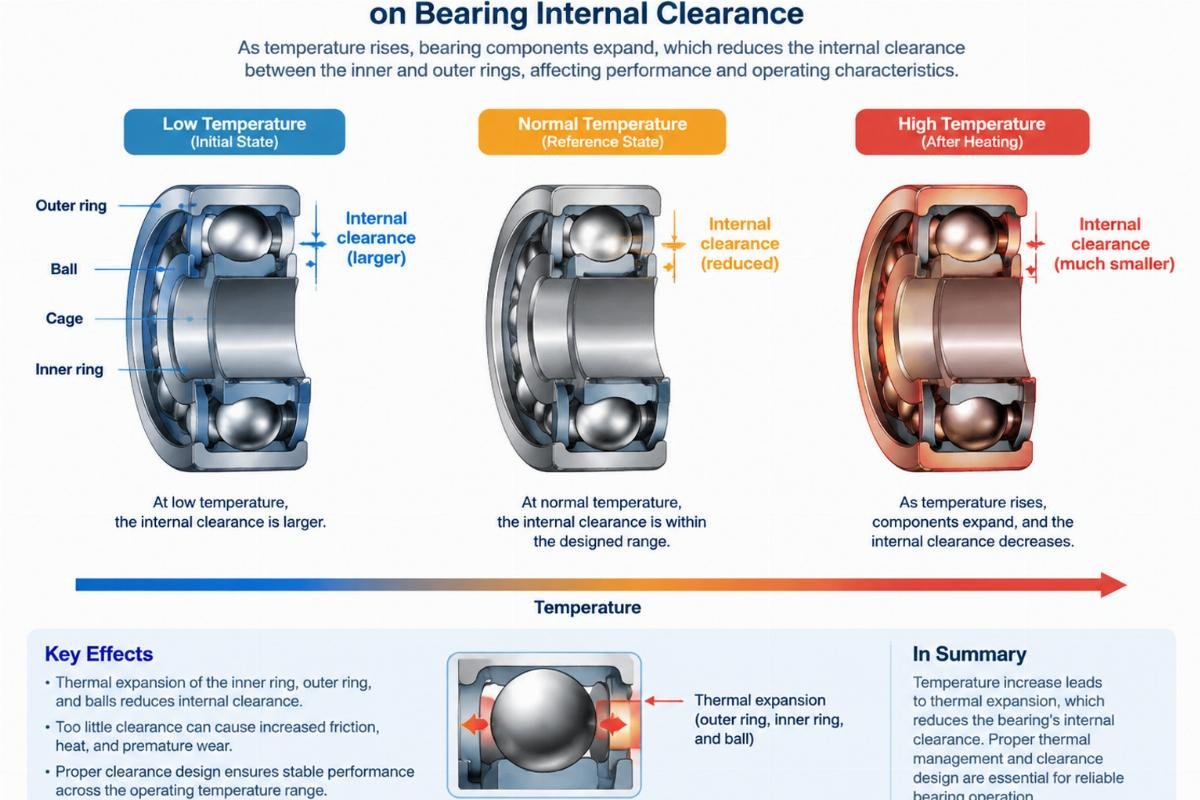
Selecting the wrong clearance group is a common error. Standard clearance may suffice for moderate temperatures, but high-operating-temperature environments require C3 or C4 clearances to accommodate thermal expansion. Without this adjustment, the bearing internals expand, reducing the internal gap until the rollers bind. This phenomenon is not a manufacturing defect but a specification mismatch. [NEED_CITE: ABMA standards for bearing clearance and thermal expansion].
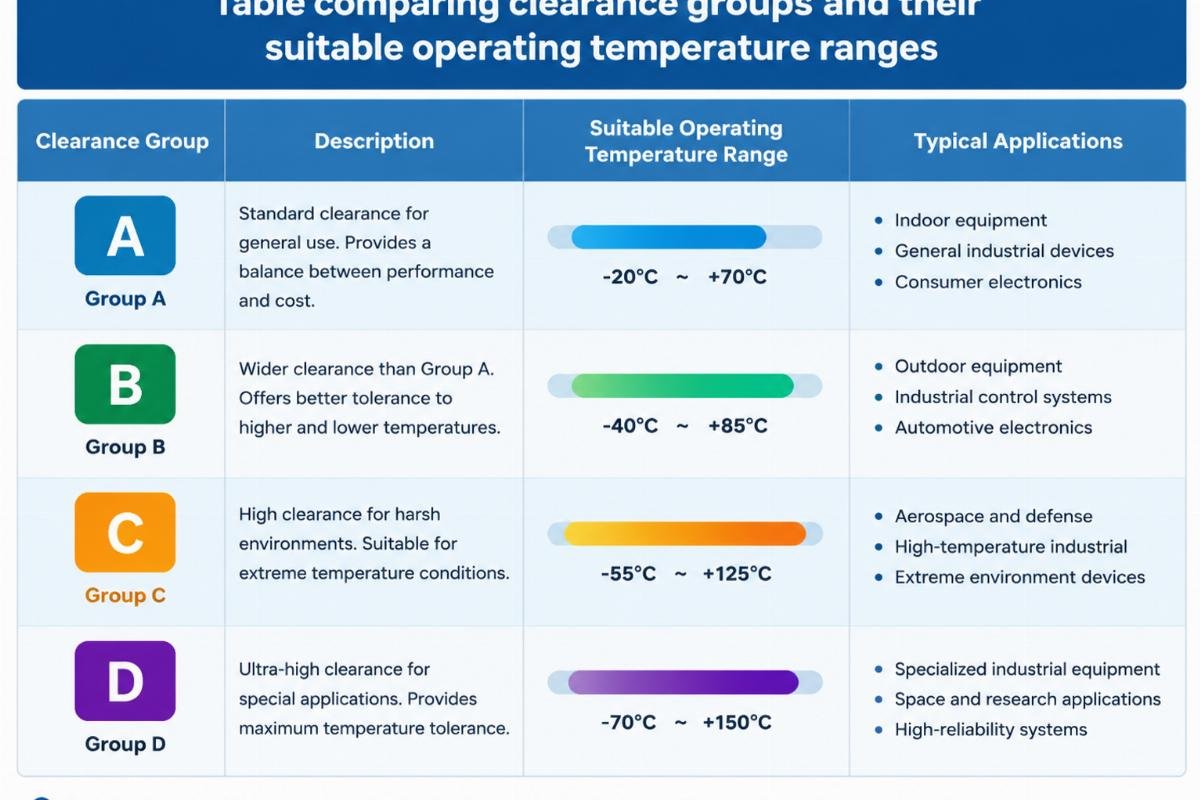
When sourcing a 32222 tapered roller bearing, buyers must look beyond the outer dimensions. The internal geometry, including the roller angle and crown profile, influences how the load distributes across the contact surface. Premium brands often optimize these profiles to reduce edge stress, extending fatigue life. However, without proper documentation, it is difficult to verify these subtle differences in a mixed-brand procurement scenario.
Which Heavy-Duty Applications Rely on the 32222?
It is the go-to choice for industries where downtime costs exceed part prices.
The 32222 tapered roller bearing is prevalent in sectors that demand robustness over precision speed. Its primary domain is heavy machinery where combined loads are the norm rather than the exception.
In agricultural machinery, these bearings support gearbox outputs and wheel hubs. The environment is dusty, wet, and subject to variable loads as implements engage with soil. Here, the sealing effectiveness and cage durability are paramount. A standard steel cage might suffice for light duty, but heavy tillage operations generate shocks that can fracture inferior materials.
Mining conveyors represent another major application. These systems run continuously, often in remote locations with limited maintenance access. The bearings here face constant radial loads from the belt tension and axial loads from incline angles. Thermal management is crucial because conveyor drives generate significant heat. A 32222 unit with inadequate clearance will fail prematurely due to heat buildup, causing unplanned downtime that halts entire production lines. [NEED_CITE: OEM technical manuals for mining conveyor maintenance guidelines].
Construction equipment, such as excavators and crushers, also relies heavily on this model. The shock loads in crushing applications are extreme. Bearings in these positions must withstand impact forces that far exceed their static load ratings for brief moments. This requires not just strong steel, but a cage design that can absorb vibration without fatiguing.

For distributors serving these sectors, understanding the specific operational stresses is key to recommending the right variant. A 32222 tapered roller bearing meant for a static gear box is not interchangeable with one destined for a vibrating crusher, even if the dimensions are identical. The difference lies in the internal components, which are often invisible until failure occurs.
Why Do 32222 Bearings Fail Prematurely in the Field?
Mismatched clearance and cage materials are the silent killers of heavy-duty bearings.
Most field failures are not due to material defects but to specification mismatches. Two primary causes dominate the failure analysis reports: thermal lock-up and cage fragmentation.
Thermal lock-up occurs when the operating temperature rises higher than anticipated, causing the inner ring, rollers, and outer ring to expand. If the initial clearance is too tight, this expansion eliminates the necessary running gap. The rollers then press against the raceways with excessive force, generating more heat in a positive feedback loop that ends in seizure. This is particularly common in applications where ambient temperatures are high, or where lubrication breaks down. Selecting a C3 or C4 clearance group mitigates this risk by providing extra space for thermal growth. [NEED_CITE: Root cause distribution per ISO 15243 for thermal failures].
Cage fragmentation is another frequent issue, especially in shock-load environments. Standard pressed steel cages are cost-effective but brittle under high impact. When subjected to sudden jolts, such as those in rock crushers or agricultural plows, these cages can crack or deform. Once the cage integrity is compromised, the rollers lose their spacing, leading to uneven load distribution and rapid wear. Machined brass cages or specialized polymer cages offer better resilience. Brass is softer and conforms slightly under load, while polymers provide inherent damping properties.
A European wind farm operator once reported repeated failures in a gearbox application. The investigation revealed that the supplied bearings had standard steel cages, which could not handle the micro-vibrations and occasional torque spikes. Switching to a machined brass cage variant resolved the issue, extending the service life noticeably. This case highlights that the cage is not just a spacer; it is a critical structural component.
When evaluating a 32222 tapered roller bearing, ask about the cage material. If the supplier cannot specify whether it is stamped steel, machined brass, or polymer, the risk of premature failure increases significantly. In harsh工况, the cage material determines whether the bearing survives the first year or fails in the first month.
How to Specify the Right 32222 for Your Procurement?
Strictly define clearance suffixes and cage materials in contracts to ensure consistency.
Procuring the correct 32222 tapered roller bearing requires moving beyond the basic part number. The part number alone does not specify internal variations. To avoid the pitfalls of mixed batches and inconsistent quality, buyers must include detailed technical requirements in their purchase orders.
First, specify the clearance group. For general industrial use, standard clearance may be acceptable. For high-temperature or high-speed applications, explicitly request C3 or C4 clearance. Do not assume the supplier will provide the optimal default. State it clearly.
Second, define the cage material. If the application involves shock loads or high temperatures, specify machined brass or a high-performance polymer. Avoid vague terms like “heavy-duty cage.” Use industry-standard codes or material descriptions. This ensures that every unit in the batch meets the same performance criteria.
Third, require traceability documentation. Genuine bearings from reputable manufacturers come with certificates of conformity that detail the batch number, material specs, and inspection results. This documentation is vital for verifying authenticity and for future failure analysis. [NEED_CITE: Guidelines for bearing traceability and quality assurance].
| Procurement Requirement | Recommended Specification | Reason |
|---|---|---|
| Clearance Group | C3 or C4 for high temp | Prevents thermal lock-up. |
| Cage Material | Machined Brass or Polymer | Resists shock and deformation. |
| Documentation | Certificate of Conformity | Ensures authenticity and traceability. |
| Brand Consistency | Single brand per batch | Maintains dimensional uniformity. |
Mixing brands in a single application can lead to dimensional inconsistencies, even if all parts meet ISO standards. Tolerances vary between manufacturers. For critical assemblies, stick to one brand per batch to ensure uniform fit and performance. If multi-brand sourcing is necessary for cost reasons, verify dimensional tolerances for each brand separately before assembly.
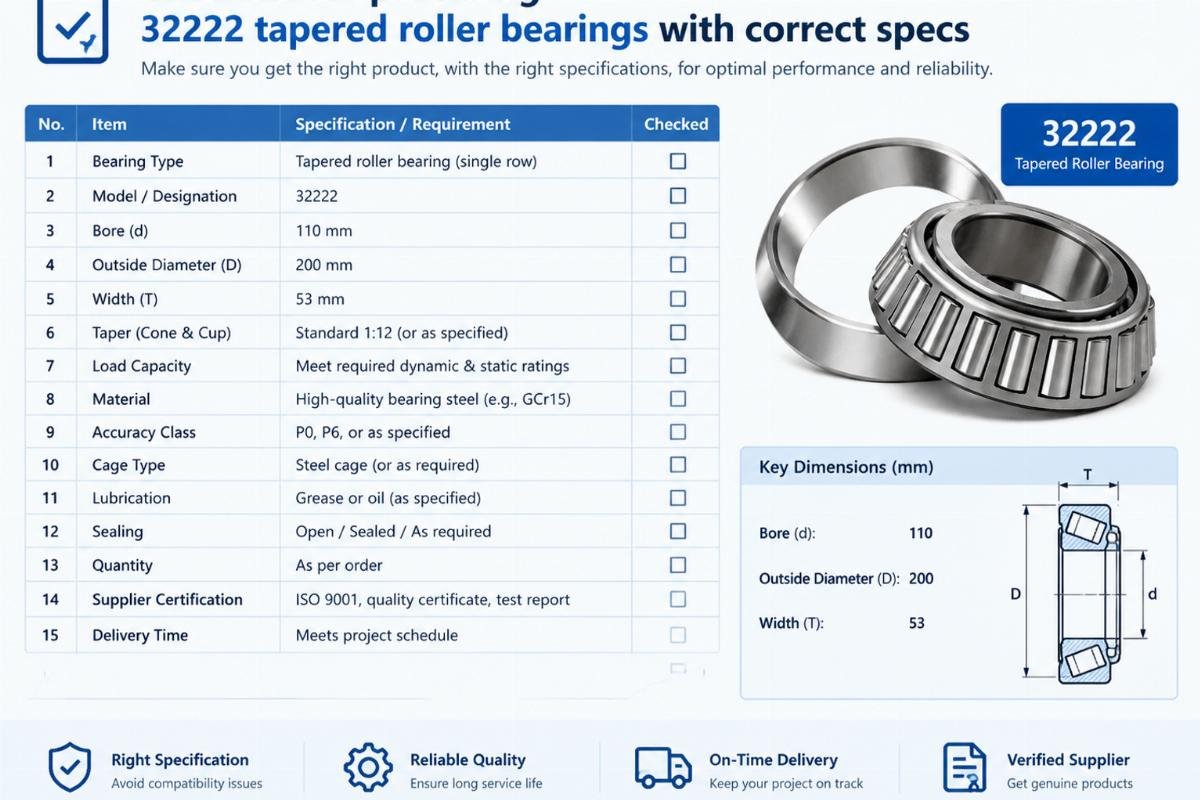
By treating the 32222 tapered roller bearing as a engineered system rather than a commodity, buyers can significantly reduce field failures. The extra effort in specifying details pays off in reduced downtime and lower total cost of ownership.
Conclusion
Precision in specification prevents catastrophe in operation.
The 32222 tapered roller bearing is a robust solution for heavy combined loads, but its reliability hinges on matching internal specs to environmental conditions. Ignoring clearance groups and cage materials invites premature failure. Procure with precision, document every detail, and prioritize technical compatibility over simple part number matching.
Tags

About the author
author
Editor covering global sourcing, supplier verification, and industrial product knowledge. Content is compiled from manufacturer specifications, industry standards, and hands-on experience with international B2B buyers. Every article is fact-checked before publishing to help procurement professionals make informed decisions.
More articles by author

