Forwarder & Skidder Bearings: Genuine Brands, Wholesale Supplier for Repairs
Prevent costly downtime by stocking genuine forwarder and skidder bearings with correct C3 or C4 clearance groups. Verify authenticity through traceability documentation and optimize MRO inventory with mixed-brand consolidation for urgent repairs in harsh logging environments.
 Written by
author
- Published on
- 6 min read
- Updated
Forwarder & Skidder Bearings: Genuine Brands, Wholesale Supplier for Repairs
Standard clearance is often the wrong choice for forestry equipment.
To prevent costly downtime in harsh logging environments, stock genuine forwarder and skidder bearings with C3 or C4 clearance groups and verified traceability documentation. Focus on spherical roller bearings for articulation points and tapered roller bearings for high-load hubs, sourcing from a reliable wholesale supplier for repairs who can provide mixed-brand consolidation and full customs-compliant paperwork.
I still remember the panic in a client’s voice when a container of repair bearings got stuck at customs in St. Petersburg. The issue was not the quality of the parts, but a missing suffix code on the commercial invoice that made them look like counterfeit goods to the officers. That delay cost more than the entire shipment. Later, working with a timber operation in South America, I saw a whole harvesting line shut down because the bearings seized. They had installed standard clearance units in a high-heat, high-friction environment where C3 clearance was mandatory. These were not theoretical failures. They were expensive lessons in why specific technical details matter more than the brand name alone. When sourcing forwarder and skidder bearings, the difference between a quick repair and a week-long shutdown often lies in these subtle specifications.
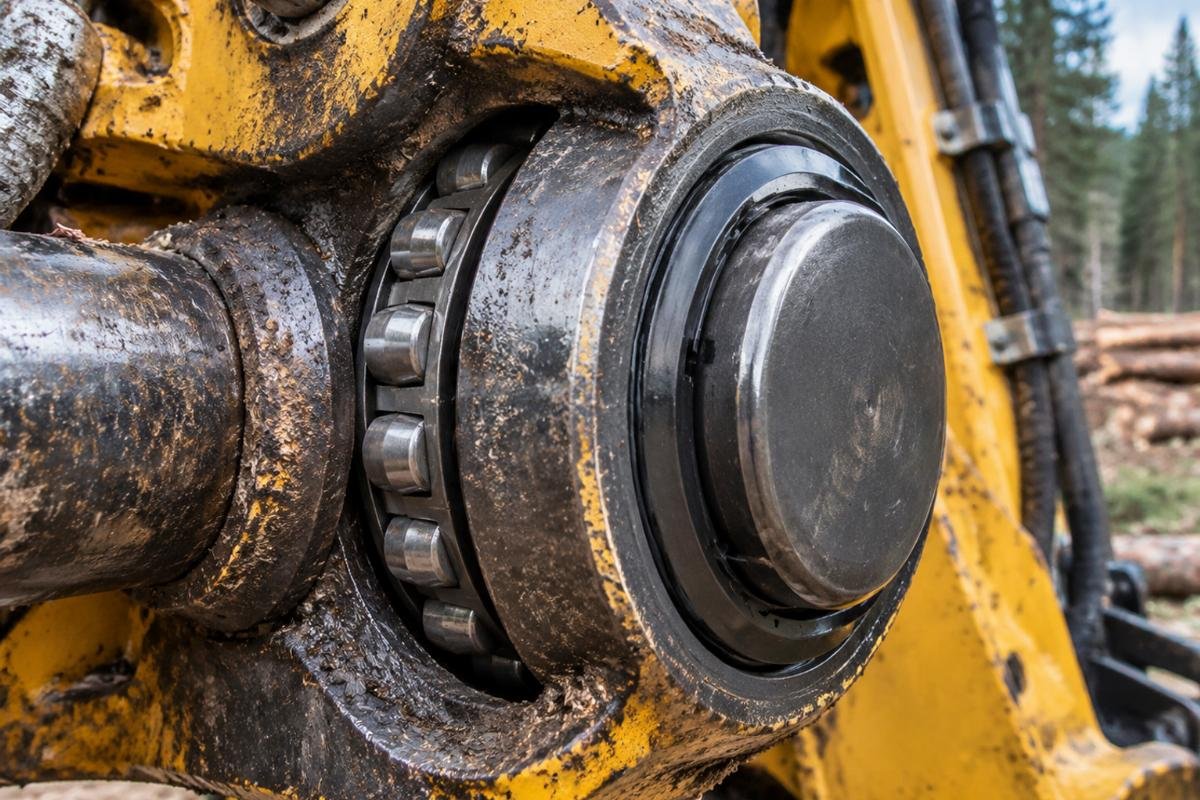
Understanding the mechanical demands of these machines helps explain why generic solutions fail. Forestry equipment operates in conditions that are brutal on components. Sawdust acts as an abrasive, moisture causes corrosion, and shock loads from uneven terrain exceed standard design parameters. A wholesale supplier for repairs must understand that the inventory strategy for these machines differs significantly from general industrial applications.
What Bearing Types Do Forwarders and Skidders Need?
Not all bearings handle the same stresses.
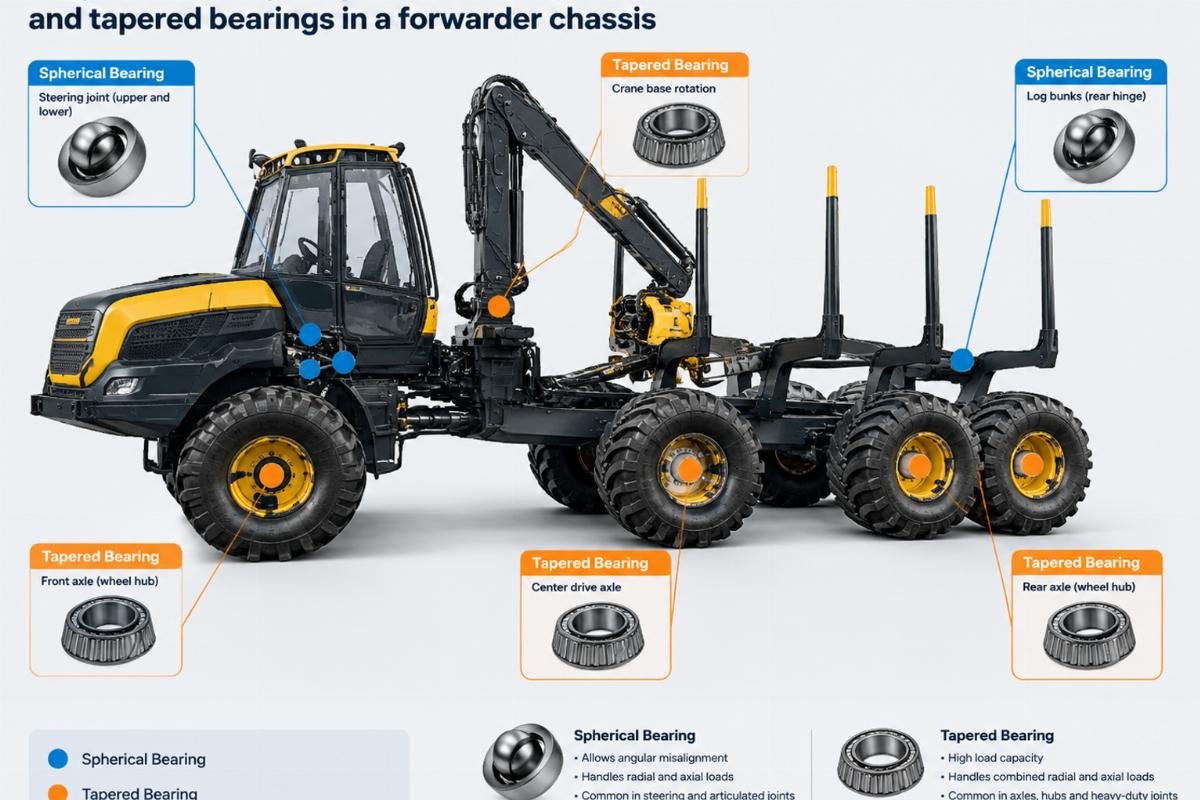
Forwarders and skidders rely on specific bearing types at critical joints to manage misalignment and heavy radial loads. Using the wrong type leads to premature failure. The primary locations require spherical roller bearings, tapered roller bearings, and sometimes CARB toroidal bearings. Each serves a distinct function based on the joint’s movement and load profile.
Spherical roller bearings are essential for articulation points, such as the boom hinges and frame connections. Their self-aligning capability compensates for shaft deflection and misalignment caused by the rough terrain. Tapered roller bearings are typically found in wheel hubs and transmission systems, where they handle combined radial and axial loads. CARB toroidal bearings offer a unique solution for applications requiring high load capacity and misalignment tolerance without the friction of traditional designs.
| Bearing Type | Primary Application | Key Feature | Misalignment Tolerance |
|---|---|---|---|
| Spherical Roller | Boom hinges, frame joints | Self-aligning | High |
| Tapered Roller | Wheel hubs, transmissions | Combined load capacity | Low |
| CARB Toroidal | High-load articulation | Low friction, high capacity | Very High |
| Deep Groove Ball | Auxiliary drives, fans | High speed, low load | Very Low |
[NEED_CITE: ISO 15243 failure mode classification for misalignment]
A European distributor once ordered a batch of deep groove ball bearings for a skidder’s main pivot, assuming they would suffice due to lower cost. Within weeks, the bearings failed due to edge loading caused by misalignment. Replacing them with spherical roller bearings resolved the issue. This highlights the importance of matching the bearing type to the mechanical requirement rather than just the physical dimensions. When consulting a wholesale supplier for repairs, ensure they can distinguish between these types and recommend the correct one for each application point.
Why Clearance Groups Matter in Forestry?
Heat expansion destroys standard clearance bearings.
In forestry operations, ambient temperatures rise significantly due to friction, braking, and environmental conditions. Standard internal clearance (C0 or CN) often becomes insufficient as components expand. This leads to preload, increased friction, and eventual seizure. For forwarder and skidder bearings, selecting the correct clearance group is critical.
C3 and C4 clearance groups provide additional internal space to accommodate thermal expansion. In high-heat environments filled with sawdust and debris, this extra clearance prevents the rolling elements from binding. While standard clearance might work in controlled factory settings, it fails in the field. The choice between C3 and C4 depends on the specific operating temperature and load conditions.
| Clearance Group | Typical Use Case | Thermal Expansion Handling | Risk in High Heat |
|---|---|---|---|
| C0 (CN) | General industrial, low heat | Minimal | High seizure risk |
| C3 | Heavy machinery, moderate heat | Good | Moderate |
| C4 | High temperature, high speed | Excellent | Low |
[NEED_CITE: Bearing manufacturer technical catalog on thermal expansion effects]
I recall a case where a mining contractor used standard clearance bearings in a hot, dusty environment. The bearings overheated and failed repeatedly. Switching to C3 clearance reduced the failure rate dramatically. For forestry equipment, where heat buildup is common, starting with C3 is often the safest baseline. A knowledgeable wholesale supplier for repairs will ask about operating conditions before recommending a clearance group, ensuring the parts can withstand the specific demands of the job.

How to Verify Genuine Parts for Repairs?
Traceability documents are your only proof of authenticity.
Counterfeit bearings look identical to genuine ones but lack the material quality and precision engineering. They fail prematurely, causing unplanned downtime. Verifying genuine forwarder and skidder bearings requires checking more than just the packaging. Traceability documentation, including batch numbers and material certificates, is essential.
Genuine bearings come with complete documentation that links the part to its manufacturing batch. This includes certificates of conformity and, in some cases, material test reports. Packaging should be intact, with clear branding and part numbers. Any signs of tampering or poor printing quality are red flags. Additionally, the bearing itself should have precise marking, including the brand, model number, and country of origin.
- Check for complete traceability documentation.
- Verify packaging integrity and branding quality.
- Inspect bearing markings for precision and clarity.
- Request material certificates for critical applications.
[NEED_CITE: Industry guidelines on counterfeit bearing identification]
A buyer in Southeast Asia once received a shipment of bearings that looked authentic but failed within days. Upon investigation, the traceability codes were invalid. The supplier had no record of the batch. This incident highlighted the importance of sourcing from a wholesale supplier for repairs who provides verifiable documentation. Without it, you are gambling with equipment reliability. Always insist on full documentation before accepting delivery.

What to Stock for Urgent MRO?
Balance fast-moving SKUs with strategic slow-movers.
Maintenance, Repair, and Operations (MRO) inventory for forestry equipment requires a strategic approach. Stocking every possible part number is impractical and expensive. Instead, focus on fast-moving items that fail frequently, such as spherical roller bearings for boom joints and tapered roller bearings for hubs. Slow-moving items, like specialized seals or large diameter bearings, can be sourced on demand if the supply chain is reliable.
A one-stop mixed-brand consolidation service allows operators to order various brands and sizes in a single shipment. This reduces shipping costs and simplifies inventory management. Flexible minimum order quantities (MOQs) enable buyers to purchase small batches for urgent repairs without committing to large volumes. This approach is particularly useful for remote sites where storage space is limited.
| SKU Category | Examples | Stocking Strategy | Sourcing Method |
|---|---|---|---|
| Fast-Moving | Spherical rollers, tapered rollers | High stock levels | Bulk orders |
| Slow-Moving | Large diameter, special seals | Low/Zero stock | On-demand |
| Critical Spares | Main shaft bearings | Moderate stock | Mixed-brand consolidation |
[NEED_CITE: MRO best practices for heavy equipment inventory]
For urgent MRO needs, having a wholesale supplier for repairs who offers mixed-brand consolidation is invaluable. It allows you to combine orders from different manufacturers, ensuring you get the right part for each application while optimizing logistics. This flexibility minimizes downtime and reduces the total cost of ownership. By focusing on critical spares and leveraging flexible sourcing options, operators can maintain high equipment availability without excessive inventory costs.

Conclusion
Correct specifications prevent expensive failures.
Stocking the right forwarder and skidder bearings involves more than just matching part numbers. It requires understanding clearance groups, verifying authenticity through traceability, and optimizing inventory for urgent MRO needs. By focusing on these technical details and partnering with a reliable wholesale supplier for repairs, operators can minimize downtime and extend equipment life. The cost of getting it right is far less than the cost of getting it wrong.
Tags

About the author
author
Editor covering global sourcing, supplier verification, and industrial product knowledge. Content is compiled from manufacturer specifications, industry standards, and hands-on experience with international B2B buyers. Every article is fact-checked before publishing to help procurement professionals make informed decisions.
More articles by author