Forestry Harvester Bearings: Genuine SKF/TIMKEN Wholesale Supplier
Sourcing genuine forestry machine bearings requires prioritizing seal integrity and material traceability over initial price to prevent costly spindle seizures. Learn why standard seals fail under heavy loads, how to verify authenticity against counterfeits, and optimize procurement through mixed-brand consolidation for reliable harvester operations.
 Written by
author
- Published on
- 7 min read
- Updated
Forestry Harvester Bearings: Genuine SKF/TIMKEN Wholesale Supplier
The cheapest bearing is often the most expensive component in your maintenance budget.
Sourcing genuine forestry machine bearings for harvesters requires prioritizing seal integrity and material traceability over initial purchase price. Standard industrial seals fail rapidly under forestry conditions, leading to spindle seizure and unplanned downtime that far exceeds the cost difference between premium and generic components.
I still remember the smell of burnt oil and crushed pine at a logging site in the Pacific Northwest. A fleet manager showed me a tapered roller bearing that had failed after only a few weeks of operation. The outer race was intact, but the inner components were packed with fine wood dust and moisture. He had sourced them from a low-cost supplier who claimed they were equivalent to major brands. They were not. The seals had collapsed under axial load, allowing debris to ingress and destroy the lubrication film. That day reinforced a lesson I carry into every procurement discussion: in heavy forestry equipment, the environment does not forgive compromise. [NEED_CITE: common failure modes in heavy-duty forestry applications per ISO 15243]
When you are evaluating options for forestry machine bearings, the decision matrix shifts from simple cost-per-unit to total cost of ownership. This guide breaks down the specific technical requirements for harvester joints, explains why standard seals fail, and outlines how to verify authenticity in a market flooded with counterfeits.
What Bearing Types Do Harvesters Actually Need?
Harvesters demand bearings that can handle simultaneous heavy radial and axial loads while accommodating misalignment.
Unlike standard conveyor systems or light agricultural machinery, forestry harvesters operate in high-shock environments. The boom joints, swing circles, and wheel hubs experience dynamic loads that fluctuate wildly as the machine grips and cuts timber. This creates a need for specific bearing geometries that generic deep-groove ball bearings cannot satisfy.
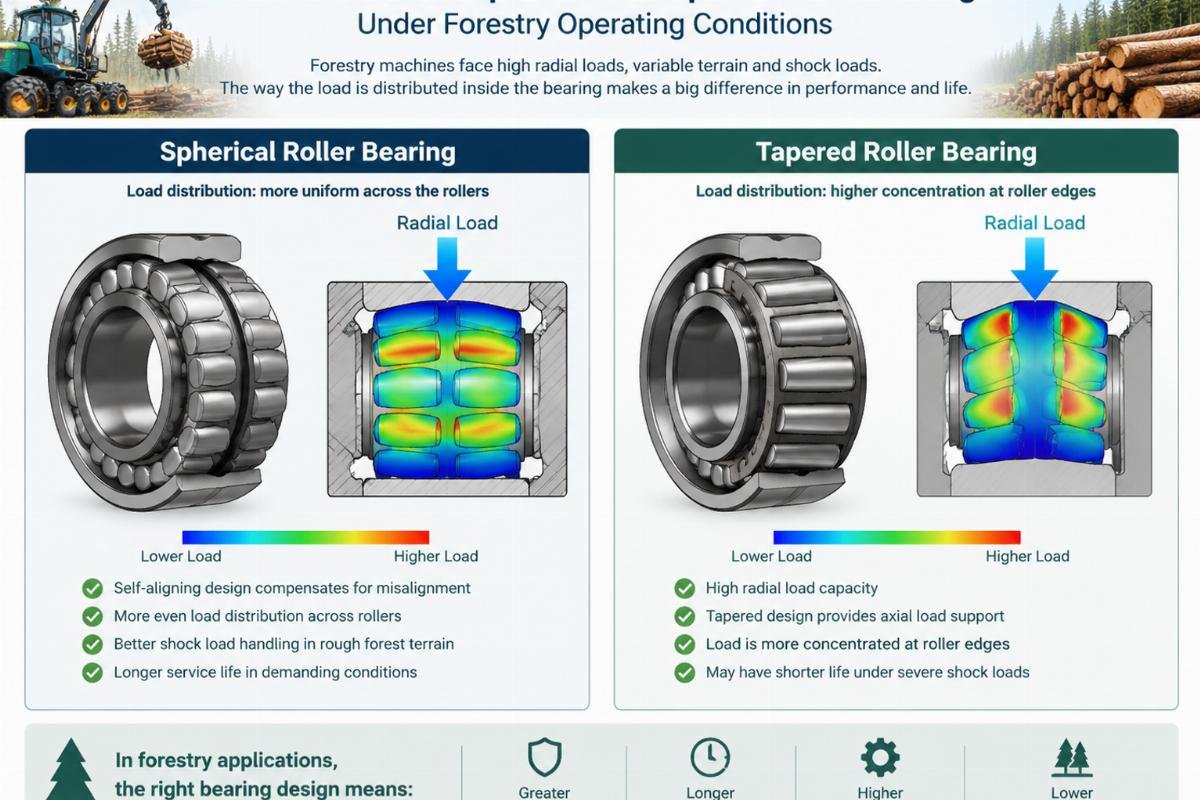
The two dominant types in this sector are spherical roller bearings and tapered roller bearings. Spherical roller bearings are critical for pivot points where shaft misalignment is inevitable due to frame flexing under load. Their internal design allows for angular misalignment, preventing edge loading that would otherwise cause premature fatigue. Tapered roller bearings, on the other hand, are essential for wheel hubs and gearboxes where precise axial positioning is required to manage thrust loads during steep incline operations.
| Application Area | Primary Load Type | Recommended Bearing Type | Seal Requirement |
|---|---|---|---|
| Boom Pivot Joints | Heavy Radial + Misalignment | Spherical Roller Bearings | Multi-labyrinth / Heavy-duty |
| Wheel Hubs | Combined Radial & Axial | Tapered Roller Bearings | Triple-lip / V-ring |
| Swing Circle | High Axial Thrust | Slewing Ring / Tapered | Integrated sealing system |
| Gearbox Shafts | High Speed + Radial | Cylindrical / Angular Contact | Standard labyrinth |
Selecting the wrong type leads to rapid failure. For instance, using a cylindrical roller bearing in a boom pivot that experiences significant misalignment will cause stress concentration on the roller ends. This results in spalling and eventual cage fracture. [NEED_CITE: load rating calculations for misaligned heavy-equipment bearings]
When sourcing forestry machine bearings, ensure your supplier provides detailed load rating data that matches the OEM specifications for your specific harvester model. Do not rely on generic cross-references without verifying dimensional tolerances and internal clearance classes, such as C3 or C4, which are often required for high-temperature forestry operations.
Why Do Standard Seals Fail in Forestry Environments?
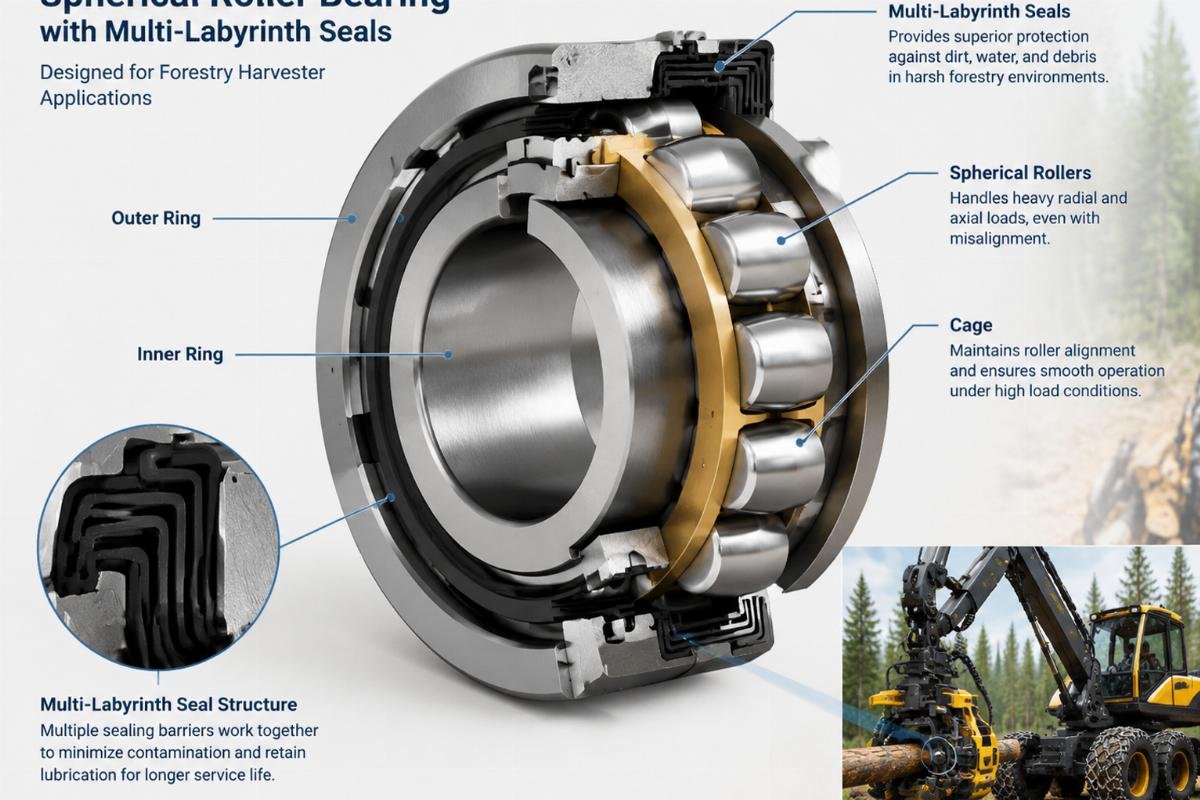
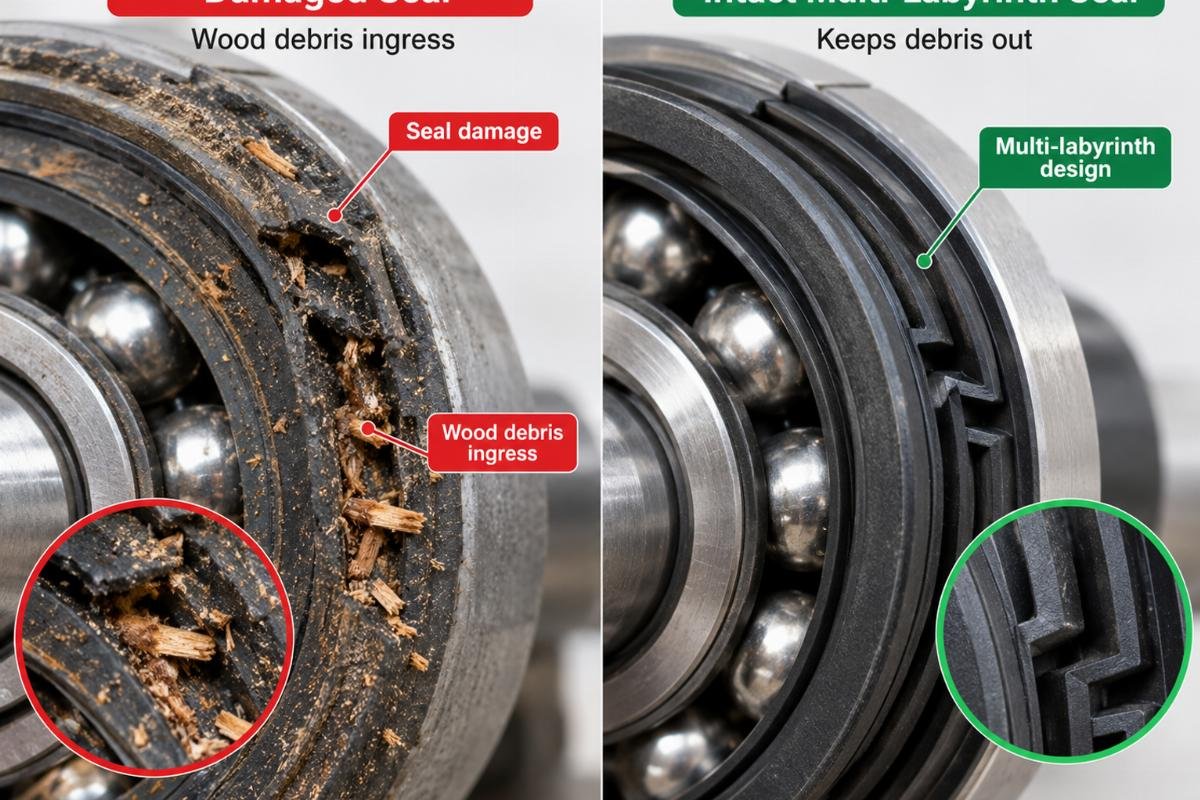
Wood chips and moisture bypass standard rubber seals, requiring specialized multi-labyrinth designs to prevent spindle seizure.
In a clean factory setting, a standard contact seal might last for years. In a forest, it lasts for days. The primary enemy of harvester bearings is not just load, but contamination. Fine wood dust acts as an abrasive paste when mixed with grease and moisture. If this mixture enters the bearing raceway, it accelerates wear exponentially.
Standard single-lip seals are designed to keep grease in and large particles out. They are not designed to withstand the pressure differentials created by rapid temperature changes and water jets used during cleaning operations. When a harvester is washed down after a shift, water can be forced past inadequate seals, washing away lubricant and introducing rust-promoting moisture.
Advanced sealing solutions for forestry machine bearings often feature multi-labyrinth paths. These non-contact seals create a tortuous path for contaminants, using centrifugal force to throw debris away from the bearing interior. Some premium designs incorporate V-rings or triple-lip configurations that provide redundant protection.
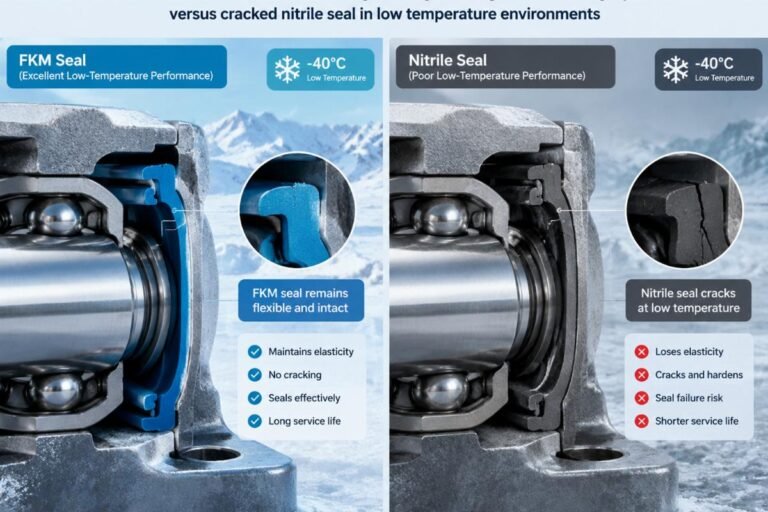
I once inspected a batch of failed bearings from a Scandinavian logging operator. The outer surfaces were pristine, but the internal grease was black and gritty. The original seals had hardened and cracked due to exposure to cold temperatures and chemical cleaners. Replacing them with bearings featuring fluorocarbon elastomer seals and labyrinth shields extended the service life significantly. [NEED_CITE: seal IP rating comparisons for harsh environment machinery]
When evaluating suppliers, ask specifically about the seal material composition and design geometry. Do not accept “standard seal” as a specification. Request details on whether the seals are designed to handle the specific debris profile of forestry work, including bark fragments and resinous sap.
How to Verify Bearing Authenticity and Quality?
Implement strict traceability checks and flaw detection to avoid counterfeit-induced spindle seizures.
The market for heavy-equipment parts is rife with counterfeits. These fake bearings often look identical to genuine products from brands like SKF, FAG, or TIMKEN. They may even carry authentic-looking packaging and laser-etched codes. However, the steel quality, heat treatment, and precision grinding are vastly inferior.
Counterfeit bearings typically use lower-grade steel with higher inclusion density. This leads to early fatigue failure under heavy loads. Additionally, the heat treatment process may be inconsistent, resulting in soft spots that deform under pressure or brittle areas that crack under shock loads.
To verify authenticity, you must go beyond visual inspection. Use precision tools to measure dimensional tolerances and surface finish. Genuine bearings adhere to strict ISO standards for roundness and waviness. Counterfeits often fall outside these tight tolerances, leading to vibration and noise.
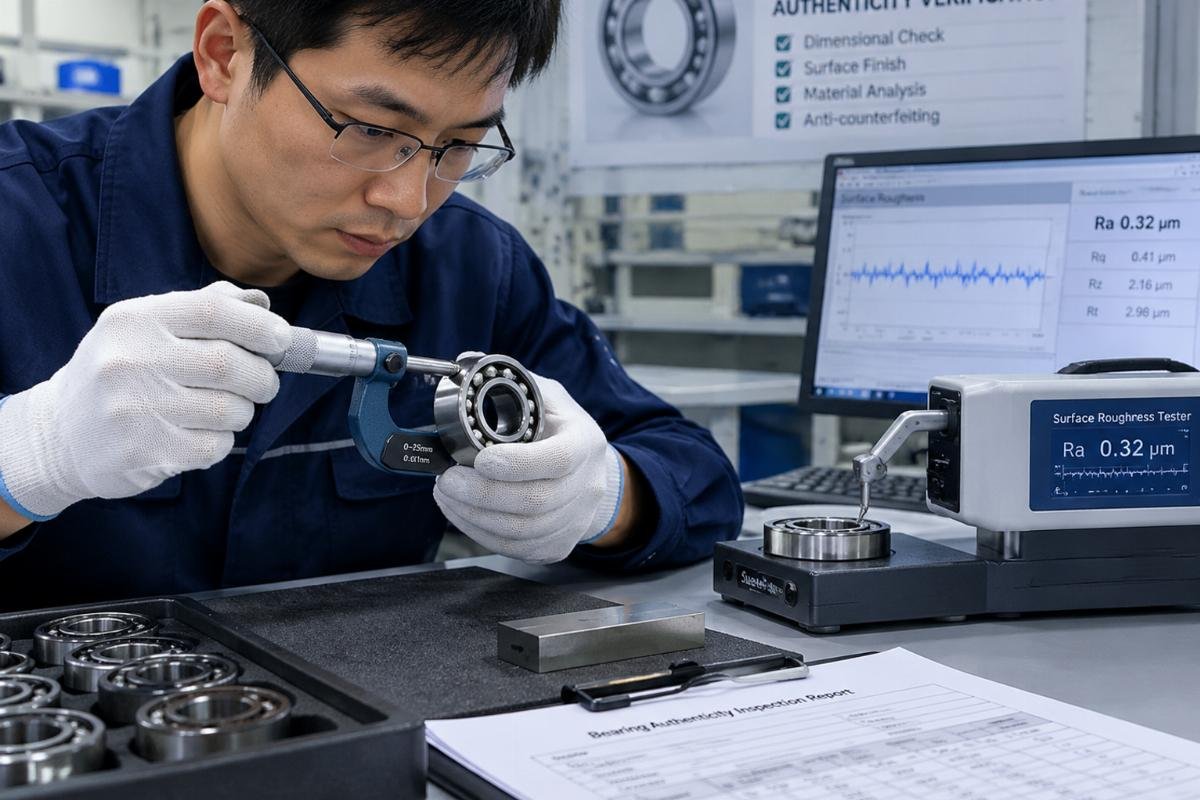
One effective method is batch tracing. Reputable suppliers provide documentation that links the bearing to its manufacturing batch, including material certificates and heat treatment logs. If a supplier cannot provide this level of traceability, consider it a red flag. [NEED_CITE: methods for detecting counterfeit industrial bearings]
I recall a case where a distributor in Southeast Asia purchased a container of what they believed were genuine NSK bearings. Upon arrival, we performed random hardness testing. The results showed significant variation within the same batch, indicating poor quality control. These bearings were rejected before they reached the end user, saving the client from potential catastrophic failures in the field.
When sourcing forestry machine bearings, insist on seeing the original manufacturer’s certificate of conformity. Verify the part numbers against the official brand catalogs. Be wary of prices that seem too good to be true; they usually are. The cost of a failed bearing in a remote logging location includes not just the part, but the crane, the crew, and the lost production time.
How to Optimize Your Bearing Procurement Strategy?
Consolidate mixed-brand orders to balance performance, cost, and lead times.
Procuring bearings for a diverse fleet of harvesters can be complex. Different joints and systems may require different brands or types. Managing multiple suppliers for each brand increases administrative overhead and shipping costs.
A more efficient approach is to work with a single supplier who can consolidate mixed-brand orders. This allows you to source premium brands like SKF or TIMKEN for critical high-load applications while using reliable alternatives for less critical positions. This strategy optimizes both performance and budget.
Additionally, consolidating orders into full container loads reduces shipping costs per unit and ensures faster lead times. It also simplifies inventory management and customs clearance. [NEED_CITE: benefits of consolidated logistics for MRO spare parts]
Consider the following factors when optimizing your procurement strategy:
- Criticality Analysis: Identify which bearings are critical to machine uptime and prioritize premium brands for these positions.
- Inventory Consolidation: Group orders to achieve economies of scale in shipping and handling.
- Technical Support: Choose a supplier who offers technical selection support to ensure the right bearing is chosen for each application.
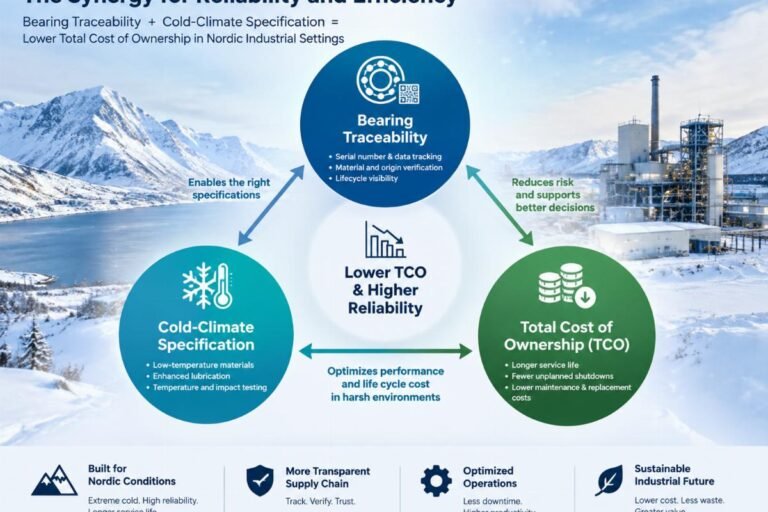
By adopting a strategic approach to sourcing forestry machine bearings, you can reduce total cost of ownership and minimize unplanned downtime. This involves not just buying parts, but building a supply chain that supports your operational reliability.

Conclusion
Reliability in forestry harvesting is built on genuine components and verified supply chains.
Sourcing the right forestry machine bearings means looking beyond the price tag to understand the technical demands of the environment. Prioritize seal integrity, verify material authenticity, and optimize your procurement through consolidation. By focusing on these elements, you protect your equipment from premature failure and ensure continuous operation in the toughest conditions.
Tags

About the author
author
Editor covering global sourcing, supplier verification, and industrial product knowledge. Content is compiled from manufacturer specifications, industry standards, and hands-on experience with international B2B buyers. Every article is fact-checked before publishing to help procurement professionals make informed decisions.
More articles by author