Genuine Press Section Bearings for Paper Machines Wholesale Supplier
Prevent catastrophic press section bearing failures in paper machines caused by moisture ingress and thermal expansion. Select genuine bearings with correct C3/C4 clearances and specialized seals to avoid costly downtime. Verify authenticity through traceable supply chains for reliable wet-end performance.
 Written by
author
- Published on
- 6 min read
- Updated
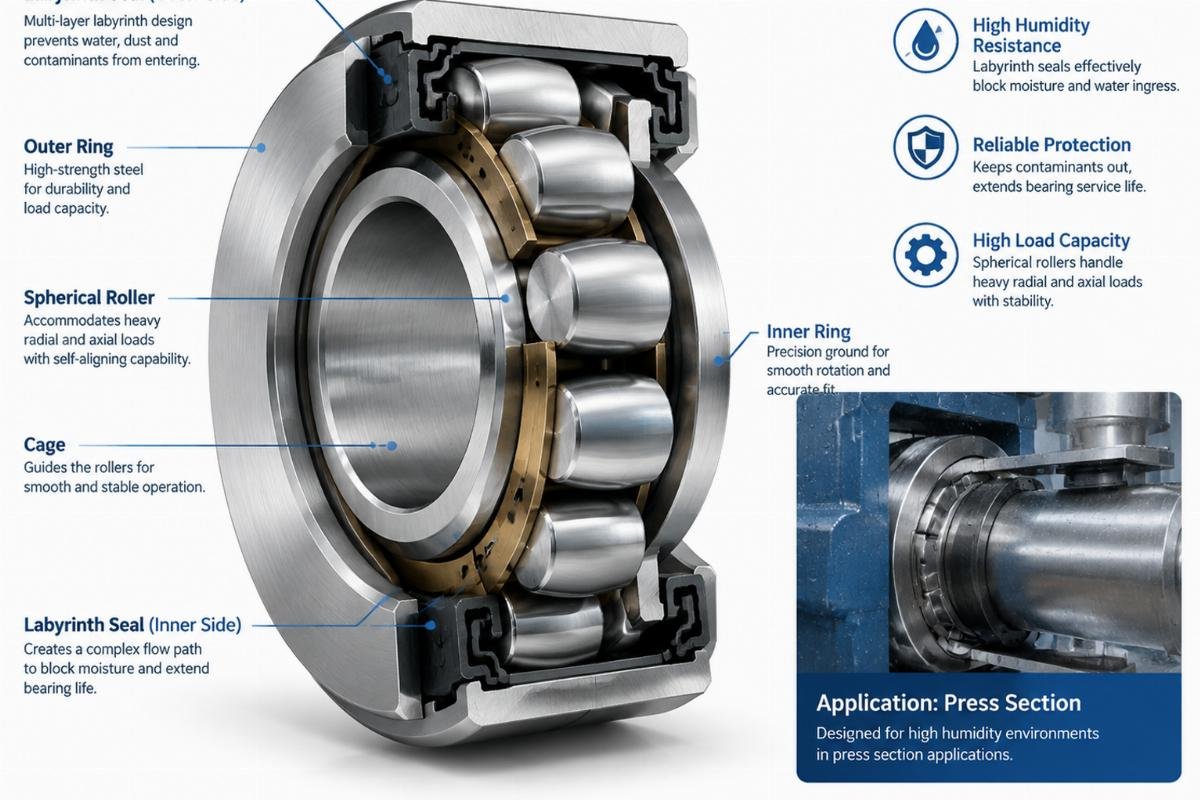
Genuine Press Section Bearings for Paper Machines Wholesale Supplier
Cheaper bearings do not save money in the wet end.
Selecting genuine press section bearings with correct internal clearances and specialized sealing is the only reliable method to prevent catastrophic roll seizures and unplanned downtime in high-temperature, high-humidity paper machine environments.
I still remember the silence in a Southeast Asian mill when a press roll seized. It was not a quiet failure; it was a sudden, violent stop that halted the entire production line. The maintenance manager had sourced non-OEM spherical roller bearings to cut costs. Within months, the high humidity and steam penetrated the inadequate seals, washing out the lubricant and causing rapid corrosion. The downtime cost multiplied the initial savings many times over. This incident reinforced a hard truth: in the press section, where heat and moisture are extreme, bearing selection is not about price per unit but about total operational reliability [NEED_CITE: common failure modes in paper machine wet ends].
The press section is arguably the most punishing environment in a paper machine. Bearings here must support massive radial loads while enduring constant exposure to hot water, steam, and chemical sprays. A single failure can lead to roll damage, felt destruction, and days of lost production. Understanding why these components fail and how to source authentic replacements is critical for any operation aiming to minimize unexpected stops.
Why Do Press Section Bearings Fail Prematurely?
Moisture ingress and thermal expansion are the primary drivers of wet-end bearing failures.
In the press section, bearings operate in a zone of extreme thermal and hydraulic stress. Standard industrial bearings often fail here because they are not designed for such aggressive conditions. The two main culprits are seal failure due to high-pressure washdowns and incorrect internal clearance leading to thermal locking.
When steam and hot water penetrate standard rubber seals, they contaminate the grease. This leads to corrosion on the rolling elements and raceways, accelerating fatigue. Furthermore, the press rolls expand significantly under operating temperatures. If the bearing internal clearance is too tight, this thermal expansion creates excessive preload, generating heat that further expands the metal until the bearing seizes [NEED_CITE: thermal expansion effects on bearing clearance selection].
| Failure Mode | Cause | Consequence |
|---|---|---|
| Seal Ingress | High-pressure washdown exceeds IP rating | Grease contamination, corrosion, premature fatigue |
| Thermal Locking | Incorrect internal clearance (too tight) | Excessive heat generation, roll seizure, shaft damage |
| Lubrication Breakdown | High temperature degrades standard grease | Metal-to-metal contact, spalling, catastrophic failure |
A Latin American mill I worked with faced repeated failures on their third press nip. They were using standard C2 clearance bearings. After switching to C3 clearance units specifically rated for high-temperature operation, the overheating issues ceased. The difference was not in the brand but in the specification matching the thermal reality of the press section.

How to Select the Right Bearing Specifications?
Match load ratings, speed, and specific internal clearances to the actual press roll conditions.
Selecting the right bearing is not just about matching the part number. It requires a deep understanding of the operational parameters. For press section applications, spherical roller bearings are the standard due to their ability to accommodate misalignment and heavy loads. However, the devil is in the details: clearance class and seal type.
Internal clearance is critical. As the press roll heats up, the inner ring expands. If the initial clearance is insufficient, the operating clearance becomes negative, causing the bearing to run hot and fail. For most press section applications, C3 or C4 clearances are recommended to accommodate this thermal growth [NEED_CITE: ISO standards for bearing internal clearance].
Sealing is equally vital. Standard contact seals may not withstand the high-pressure showers used to clean felts. Labyrinth seals or specialized high-temperature resistant seals are often required to keep water out while retaining grease. The choice depends on the specific washdown pressure and temperature profile of the machine.
| Parameter | Standard Application | Press Section Requirement |
|---|---|---|
| Internal Clearance | C2 or Normal | C3 or C4 (to accommodate thermal expansion) |
| Seal Type | Standard Rubber Contact | Labyrinth or High-Temp Specialized Seals |
| Lubricant | General Purpose Grease | High-Temperature, Water-Resistant Grease |
| Cage Material | Steel or Polyamide | Reinforced Polyamide or Brass (for higher stability) |
A Middle Eastern distributor once shared how specifying the wrong cage material led to premature failures in a hot climate. Switching to a more stable cage design resolved the issue, highlighting that every component matters in this harsh environment.

What Are the Hidden Costs of Non-Genuine Bearings?
Counterfeit or inferior bearings lead to catastrophic roll seizures and line stoppages that far exceed initial savings.
The temptation to buy cheaper, non-genuine bearings is strong, especially when budgets are tight. However, the true cost of a bearing is not its purchase price but its impact on production uptime. A failed bearing in the press section does not just require replacement; it often damages the roll surface, destroys expensive felts, and halts production for days.
Non-genuine bearings often lack the precise metallurgy and heat treatment of original equipment. This results in lower fatigue life and poorer resistance to contamination. In one case, a mill saved a small amount on bearing costs but incurred a mid-six-figure loss due to a single unplanned shutdown caused by a counterfeit bearing failure. The savings were negligible compared to the lost production and repair costs.
Moreover, non-genuine parts often lack traceability. When a failure occurs, there is no way to verify the material quality or manufacturing process, making root cause analysis difficult. This uncertainty can lead to repeated failures if the underlying quality issue is not addressed.

How to Verify Bearing Authenticity and Traceability?
Require original mill certificates and traceable supply chains from suppliers to ensure genuine products.
Verifying the authenticity of bearings is crucial, especially in markets where counterfeits are prevalent. Genuine bearings come with full traceability documentation, including mill certificates that verify the steel origin and heat treatment process. This documentation is not just paperwork; it is proof of quality and reliability.
When sourcing press section bearings, ask suppliers for proof of authorization or direct sourcing channels. Reputable suppliers can provide batch-specific documentation that links the bearing to its manufacturing origin. This level of transparency is essential for maintaining trust and ensuring that the parts you install will perform as expected.
I now insist on full traceability for all critical wet-end components. Even for small, urgent orders, I source only from channels that can provide verifiable documentation. This approach has eliminated the risk of counterfeit parts entering the supply chain and has built long-term trust with clients who value reliability over short-term savings.

Sourcing genuine press section bearings for paper machines requires a partner who understands the technical demands of the wet end. It is not enough to simply supply a part number; the supplier must ensure that the bearing meets the specific clearance, sealing, and load requirements of the application. By prioritizing authenticity and technical correctness, mills can avoid the hidden costs of failure and maintain consistent production efficiency.
Conclusion
Genuine specifications prevent costly downtime.
Press section bearings operate in extreme conditions that demand precise engineering and authentic materials. Selecting the correct clearance and sealing solutions, backed by verifiable traceability, ensures reliability and protects against the high costs of unplanned stops.
Tags

About the author
author
Editor covering global sourcing, supplier verification, and industrial product knowledge. Content is compiled from manufacturer specifications, industry standards, and hands-on experience with international B2B buyers. Every article is fact-checked before publishing to help procurement professionals make informed decisions.
More articles by author

