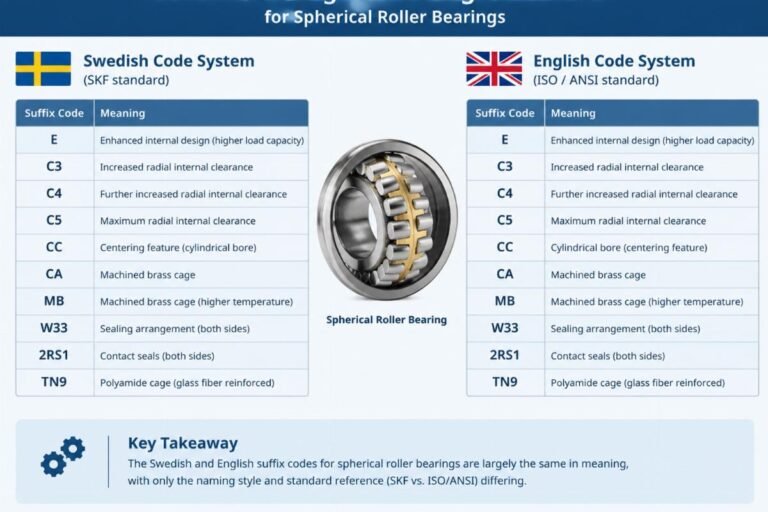
Spherical Roller Bearings Clearance Reduction Table Wholesale Supplier
Prevent premature bearing lock-up by mastering the Clearance Reduction Table for Spherical Roller Bearings. Calculate thermal expansion and interference fit reductions to determine accurate residual operational clearance. Ensure optimal performance in high-temperature environments with precise engineering verification.
 Written by
author
- Published on
- 7 min read
- Updated

Spherical Roller Bearings Clearance Reduction Table Wholesale Supplier
Factory clearance is not operating clearance.
Relying solely on the initial internal clearance specified in a factory report guarantees premature bearing lock-up in high-temperature or heavy-load applications. The correct approach requires calculating thermal expansion and interference fit reduction to determine the residual operational clearance before installation.
The dust in the grinding mill was thick enough to taste. I stood next to the roller press, watching the temperature gauge climb past the red line. The spherical roller bearings had been installed only two weeks prior, selected based on their standard C3 clearance rating. On paper, they were perfect. In reality, they were seizing. The heat generated by the friction and the ambient environment caused the inner ring to expand faster than the outer ring, eliminating the tiny gap that allowed the rollers to move. That failure taught me that a Clearance Reduction Table for Spherical Roller Bearings is not just a reference document; it is a survival guide for industrial machinery. Without accounting for the physical changes that occur during operation, even the highest quality bearing will fail. [NEED_CITE: ISO 15243 failure mode classification for overheating and seizure]
Understanding how to apply these calculations separates a parts supplier from a technical partner. This guide breaks down the methodology used to prevent such failures, focusing on the critical factors that alter internal geometry once the machine starts running.
Why Factory Clearance is Not Enough for Harsh Environments?
The clearance value stamped on a bearing box represents the state of the component at room temperature, with no load applied. This is known as the initial internal clearance. However, industrial environments rarely operate at room temperature, and bearings are almost never mounted without some degree of interference.
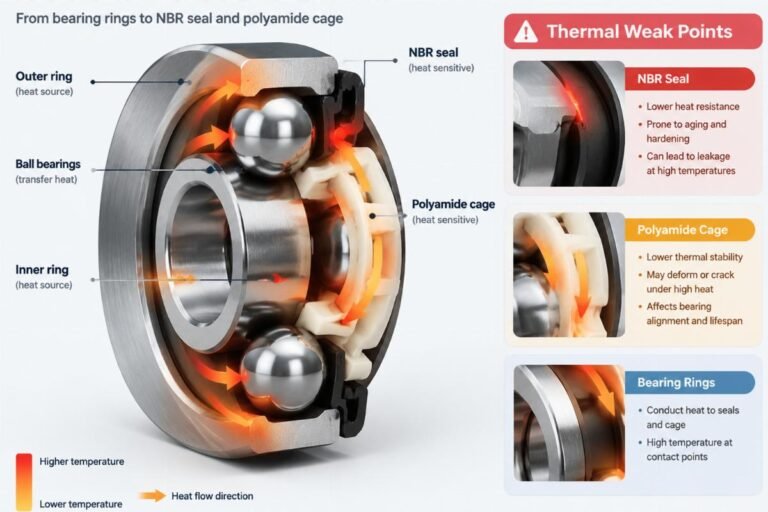
When a spherical roller bearing begins to rotate under load, two primary forces act to reduce this initial clearance. First, the temperature difference between the inner and outer rings causes thermal expansion. Since the inner ring is typically mounted on a rotating shaft that generates heat through friction and load transmission, it expands more than the stationary outer ring housed in a cooler structure. Second, the mechanical fit between the bearing and the shaft or housing compresses the rings. An interference fit on the inner ring expands its raceway, while an interference fit on the outer ring compresses its raceway. Both actions reduce the space available for the rolling elements.
In regions with extreme ambient conditions, such as the Middle East or equatorial mining sites, the baseline temperature is already high. A bearing that has adequate clearance in a temperate warehouse may have zero or negative clearance once installed in a desert conveyor system. This leads to increased friction, higher operating temperatures, and eventually, catastrophic lock-up. [NEED_CITE: Thermal expansion coefficients for bearing steel vs. cast iron housings]

Ignoring these factors is a common error among buyers who focus solely on brand authenticity or price. While genuine products are essential, they cannot overcome poor application engineering. A Spherical Roller Bearings Clearance Reduction Table Wholesale Supplier must provide the tools to calculate these reductions, ensuring that the selected clearance class matches the actual operating conditions rather than just the catalog specification.
How to Calculate Thermal Expansion Reduction?
Thermal expansion is the most significant variable in high-temperature applications. The reduction in clearance due to temperature can be estimated using a straightforward formula that accounts for the material properties and the temperature differential.
The general principle is that the inner ring expands radially outward, reducing the gap between the rollers and the outer ring raceway. The amount of reduction depends on the bore diameter, the temperature difference between the inner and outer rings, and the coefficient of thermal expansion for the bearing steel.
To estimate this reduction, engineers typically follow these steps:
- Determine the Temperature Differential: Measure or estimate the operating temperature of the inner ring and subtract the operating temperature of the outer ring. In many cases, the outer ring temperature is assumed to be close to the ambient temperature if the housing is well-ventilated.
- Identify the Bore Diameter: Larger bearings experience greater absolute expansion for the same temperature change.
- Apply the Expansion Coefficient: Use the standard coefficient for bearing steel. [NEED_CITE: Standard thermal expansion coefficient for chrome steel]
- Calculate the Reduction: Multiply the bore diameter by the temperature differential and the expansion coefficient.
For example, in a cement mill roller application, the inner ring temperature might rise significantly above the outer ring. If the calculation shows a reduction of several hundred microns, a standard C3 clearance may be insufficient. In such cases, a C4 clearance class might be required to maintain positive residual clearance.
It is crucial to note that this calculation provides an estimate. Actual temperatures can vary based on lubrication efficiency, load magnitude, and cooling systems. Therefore, conservative estimates are often preferred to avoid the risk of negative clearance. [NEED_CITE: OEM technical manuals for thermal calculation methods]

This step is where many projects fail. Buyers often request a Spherical Roller Bearings Clearance Reduction Table Wholesale Supplier to simply ship the part listed in the bill of materials, without verifying if the original design accounted for the specific thermal profile of their site. Recalculating these values can prevent costly downtime.
How Does Interference Fit Affect Clearance?
While thermal expansion reduces clearance from the inside out, interference fits reduce it through mechanical deformation. When a bearing is pressed onto a shaft or into a housing, the rings deform. An interference fit on the inner ring causes the inner raceway to expand, which reduces the internal clearance. Conversely, an interference fit on the outer ring causes the outer raceway to contract, also reducing internal clearance.
The magnitude of this reduction depends on the severity of the interference and the geometry of the bearing and its seating. Solid shafts cause more reduction than hollow shafts, and thin-walled housings allow more deformation than thick-walled ones.
To calculate the reduction due to fit:
- Determine the Effective Interference: Calculate the average interference between the bearing and the shaft or housing.
- Assess the Geometry: Consider whether the shaft is solid or hollow and whether the housing is thick or thin-walled.
- Apply the Reduction Factor: Use standard formulas or charts provided by bearing manufacturers to estimate the clearance loss. For solid steel shafts, the reduction is approximately proportional to the interference. For outer rings in cast iron housings, the reduction is less severe due to the lower modulus of elasticity of the housing material.
In a vibrating screen application, improper interference fits can eliminate operational clearance entirely. If the fit is too tight, the bearing will run hot and fail prematurely. If the fit is too loose, the bearing may creep on the shaft, causing fretting corrosion. Finding the balance requires precise calculation. [NEED_CITE: ISO standards for bearing tolerances and fit classes]

Many distributors overlook this factor, assuming that standard tolerance classes are sufficient for all applications. However, in heavy-duty industries like mining and steel production, custom fits are often necessary. A knowledgeable Spherical Roller Bearings Clearance Reduction Table Wholesale Supplier will ask about the shaft and housing specifications to ensure the selected bearing clearance accounts for these mechanical reductions.
How to Verify Residual Operational Clearance?
The final step in the selection process is verifying the residual operational clearance. This is the clearance that remains after accounting for both thermal expansion and interference fit reductions. It is this residual value that determines the bearing’s performance and lifespan.
The goal is to maintain a small positive residual clearance. Too little clearance leads to overheating and seizure. Too much clearance causes skidding, cage failure, and uneven load distribution. The optimal range depends on the bearing type, size, and application.
To verify the residual clearance:
- Sum the Reductions: Add the calculated thermal reduction and the fit reduction.
- Subtract from Initial Clearance: Subtract the total reduction from the initial internal clearance of the selected bearing class.
- Compare with Recommended Values: Check the result against the manufacturer’s recommended minimum residual clearance for the specific application.
If the calculated residual clearance is below the recommended minimum, a bearing with a larger initial clearance class must be selected. For instance, if a C3 bearing results in near-zero residual clearance, upgrading to a C4 or C5 class may be necessary.
In my experience, this verification step is often skipped due to time pressure or lack of technical data. However, it is the most critical safeguard against field failures. When working with a Spherical Roller Bearings Clearance Reduction Table Wholesale Supplier, requesting OEM calculation sheets or technical support for cross-brand equivalent selection can ensure that these calculations are accurate. This level of scrutiny transforms a simple purchase into a reliable engineering solution.
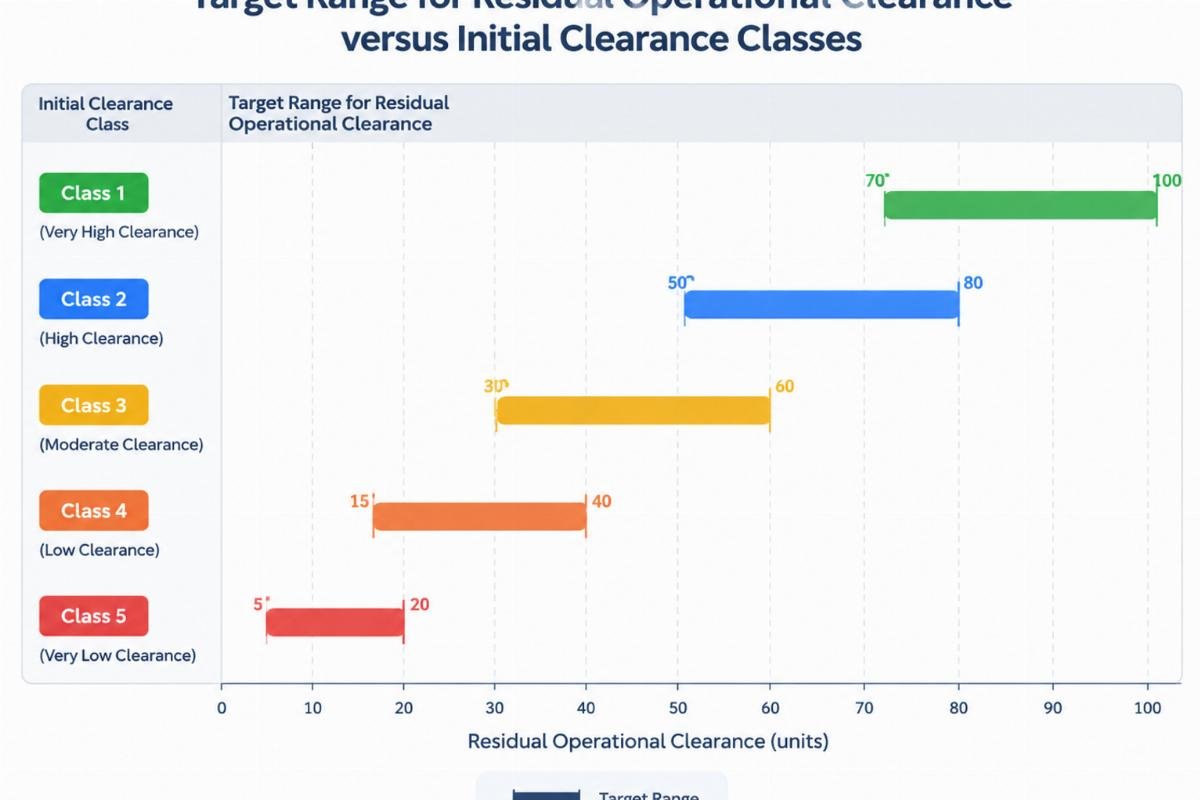
This process ensures that the bearing will perform as intended, regardless of the harsh conditions it faces. It moves the decision-making from guesswork to precision engineering.
Conclusion
Proper clearance calculation prevents premature bearing failure.
Ignoring thermal and fit-induced reductions turns high-quality bearings into liabilities. By systematically calculating these factors, engineers can select the correct initial clearance to ensure optimal residual clearance during operation. This approach minimizes downtime and extends equipment life in demanding industrial environments.
Tags

About the author
author
Editor covering global sourcing, supplier verification, and industrial product knowledge. Content is compiled from manufacturer specifications, industry standards, and hands-on experience with international B2B buyers. Every article is fact-checked before publishing to help procurement professionals make informed decisions.
More articles by author