23026 Bearing Dimensions & Equivalents: Wholesale Supplier
Master 23026 bearing dimensions and equivalents to ensure true interchangeability beyond standard 130x200x52 mm specs. Matching clearance classes like C3 and cage designs prevents premature thermal failure in heavy-duty applications. Verify suffixes for reliable cross-brand replacements that maintain operational uptime.
 Written by
author
- Published on
- 6 min read
- Updated

23026 Bearing Dimensions & Equivalents: Wholesale Supplier
Identical outer dimensions do not guarantee interchangeability.
A 23026 spherical roller bearing has standard boundary dimensions of 130 mm bore, 200 mm outer diameter, and 52 mm width. However, true equivalence for replacement requires matching internal clearance classes (such as C3), cage material designations, and lubrication features like W33 annular grooves. Relying solely on the basic part number without verifying suffixes often leads to premature thermal failure in heavy-duty applications.
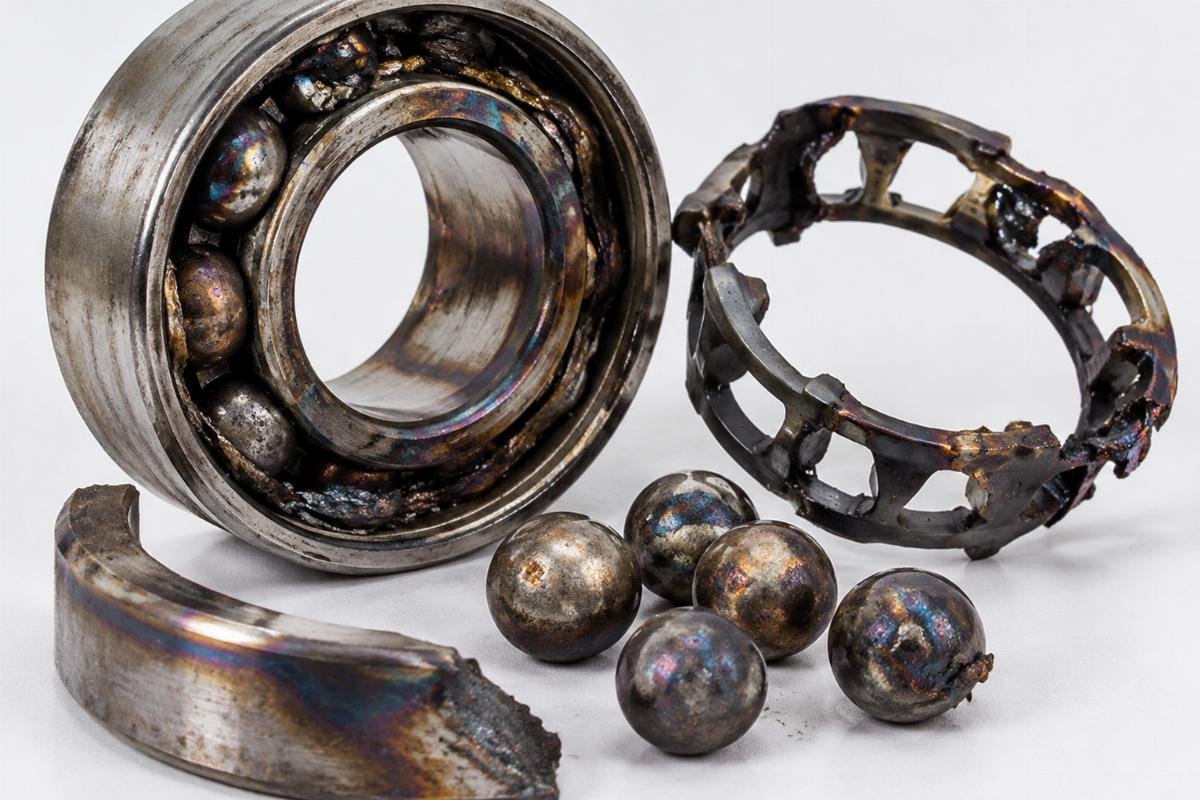
I still recall the urgent call from a mining operation in Central Asia. Their primary crusher had seized up just days after a routine maintenance swap. The procurement team had ordered a 23026 bearing based strictly on the dimensional printout, ignoring the original manufacturer’s suffix code. When I inspected the failed unit on-site, the rollers were welded to the raceways due to excessive heat. The original specification called for C3 internal clearance to accommodate thermal expansion under heavy shock loads, but the replacement was a standard CN clearance unit. The dimensions were perfect, but the operational fit was catastrophic. That incident reshaped how I approach every inquiry for this specific series. It is not just about the metal ring; it is about the engineered space inside.
Understanding these nuances is critical for distributors and MRO buyers who need to ensure uptime rather than just fill a purchase order. Let us break down exactly what defines a genuine equivalent.
What Are the Exact Dimensions of a 23026 Bearing?
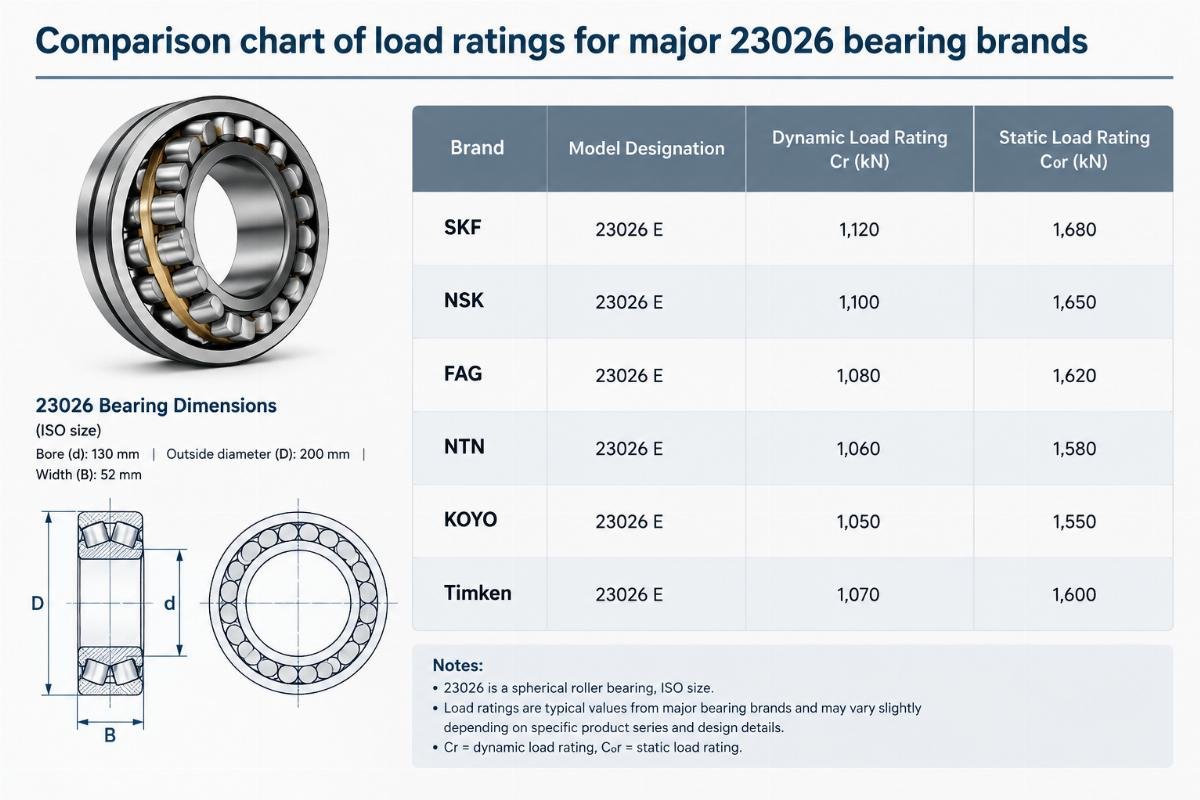
The boundary dimensions are standardized globally, but load ratings vary by design.
According to ISO 15:1998, the 23026 bearing dimensions are fixed at 130x200x52 mm. This standardization allows for physical installation across different brands. However, the dynamic and static load ratings can differ significantly depending on the internal geometry and steel quality used by the manufacturer. [NEED_CITE: ISO 15:1998 boundary dimensions for radial bearings]
When sourcing replacements, you will often see variations in the basic load rating figures provided in catalogs. These differences stem from the manufacturing processes and the specific roller profile optimization. A higher load rating does not always mean better performance if the internal clearance is mismatched for the application. For instance, a bearing with optimized roller guidance may handle misalignment better, which is crucial for shafts that deflect under load.
| Parameter | Standard Value | Note |
|---|---|---|
| Bore Diameter (d) | 130 mm | Fixed per ISO 15 |
| Outer Diameter (D) | 200 mm | Fixed per ISO 15 |
| Width (B) | 52 mm | Fixed per ISO 15 |
| Dynamic Load Rating (C) | Varies | Depends on brand/design |
| Static Load Rating (C0) | Varies | Depends on brand/design |
For a wholesaler, knowing that the physical envelope is constant simplifies logistics, but the technical data sheet must be reviewed for each brand alternative. A direct drop-in replacement must meet or exceed the original load capacity while maintaining the same spatial footprint.
How to Read 23026 Bearing Suffixes and Clearances?
Suffixes dictate the operational environment suitability, not just the factory origin.
The part number 23026 is merely the base. The real engineering intelligence lies in the suffixes. Common suffixes include C3, CC, CA, and W33. Each represents a specific design choice that affects longevity. [NEED_CITE: ISO 5753-1:2009 radial internal clearance groups]
C3 clearance indicates a radial internal clearance greater than normal. This is essential for applications where the inner ring heats up more than the outer ring, causing thermal expansion. Without this extra space, the rolling elements bind, generating friction and heat. In contrast, CN (normal) clearance is suitable for standard operating temperatures with minimal differential expansion.
Cage types are equally critical. A stamped steel cage is cost-effective and suitable for moderate speeds. However, in high-vibration environments like vibrating screens or crushers, a machined brass cage offers superior strength and resistance to deformation. The suffix often denotes this difference, such as MB for machined brass. Ignoring this detail can lead to cage fracture under shock loads, even if the bearing rings remain intact.
W33 signifies the presence of lubrication holes and an annular groove in the outer ring. This feature allows for effective grease replenishment, which is vital for sealed or hard-to-reach installations. A 23026 bearing cross reference that omits W33 when the original had it will starve the bearing of lubricant over time, leading to dry running failure.

23026 Cross-Reference Matrix: SKF vs. FAG vs. NSK vs. Domestic Brands
Brand equivalence requires matching suffix logic, not just part number translation.
Different manufacturers use varying suffix codes for similar features. A buyer must translate these correctly to ensure the 23026 bearing equivalents function as intended. Below is a generalized comparison of how major brands denote key features for this series.
| Feature | SKF | FAG / INA | NSK | Generic/Chinese |
|---|---|---|---|---|
| Internal Clearance C3 | C3 | C3 | C3 | C3 |
| Machined Brass Cage | M | MB | M | M / MB |
| Lubrication Groove | W33 | W33 | E4 | W33 |
| Standard Cage | Stamped Steel | Stamped Steel | Stamped Steel | Stamped Steel |
Note that while C3 and W33 are largely standardized across premium brands, cage designations can vary. For example, some domestic manufacturers may use different letters for brass cages. It is crucial to verify the physical cage type when switching between brand tiers.
In our supply chain, we frequently assist distributors in mapping these equivalents. A client in Southeast Asia needed to replace an obsolete European brand unit. By cross-referencing the cage material and clearance class rather than just the brand name, we sourced a compatible alternative from a reputable domestic line that matched the technical requirements. This approach reduced cost without compromising reliability. The key is verifying the exact suffix meaning with the manufacturer’s current catalog, as coding systems can evolve.

Why Dimensional Equivalence Isn’t Enough for Heavy-Duty Applications
Real-world failure stems from mismatched internal dynamics, not external size.
Consider a steel mill conveyor application. The original equipment specified a 23026 C3 clearance equivalent with a machined brass cage. The maintenance team replaced it with a standard clearance unit featuring a stamped steel cage to save costs. Within weeks, the bearing exhibited excessive vibration. The stamped cage deformed under the heavy shock loads typical of conveyor start-stop cycles, and the lack of C3 clearance caused binding during thermal spikes.
Another case involved a cement plant fan. The shaft operated at high temperatures, requiring significant thermal expansion gap. The installed replacement had the correct 130x200x52 mm dimensions but lacked the W33 lubrication feature. Grease could not reach the rolling elements effectively, leading to rapid wear. The fan’s downtime cost far exceeded the price difference between the correct and incorrect bearings.
These scenarios highlight that a 23026 spherical roller bearing size match is only the first step. The internal architecture must align with the operational stresses. Distributors who offer technical consultation on these specifics provide far more value than those who simply ship boxes. Understanding the application context—whether it involves high heat, heavy shock, or contamination risks—guides the correct suffix selection.
Conclusion
Precision in suffix selection prevents costly operational failures.
While the 23026 bearing dimensions are universal, the performance depends on matching clearance, cage type, and lubrication features to the specific application. Distributors and buyers must look beyond the basic part number to ensure true equivalence. Verifying suffixes like C3 and W33 ensures that the replacement bearing can withstand the thermal and mechanical stresses of heavy-duty environments.
Tags

About the author
author
Editor covering global sourcing, supplier verification, and industrial product knowledge. Content is compiled from manufacturer specifications, industry standards, and hands-on experience with international B2B buyers. Every article is fact-checked before publishing to help procurement professionals make informed decisions.
More articles by author

