22217 Bearing Specs & Gearbox Uses: Wholesale Supplier
Selecting the correct 22217 bearing specs for heavy-duty gearboxes requires matching cage material and radial clearance to operating temperatures, not just dimensions. Avoid premature failure by choosing machined brass or solid steel cages over stamped steel in high-shock environments. Verify internal clearance groups like C3 or C4 to prevent thermal seizure and ensure long-term reliability.
 Written by
author
- Published on
- 8 min read
- Updated

22217 Bearing Specs & Gearbox Uses: Wholesale Supplier
Matching dimensions is not enough to prevent gearbox failure.
Selecting the correct 22217 bearing for heavy-duty gearboxes requires matching specific internal specifications, such as cage material and radial clearance, to actual operating temperatures and shock loads rather than relying solely on basic dimensional data. Ignoring these critical parameters often leads to premature cage fragmentation or thermal seizure, even when the bearing fits the housing perfectly.
I still remember the phone call at two in the morning from a mining site supervisor. A primary crusher gearbox had shut down unexpectedly, halting production. When we opened the casing, the 22217 spherical roller bearing looked intact from the outside, but the internal cage was shattered into pieces. The client accused us of supplying counterfeit goods because the part number matched their order exactly. However, the root cause was not authenticity but selection. They had installed a standard stamped steel cage bearing in a high-temperature zone where only a machined brass or solid steel cage could survive. That night taught me that a part number is just a starting point, not a complete solution. [NEED_CITE: common failure modes in spherical roller bearings per ISO 15243]
Understanding the technical nuances behind the 22217 bearing specs is essential for anyone responsible for maintaining heavy industrial transmissions. This guide breaks down the critical specifications and selection criteria that determine whether a bearing will last for years or fail within weeks.
What Are the Core Specs of a 22217 Bearing?
Basic dimensions provide the baseline, but load ratings define the capability.
The 22217 bearing is a self-aligning spherical roller bearing designed to accommodate misalignment and heavy radial loads. Its popularity in gearbox applications stems from its robust construction, but buyers must verify more than just the outer diameter. The core specifications include the bore diameter, outside diameter, width, and crucially, the dynamic and static load ratings. These values determine how much stress the bearing can withstand before fatigue sets in. [NEED_CITE: ISO standards for rolling bearing dimensions and load ratings]
For a 22217 bearing, the dimensional tolerance is typically manufactured to normal class precision unless specified otherwise. However, the internal geometry, including the roller profile and raceway curvature, plays a significant role in load distribution. In heavy-duty gearboxes, the bearing must handle not only radial forces from gear meshing but also occasional axial shifts. The spherical outer ring allows the inner ring to tilt slightly, compensating for shaft deflection or housing misalignment.
| Specification Category | Typical Characteristic | Application Impact |
|---|---|---|
| Bore Diameter | Standard metric size | Ensures fit on designated shaft |
| Cage Material | Stamped steel or machined brass/steel | Determines thermal and shock resistance |
| Internal Clearance | C3, C4, or Normal | Accommodates thermal expansion |
| Load Rating | High dynamic capacity | Supports heavy radial loads in gearboxes |
When sourcing a 22217 bearing, it is vital to confirm these specs against the original equipment manufacturer’s requirements. Many failures occur because users assume all 22217 bearings are identical across brands. While the dimensions are standardized, the internal design and material quality can vary significantly. [NEED_CITE: bearing manufacturer technical catalogs for internal design variations]

How Do Gearbox Conditions Dictate 22217 Selection?
Operating temperature and shock loads determine the required cage material and internal clearance.
Gearboxes are harsh environments. The selection of a 22217 bearing must account for the specific conditions inside the housing. Two primary factors drive this decision: temperature and load type. If the gearbox operates at elevated temperatures due to high speed or heavy loading, the internal clearance must be adjusted to prevent seizure. As metals heat up, they expand. If the initial clearance is too tight, the rollers will bind against the raceways, generating excessive heat and leading to catastrophic failure.
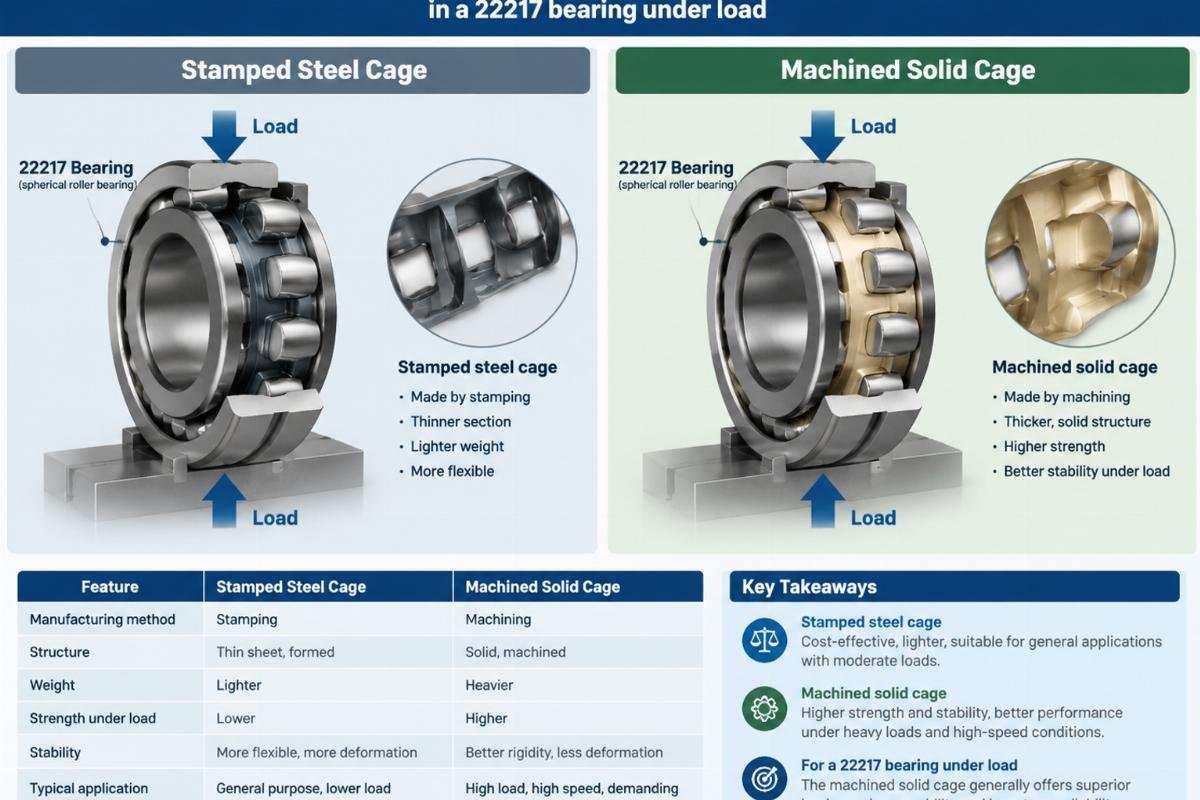
Cage material is equally critical. Standard stamped steel cages are cost-effective and suitable for moderate conditions. However, in applications with high vibration or shock loads, such as mining crushers or stone pulverizers, stamped cages can fatigue and crack. In these scenarios, a machined brass or solid steel cage offers superior strength and durability. Brass cages also provide better emergency running properties if lubrication is temporarily compromised. [NEED_CITE: industry gear design manuals for cage material selection guidelines]
Consider a high-shock load reducer used in a cement plant. The input shaft experiences intense torque spikes during startup and material jams. A standard 22217 bearing with a stamped cage might survive for a few months, but the repeated shock waves will eventually cause the cage pockets to deform. Switching to a version with a solid machined cage extends service life noticeably by distributing the impact forces more evenly across the rollers.
Another factor is lubrication. Continuous kiln drives operate at steady speeds but high temperatures. Here, the focus shifts to thermal expansion compensation. The clearance group, such as C3 or C4, must be selected based on the expected temperature rise. A C3 clearance is often recommended for general industrial gearboxes, while C4 is reserved for higher temperature differentials. Selecting the wrong clearance can lead to either excessive play or tight operation, both of which reduce bearing life.
Why Do Standard 22217 Bearings Fail in Gearboxes?
Using stamped cages in high-heat zones leads to fragmentation; proper solid cages prevent this.
A common misconception is that dimension matching is sufficient for replacement. In reality, ignoring cage material limits under high heat is a primary cause of failure. I have seen numerous cases where maintenance teams replaced a failed bearing with an identical part number, only to face the same issue weeks later. The culprit was often the cage material. Stamped steel cages have lower thermal stability compared to machined brass or solid steel alternatives. When exposed to temperatures beyond their design limit, the steel can lose temper strength, leading to deformation and eventual breakage.
In one instance, a steel mill operator reported repeated failures in a main drive gearbox. The ambient temperature around the gearbox was high, and the internal oil temperature exceeded standard operating ranges. The original specification called for a 22217 bearing with a machined brass cage, but a cheaper alternative with a stamped steel cage had been installed during a previous repair. The steel cage could not withstand the thermal stress, resulting in fragmentation that damaged the rollers and raceways. Replacing it with the correct cage material resolved the issue permanently.
Another frequent error is assuming tighter clearance improves precision. In gearbox applications, insufficient thermal expansion space is a leading cause of seizure. As the shaft and housing heat up, they expand. If the bearing internal clearance is too small, the rollers have no room to move, causing them to press hard against the raceways. This generates friction, which creates more heat, leading to a runaway thermal event. Proper selection involves calculating the expected temperature rise and choosing a clearance group that accommodates this expansion. [NEED_CITE: thermal expansion calculations for bearing installations]
| Failure Mode | Primary Cause | Recommended Solution |
|---|---|---|
| Cage Fragmentation | High temperature or shock load on stamped cage | Switch to machined brass or solid steel cage |
| Thermal Seizure | Insufficient internal clearance for expansion | Select higher clearance group (e.g., C3 or C4) |
| Premature Fatigue | Misalignment or inadequate lubrication | Verify housing alignment and lubrication intervals |
Understanding these failure mechanisms helps in making informed decisions when selecting a 22217 bearing. It is not just about buying a part; it is about ensuring the part matches the operational reality of the machine.

How to Verify 22217 Specs Before Installation?
Step-by-step clearance checking and dimensional verification ensure gearbox reliability.
Before installing a new 22217 bearing, it is crucial to verify its specifications to ensure it meets the application requirements. This process involves checking dimensional tolerances, internal clearance, and cage type. Skipping these steps can lead to installing the wrong bearing, resulting in immediate or premature failure.
First, verify the dimensional tolerances. Use precision micrometers to measure the bore, outside diameter, and width. Compare these measurements against the manufacturer’s catalog specifications. Any deviation beyond the allowed tolerance range indicates a potential issue with the bearing or the measurement tool. [NEED_CITE: ISO standards for bearing dimensional tolerances]
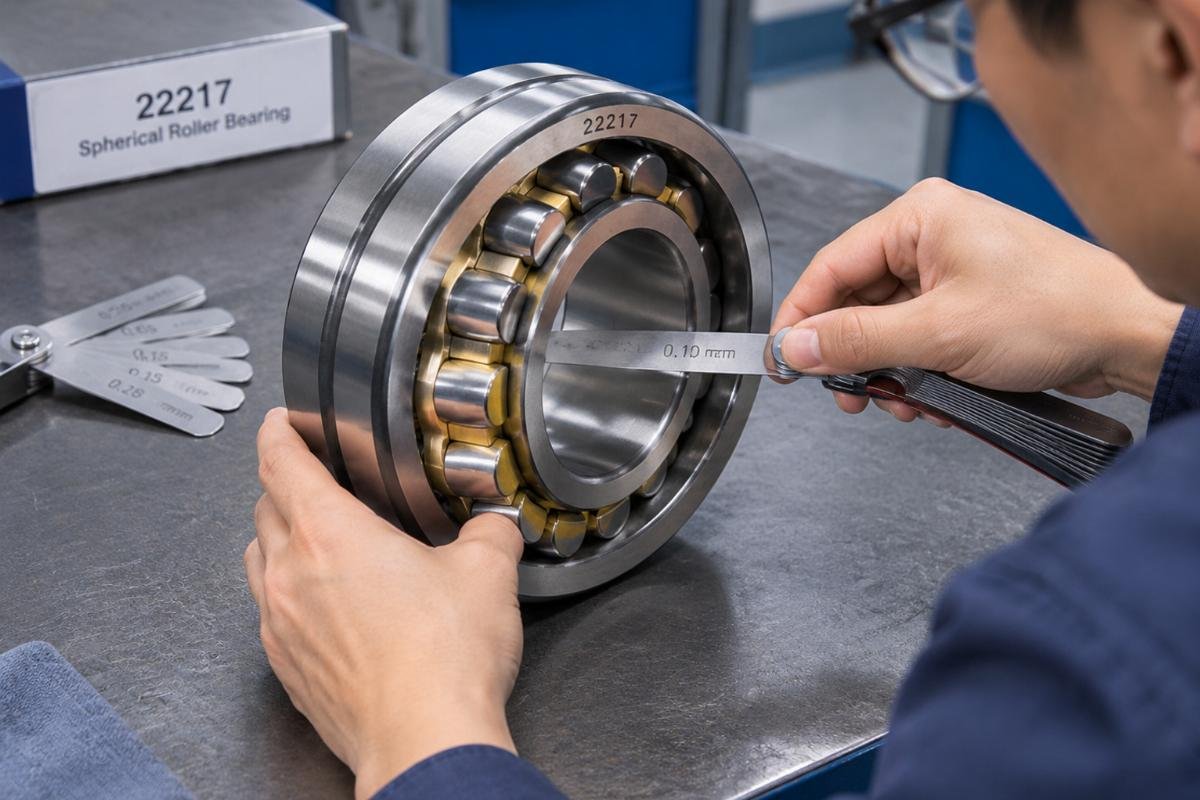
Next, check the internal clearance. This can be done using feeler gauges or specialized clearance measurement tools. For spherical roller bearings, the radial internal clearance is a key parameter. Ensure the measured clearance matches the specified clearance group (e.g., Normal, C3, C4). If the clearance is too tight, the bearing may seize under load. If it is too loose, it may cause vibration and noise.
Finally, inspect the cage material. Visually identify whether the cage is stamped steel, machined brass, or solid steel. Confirm that this matches the requirement for the specific gearbox application. For high-temperature or high-shock environments, ensure the cage is made of a material capable withstanding those conditions.
- Measure Dimensions: Use calibrated micrometers to check bore, OD, and width against catalog specs.
- Check Clearance: Measure radial internal clearance using feeler gauges or dedicated tools.
- Identify Cage: Visually confirm cage material (stamped vs. machined) matches application needs.
- Inspect Surface: Look for any signs of damage, corrosion, or manufacturing defects on rollers and raceways.
By following these steps, you can ensure that the 22217 bearing is suitable for installation. This proactive approach minimizes the risk of unexpected downtime and extends the service life of the gearbox. In our inventory, we maintain a wide range of 22217 bearings from reputable brands like SKF, FAG, and ZWZ, each with full traceability documentation to support these verification processes.
Conclusion
Correct specification matching prevents costly gearbox failures.
Selecting the right 22217 bearing involves more than just matching part numbers. It requires a deep understanding of operating conditions, including temperature, load, and clearance requirements. By focusing on cage material and internal clearance, operators can avoid common pitfalls that lead to premature failure. Always verify specifications before installation to ensure reliability and longevity in heavy-duty applications.
Tags

About the author
author
Editor covering global sourcing, supplier verification, and industrial product knowledge. Content is compiled from manufacturer specifications, industry standards, and hands-on experience with international B2B buyers. Every article is fact-checked before publishing to help procurement professionals make informed decisions.
More articles by author

