6316 Bearing Dimensions & Large Motor Uses: Wholesale Supplier
Stop ordering wrong 6316 bearing dimensions for large motors by ignoring thermal expansion risks. Standard 80x170x39mm fit is insufficient without C3 or C4 clearance and proper cage material. Learn to match internal specs with physical size to prevent seizure and extend equipment life in harsh industrial environments.
 Written by
author
- Published on
- 6 min read
- Updated

6316 Bearing Dimensions & Large Motor Uses: Wholesale Supplier
Most buyers order the wrong 6316 bearing for large motors because they only check the outer dimensions.
The standard 6316 bearing dimensions are 80mm inner diameter, 170mm outer diameter, and 39mm width. However, for large motor applications, relying solely on these physical measurements is insufficient. Successful operation depends on selecting the correct radial internal clearance (typically C3 or C4) and appropriate cage material to accommodate thermal expansion and high-speed rotation.
I still remember the humid air in a Riyadh workshop, the smell of burnt insulation hanging heavy in the room. A cement plant manager was shouting over the silence of a stopped kiln drive motor. We had supplied what we thought were perfect replacements. The 6316 bearing dimensions matched the drawing exactly: 80x170x39mm. Yet, within months, the bearings seized. The issue wasn’t the size; it was the clearance. We had supplied standard CN clearance bearings, but the large motor’s operating temperature caused the inner ring to expand more than the outer, eliminating the internal play and leading to catastrophic failure. That mid-six-figure loss taught me that in industrial procurement, the drawing is just the starting point, not the finish line.
When sourcing for harsh environments, you must look beyond the basic envelope. The following guide breaks down how to match 6316 bearing dimensions with the internal specifications required for large motor reliability.
What Are the Exact Dimensions of a 6316 Bearing?
The baseline compatibility of any replacement starts with verifying the three critical physical measurements against ISO standards.
The 6316 bearing dimensions are defined by international standards to ensure interchangeability across brands. For any MRO operator or buyer, these numbers are non-negotiable for fitment.
| Parameter | Value (mm) | Value (inches) | Note |
|---|---|---|---|
| Inner Diameter (d) | 80 | 3.150 | Shaft fit |
| Outer Diameter (D) | 170 | 6.693 | Housing fit |
| Width (B) | 39 | 1.535 | Axial space |
| Chamfer Dimension | ~2.1 | ~0.083 | Typical max [NEED_CITE: ISO 15] |
These 6316 bearing dimensions place it in the medium-heavy series, capable of handling significant radial loads. However, dimensional tolerance is where cheap imitations fail. A bearing might measure 80mm on a caliper but have poor roundness or surface finish, leading to premature wear. Genuine brands like SKF, FAG, and ZWZ adhere to strict P0 or higher precision classes, ensuring that the 6316 bearing dimensions are not just nominal but precise within micron-level tolerances. [NEED_CITE: ISO 492 tolerance classes]

When replacing units in existing machinery, always verify the housing and shaft condition. Even if the new bearing meets the standard 6316 bearing dimensions, a worn shaft can cause slippage and fretting corrosion, mimicking bearing failure.
Why Do 6316 Bearings Fail in Large Motors?
Thermal expansion mismatch is the primary killer of bearings in large motors, not load capacity.
Large motors generate substantial heat during operation. As the motor runs, the shaft heats up faster than the housing. If the bearing has standard internal clearance (CN), the inner ring expands onto the balls, creating preload. This generates more heat, which causes more expansion, leading to a thermal runaway loop that ends in seizure.
In a case involving a European wind farm operator, we analyzed a batch of failed generators. The failure mode was consistent: spalling on the raceways due to excessive preload. The maintenance team had ordered replacements based strictly on 6316 bearing dimensions without specifying clearance. They received standard clearance units. In the variable temperature environment of a nacelle, these bearings could not accommodate the differential expansion between the steel shaft and the cast-iron housing.

To prevent this, large motor applications typically require C3 or C4 radial internal clearance. These clearances provide extra space inside the bearing to allow for thermal growth without inducing harmful preload. [NEED_CITE: Bearing manufacturer technical catalogs on thermal expansion] Ignoring this aspect while focusing only on 6316 bearing dimensions is a common procurement error that leads to repeated downtime.
How to Select the Right Clearance and Cage?
Cage material dictates high-speed survival, while clearance dictates thermal stability.
Selecting the right configuration involves two key decisions: radial internal clearance and cage type.
Radial Internal Clearance:
- CN (Normal): Suitable for general purpose applications with minimal temperature differential. Rarely suitable for large motors.
- C3: Greater than normal clearance. The standard choice for most electric motors where the inner ring is hotter than the outer ring.
- C4: Greater than C3. Used in very high-temperature applications or where precise axial positioning is less critical than thermal accommodation.
Cage Material:
- Steel Cage: Robust and cost-effective. Suitable for moderate speeds and temperatures.
- Brass Cage: Better for higher speeds and slightly higher temperatures. Offers good strength and low friction.
- Polyamide (Nylon) Cage: Lightweight and allows for high speeds. However, temperature limits are lower, and they can be susceptible to chemical attack from certain lubricants.
A Middle East steel mill once faced repeated failures in their main exhaust fans. The motors ran at high speeds, generating significant heat. The original equipment used steel cages with C3 clearance. We recommended switching to brass cages with C4 clearance. The brass cage handled the higher rotational forces better, and the C4 clearance accommodated the extreme ambient and operational heat. The result was a noticeable extension in service life, reducing emergency shutdowns significantly.

When requesting quotes, specify both the 6316 bearing dimensions and the required suffixes (e.g., 6316/C3 or 6316/C4 M). This ensures the supplier provides a unit that matches the operational reality, not just the physical space.
What Are the Key Specs for Large Motor Applications?
Load ratings and speed limits define the operational envelope, but lubrication defines the lifespan.
Beyond 6316 bearing dimensions, clearance, and cage, you must consider dynamic and static load ratings. The 6316 is a deep groove ball bearing, primarily designed for radial loads but capable of handling moderate axial loads in both directions.
| Specification | Typical Value | Application Impact |
|---|---|---|
| Dynamic Load Rating (C) | ~120 kN | Determines fatigue life under rotation [NEED_CITE: ISO 281] |
| Static Load Rating (C0) | ~70 kN | Determines resistance to deformation under stationary load |
| Limiting Speed (Grease) | Varies by brand | Max speed before heat generation becomes critical |
| Limiting Speed (Oil) | Higher than grease | Allows for higher RPM in specialized cooling setups |
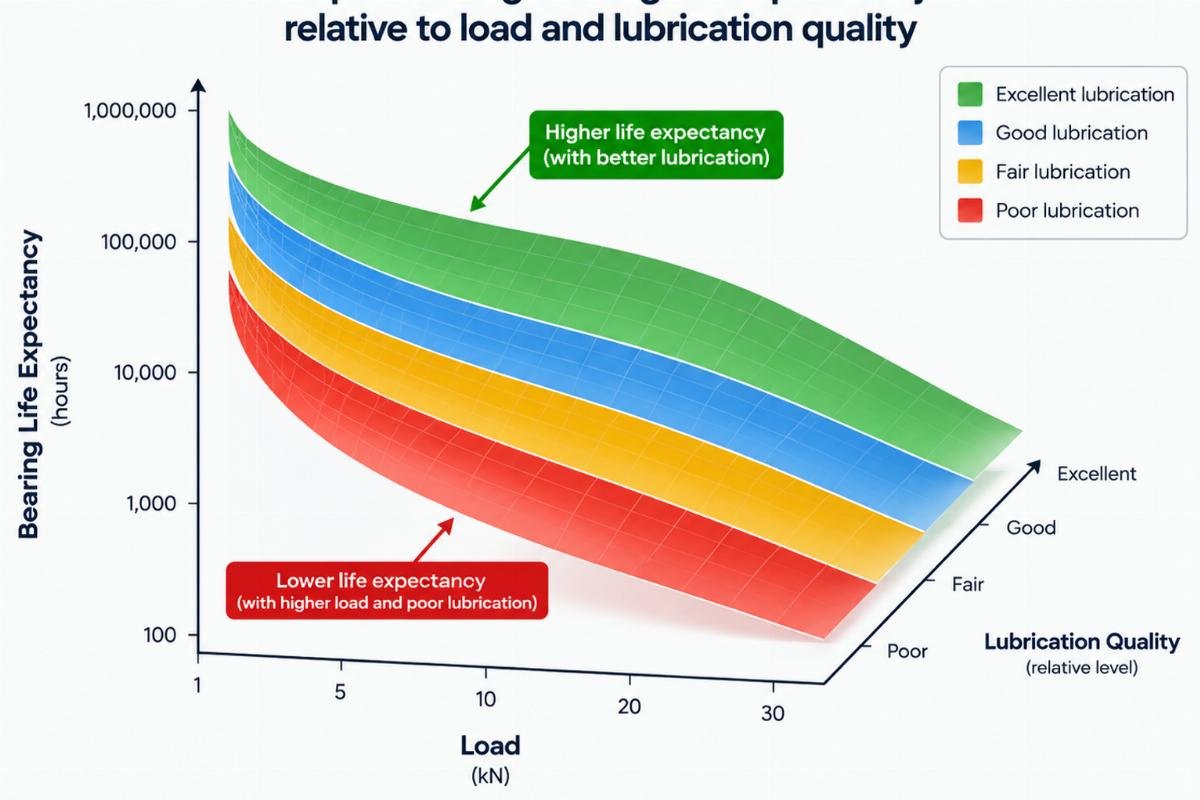
For large motors, the dynamic load rating helps calculate the expected L10 life. However, real-world conditions often deviate from ideal calculations. Contamination, misalignment, and improper lubrication are frequent culprits.
In a cross-brand replacement scenario for a mining crusher motor, a client switched from a premium European brand to a cost-effective Asian alternative. The 6316 bearing dimensions were identical, and the load ratings were comparable on paper. However, the cheaper bearing had less consistent grease filling and lower quality steel cleanliness. Within a year, vibration levels increased noticeably. This highlights that while 6316 bearing dimensions ensure fit, material quality and manufacturing consistency ensure performance. [NEED_CITE: ISO 15243 failure classification]
Always verify the traceability of the bearings. Genuine products come with batch numbers that link back to the manufacturer’s production facilities, ensuring that the stated load ratings and 6316 bearing dimensions are backed by rigorous quality control.
Conclusion
Correctly specifying a 6316 bearing requires balancing physical size with internal engineering parameters.
Focusing exclusively on 6316 bearing dimensions ignores the critical factors of thermal expansion and high-speed dynamics that define large motor performance. By selecting appropriate C3 or C4 clearances and durable cage materials, operators can prevent premature failures and extend equipment life. Reliable sourcing involves verifying these technical details alongside physical fitment to ensure long-term operational stability.
Tags

About the author
author
Editor covering global sourcing, supplier verification, and industrial product knowledge. Content is compiled from manufacturer specifications, industry standards, and hands-on experience with international B2B buyers. Every article is fact-checked before publishing to help procurement professionals make informed decisions.
More articles by author

