Biomass Boiler Bearings for Feed Screws & Fans: Wholesale Supplier
Standard bearings fail rapidly in biomass boilers due to heat and dust. Replace them with heavy-duty sealed spherical roller bearings for feed screws and fans to prevent catastrophic downtime. This engineering approach ensures operational stability and significantly reduces total cost of ownership.
 Written by
author
- Published on
- 7 min read
- Updated
Biomass Boiler Bearings for Feed Screws & Fans: Wholesale Supplier
Matching dimensions is not enough.
To prevent catastrophic downtime in biomass boilers, you must replace standard deep-groove ball bearings with heavy-duty sealed spherical roller bearings engineered for high thermal expansion and abrasive wood dust ingress.
I still recall the silence of a production line in Scandinavia that should have been roaring. The feed screw had seized. Again. We had supplied what looked like perfect replacements—standard deep-groove ball bearings that matched the shaft diameter and housing bore precisely. On paper, they were correct. In reality, they were doomed. The environment was brutal: extreme heat radiating from the combustion chamber and fine, abrasive wood dust penetrating every gap. Within weeks, the bearings failed. The thermal expansion locked the inner race, while the dust acted like grinding paste on the rolling elements. The result was not just a replaced part, but a complete line shutdown and a penalty claim that dwarfed the cost of the bearings themselves. That failure shifted my entire approach to selecting biomass boiler bearings. I no longer look at dimensions first; I look at the environment. [NEED_CITE: common failure modes in high-temperature abrasive environments per ISO 15243]
This experience is not unique. Across the industry, operators face the same harsh conditions. Whether you are managing a district heating plant or an industrial power station, the choice of bearing dictates your reliability. Let us break down why standard solutions fail and how to select the right components for your feed screws and fans.
Why Do Standard Bearings Fail in Biomass Boilers?
Standard bearings are designed for clean, moderate-temperature environments, not the hostile interior of a biomass boiler.
The core issue lies in two factors: thermal expansion and particle ingress. Most general-purpose deep-groove ball bearings use standard C3 clearance and light rubber seals. In a biomass boiler, the feed screw operates close to the combustion zone. As the temperature rises, the steel shaft expands. If the bearing clearance is insufficient, this expansion creates excessive preload. The rolling elements become overloaded, generating more heat, which leads to further expansion and eventual seizure. [NEED_CITE: thermal expansion coefficients of bearing steel vs shaft steel]
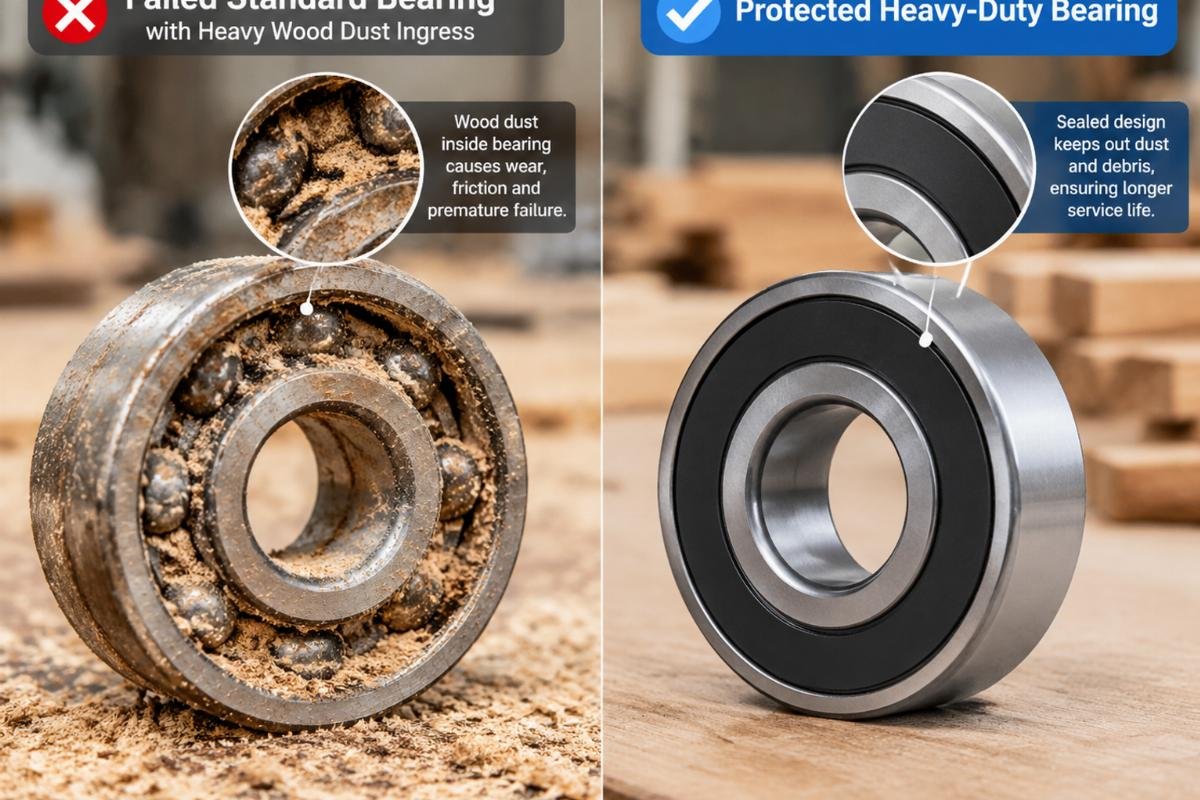
Simultaneously, biomass fuel produces fine, hard particulates. Wood dust, bark fragments, and ash are highly abrasive. Standard seals cannot withstand this constant bombardment. Once particles breach the seal, they mix with the lubricant, forming an abrasive slurry that accelerates wear on the raceways and balls. This is not a gradual degradation; it is a rapid destruction of the bearing geometry.
| Failure Factor | Standard Deep-Groove Ball Bearing | Heavy-Duty Spherical Roller Bearing |
|---|---|---|
| Thermal Handling | Vulnerable to preload from shaft expansion | Robust, accommodates misalignment and expansion |
| Sealing Capability | Basic contact seals, prone to dust ingress | Advanced labyrinth or heavy-duty seals for abrasive environments |
| Load Capacity | Limited radial load capacity | High radial load capacity for heavy feed screws |
| Lifespan in Biomass | Weeks to months | Extended service life meaningfully |
I have seen this pattern repeat in multiple regions. A client in Southeast Asia reported replacing fan bearings every few months. Upon inspection, we found the seals were torn, and the internal grease was black with carbon and dust. Switching to a bearing with a higher IP rating and robust sealing structure solved the issue. The key is recognizing that the environment dictates the specification, not just the load. [NEED_CITE: IP sealing ratings effectiveness in dusty industrial environments]
What is the Right Bearing for Feed Screws?
Heavy-duty spherical roller bearings with robust seals are the only viable solution for biomass feed screws.
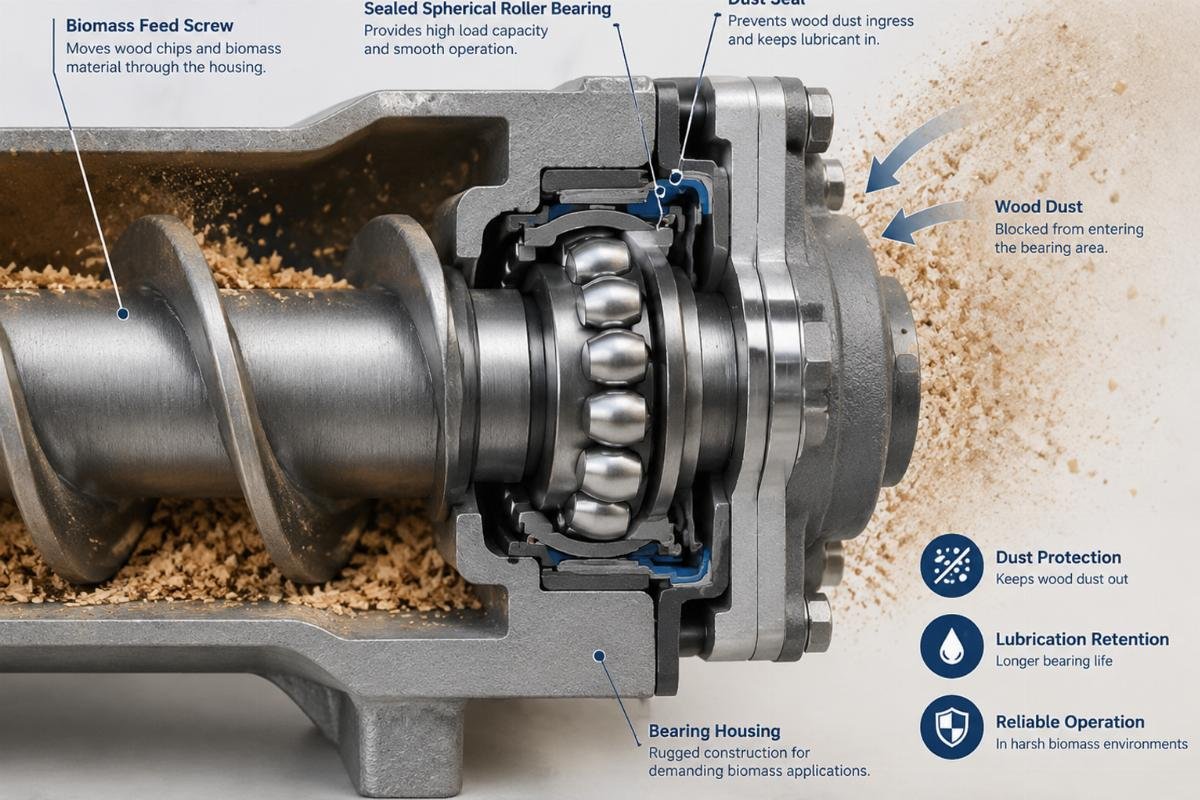
Feed screws operate under heavy radial loads and significant axial thrust. They also experience shaft deflection due to the weight of the fuel and thermal gradients. Standard ball bearings cannot accommodate this misalignment. When the shaft bends slightly, the balls edge-load, causing premature fatigue. Spherical roller bearings, however, have a curved outer raceway that allows the inner ring to tilt. This self-aligning feature compensates for shaft deflection and thermal expansion, preventing the destructive preload that seizes standard bearings.
The sealing system is equally critical. For biomass boiler bearings, you need seals that can resist abrasive particles without generating excessive friction heat. Look for bearings with heavy-duty contact seals or labyrinth designs that create a tortuous path for dust. Some applications benefit from additional external protection, such as flinger rings or positive pressure air seals, but the bearing itself must be the first line of defense. [NEED_CITE: load capacity calculations for feed screw applications]
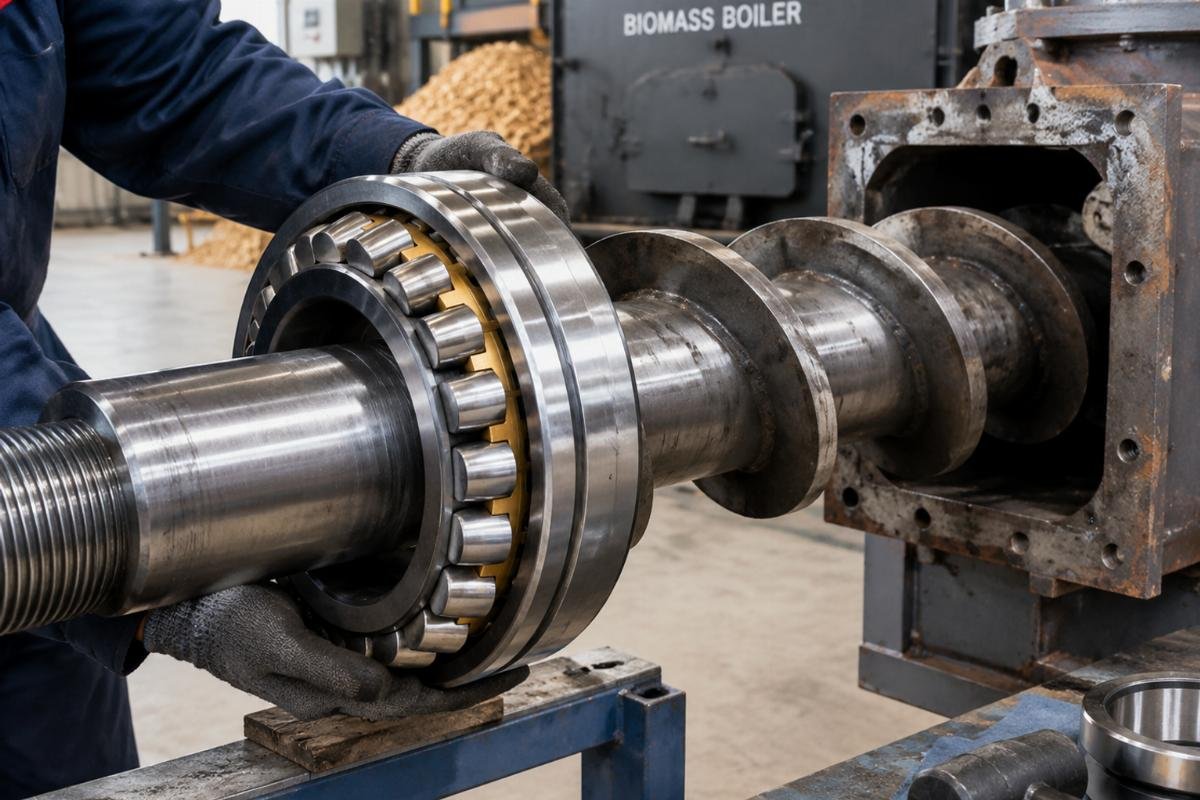
In a recent project for a European heating plant, we replaced the original equipment manufacturer’s standard units with premium brand spherical roller bearings featuring enhanced sealing. The difference was immediate. The vibration levels dropped, and the temperature stabilised. The client reported that the maintenance interval extended from monthly checks to quarterly inspections. This is not just about convenience; it is about operational stability. When sourcing these components, ensure you are getting genuine products with traceable documentation. Counterfeit or substandard seals will fail just as quickly as the wrong bearing type.
How to Select Bearings for Biomass Fans?
Match the bearing to the specific high-temperature and high-vibration operating environment of the fan.
Biomass fans, particularly induced draft fans, operate in hot, dirty air streams. They are subject to high vibration levels due to imbalance from ash buildup on the blades. The bearings must handle both the radial load from the fan wheel and the dynamic loads from vibration. Standard bearings often fail here due to fatigue spalling caused by these cyclic stresses.
When selecting biomass boiler bearings for fans, consider the following:
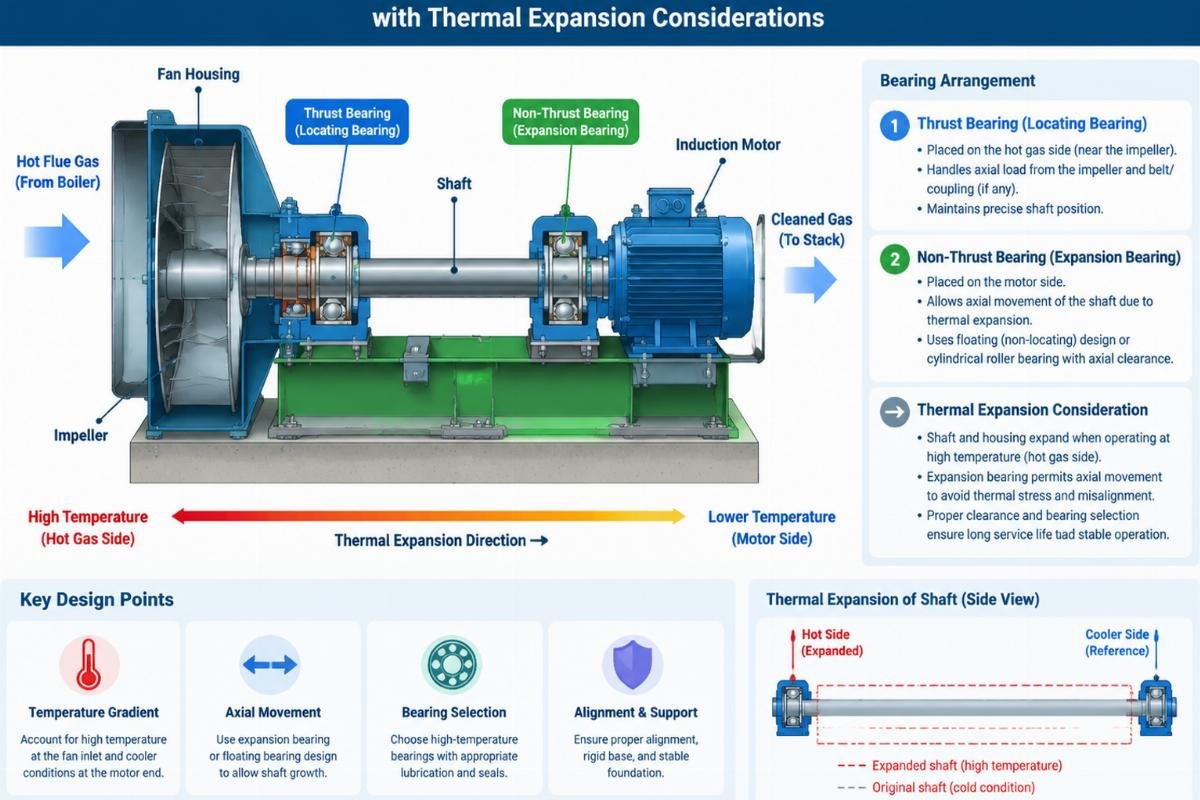
- Clearance: Use bearings with C3 or C4 clearance to accommodate thermal expansion of the shaft and housing. Standard clearance will lead to overheating.
- Cage Material: Steel cages are generally preferred over polymer cages in high-temperature applications, as polymers can degrade or soften. [NEED_CITE: material suitability for high-temperature bearing cages]
- Lubrication: Ensure the bearing is compatible with high-temperature grease. Some premium brands offer bearings pre-filled with specialized grease designed for harsh environments.
- Vibration Resistance: Look for bearings with optimized internal geometry that reduces stress concentrations under dynamic loads.
A case from a Middle East industrial facility illustrates this. Their fan bearings were failing frequently due to heat and vibration. We recommended switching to cylindrical roller bearings for the non-locating end, paired with spherical roller bearings for the locating end, all with high-temperature specifications. The combination handled the thermal growth and radial loads effectively. The fan ran substantially longer without intervention. This highlights the importance of a holistic approach: you are not just buying a bearing; you are buying a solution to a specific set of physical challenges.
What is the True Cost of Cheap Bearings?
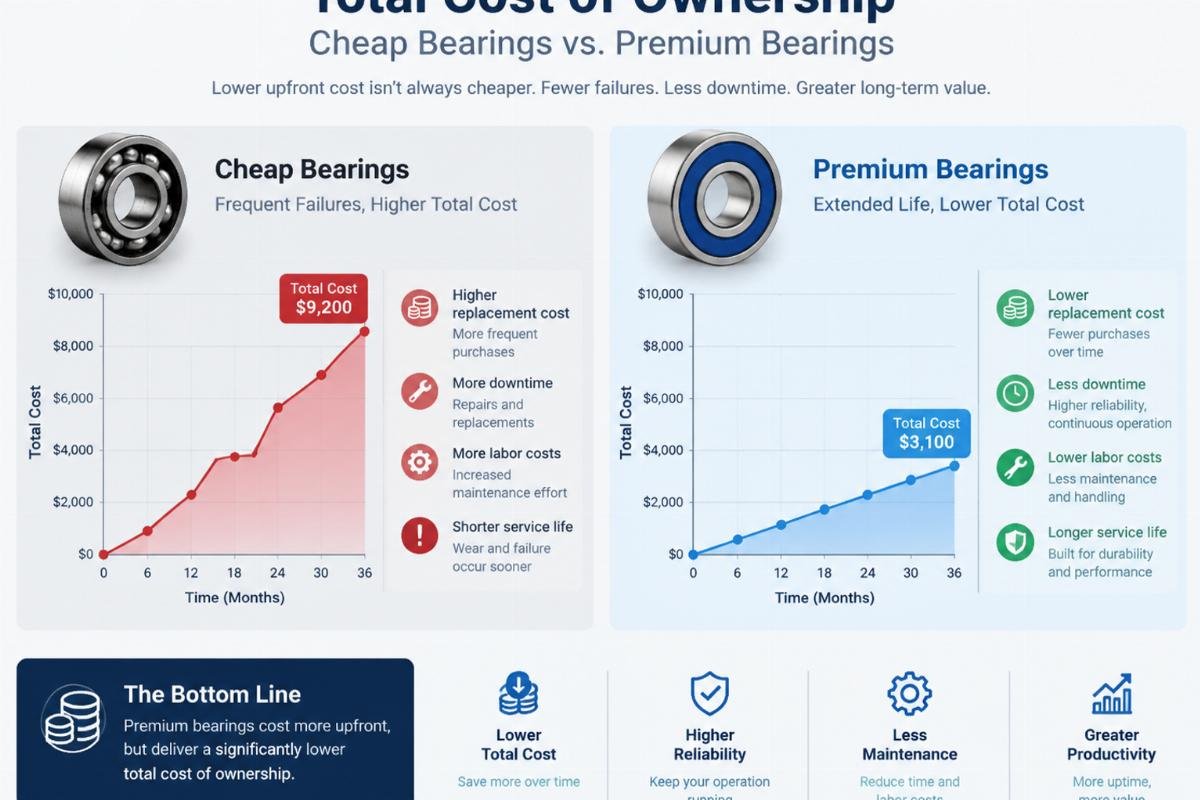
A cheap bearing that fails in a month costs ten times more than the right one upfront due to downtime.
It is tempting to opt for the lowest-priced bearing, especially when budgets are tight. However, in the context of biomass boiler bearings, this is a false economy. The cost of the bearing itself is a tiny fraction of the total cost of failure. Consider the expenses involved in a unplanned shutdown: labor for emergency repair, lost production revenue, potential penalty claims from customers, and the risk of secondary damage to the feed screw or fan assembly.
I once consulted for a plant where management insisted on using budget bearings to cut costs. Within six months, they experienced three major failures. Each shutdown cost them a mid-six-figure loss in penalties and lost energy sales. When we switched them to genuine, heavy-duty bearings from premium brands, the initial outlay was higher. But over the next two years, they had zero unplanned downtime related to bearings. The savings were enormous. [NEED_CITE: cost-benefit analysis of preventive maintenance vs reactive repair in industrial settings]
This is why I always advise buyers to look beyond the unit price. Evaluate the total cost of ownership. Genuine bearings from brands like SKF, FAG, NSK, or TIMKEN come with the assurance of quality control and material integrity. They are engineered to perform in harsh conditions. When you source from a reliable global supplier, you are also gaining access to technical support that can help you select the right specification initially, avoiding costly mistakes.
Conclusion
Selecting the right bearing is an engineering decision, not just a procurement task.
Standard bearings cannot survive the heat and abrasion of biomass boilers. By choosing heavy-duty sealed spherical roller bearings for feed screws and appropriately specified bearings for fans, you protect your operation from catastrophic failure. The upfront investment in quality pays for itself many times over in reduced downtime and maintenance costs. Ensure you source genuine products with full traceability to guarantee performance. Your production line depends on it.
Tags

About the author
author
Editor covering global sourcing, supplier verification, and industrial product knowledge. Content is compiled from manufacturer specifications, industry standards, and hands-on experience with international B2B buyers. Every article is fact-checked before publishing to help procurement professionals make informed decisions.
More articles by author

