Forestry Machine Bearing Maintenance Winter: Wholesale Supplier
Prevent winter downtime with proper Forestry Machine Bearing Maintenance in Winter by replacing standard lubricants with low-temperature synthetic greases. Swap conventional rubber seals for cold-resistant materials to avoid brittle fracture and ensure reliable operation in sub-zero conditions.
 Written by
author
- Published on
- 7 min read
- Updated
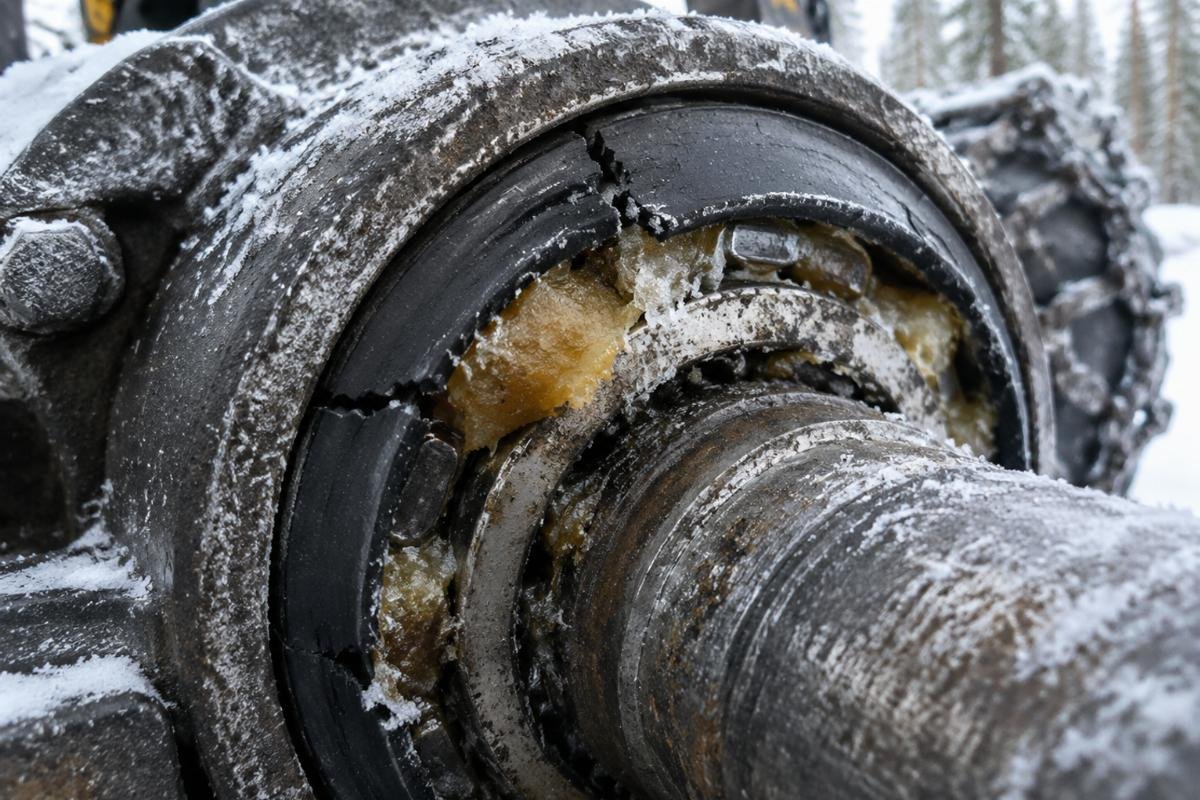
Forestry Machine Bearing Maintenance Winter: Wholesale Supplier
Thicker grease does not protect bearings better in winter; it causes starvation and seizure.
Effective forestry machine bearing maintenance in winter requires replacing standard lubricants with low-temperature synthetic greases and swapping conventional rubber seals for cold-resistant materials to prevent freezing and brittle fracture in sub-zero conditions.
I still remember the silence of a northern farm in Riyadh during a rare cold snap years ago. The sand barrier laying machines, usually roaring with activity, stood frozen. When we dismantled the slew bearings, the lubricant had solidified into a rock-hard mass, and the seals snapped like dry twigs under slight pressure. The decision to save costs by skipping low-temperature specifications resulted in weeks of downtime and penalties that far exceeded the initial savings. That incident reshaped my approach to sourcing. Now, when advising clients on forestry equipment, I start by asking for the lowest local winter temperature before discussing any other specification. This focus on environmental compatibility is critical because standard components fail not due to wear, but due to thermal contraction and material phase changes. [NEED_CITE: impact of low temperature on lubricant viscosity and seal elasticity]
Understanding these failure modes is the first step toward reliable operation. The following sections detail how to select appropriate materials and execute maintenance procedures that withstand harsh winter conditions.
Why Do Forestry Bearings Fail in Winter?
Standard greases and seals fail under sub-zero thermal contraction, leading to immediate mechanical lockup.
The primary cause of winter failure is not external load but internal resistance. As temperatures drop, the base oil in standard lithium-complex greases thickens exponentially. This increase in viscosity creates drag that the bearing cage cannot overcome, leading to grease starvation in the rolling element path. Simultaneously, standard nitrile rubber seals undergo a glass transition, losing their elasticity and becoming brittle. [NEED_CITE: glass transition temperature of common sealing elastomers]
When a harvester operates in freezing conditions, the slewing ring experiences significant thermal contraction. If the seal is brittle, it cracks under the stress of this contraction, allowing moisture ingress. Once water enters, it freezes, expanding and further damaging the raceway. This cycle of freeze-thaw accelerates corrosion and pitting, which are irreversible damage modes.
Many operators mistakenly believe that packing more grease provides a better barrier against cold. In reality, excessive grease increases churning heat during startup attempts, which can melt the outer layer while the core remains frozen, creating inconsistent lubrication films. This inconsistency leads to metal-to-metal contact and rapid wear. [NEED_CITE: effects of over-lubrication in low-temperature environments]

To prevent these failures, one must understand that winter maintenance is not about doing more, but about using materials designed for lower energy states. The right combination of low-viscosity base oils and flexible seal compounds ensures that the bearing remains compliant even when the ambient temperature plummets.
How to Select the Right Cold-Weather Lubricant?
Match grease dropping point and base oil viscosity to the lowest local winter temperature.
Selecting the correct lubricant involves analyzing two key parameters: the base oil viscosity at low temperatures and the grease’s structural stability. Standard industrial greases often use mineral oils that become too viscous below zero degrees Celsius. For winter operations, synthetic base oils such as polyalphaolefins (PAO) or esters are essential because they maintain fluidity at much lower temperatures. [NEED_CITE: viscosity-temperature characteristics of synthetic vs mineral base oils]
The table below compares the qualitative performance of different lubricant types in cold conditions:
| Lubricant Type | Low-Temp Fluidity | Seal Compatibility | Thermal Stability |
|---|---|---|---|
| Mineral Oil Based | Poor | Good | Moderate |
| PAO Synthetic | Excellent | Good | High |
| Ester Synthetic | Superior | Variable | High |
| Silicone Based | Good | Excellent | Low Load Capacity |
Note that while silicone greases offer excellent low-temperature performance, they often lack the load-carrying capacity required for heavy forestry machinery. Therefore, PAO-based synthetic greases are typically the preferred choice for slewing bearings and main shafts in harvesters. [NEED_CITE: load-carrying capacity of synthetic greases in heavy equipment]
Another critical factor is the dropping point, which indicates the temperature at which the grease structure collapses. While this is less relevant for extreme cold than viscosity, it ensures that if the bearing heats up during operation, the grease does not separate. A high dropping point combined with low-temperature fluidity provides a wide operating window.
When sourcing these lubricants, verify the technical data sheet for the kinematic viscosity at minus forty degrees Celsius. If this value is not provided, the grease is likely not suitable for severe winter conditions. [NEED_CITE: ISO standards for grease testing at low temperatures]

Choosing the right lubricant is only half the battle. The delivery system must also be capable of pumping this thicker fluid, requiring heated lines or specialized pumps in some cases. However, for most maintenance scenarios, selecting the correct grease type prevents the need for complex heating systems.
What Are the Step-by-Step Winter Maintenance Procedures?
Purge old grease, inspect seal brittleness, and apply low-temp grease correctly.
Proper maintenance execution is as important as material selection. A systematic approach ensures that no residual summer grease compromises the new low-temperature lubricant. The following steps outline a robust winterization procedure.
- Clean and Purge: Remove all old grease from the bearing housing. Residual mineral-based grease will mix with the new synthetic grease, potentially raising the overall viscosity and negating the benefits of the upgrade. Use a solvent compatible with the seal material to clean the raceways. [NEED_CITE: compatibility issues between mixed grease types]
- Inspect Seals: Check existing seals for signs of hardening or cracking. Press the seal lip with a fingernail; if it does not rebound immediately, it has exceeded its glass transition temperature and must be replaced. Do not attempt to reuse brittle seals, as they will leak upon installation.
- Apply New Grease: Fill the bearing cavity with the selected low-temperature synthetic grease. Avoid overfilling. For sealed bearings, ensure the grease is compatible with the seal material to prevent swelling or shrinkage.
- Run-In Procedure: Start the machine at low speed and no load. Allow the bearing to rotate for several minutes to distribute the grease evenly. Monitor for unusual noise or vibration, which may indicate incomplete purging or seal interference.
A common mistake during this process is ignoring the purge volume. Calculating the correct amount of grease to purge ensures that old contaminants are fully removed. [NEED_CITE: calculation methods for grease purge volume]
In one case, a European forestry operator skipped the purging step, assuming the new grease would push out the old. The mixture created a sludge that clogged the relief valves, leading to pressure buildup and seal blowout within days. Proper purging is non-negotiable.

Following these steps meticulously ensures that the bearing system is prepared for the thermal stresses of winter. It transforms maintenance from a reactive repair task into a proactive reliability strategy.
How to Verify Seal and Bearing Quality Before Winter?
Check material certifications and traceability documents for cold-resistant specs.
Verification is the final safeguard against winter failures. Not all bearings labeled as “industrial grade” are suitable for sub-zero operations. The key lies in the documentation. Genuine manufacturers provide material certificates that specify the steel cleanliness and heat treatment processes, which affect toughness at low temperatures. [NEED_CITE: importance of steel cleanliness for bearing fatigue life]
For seals, request the compound specification. Look for materials such as hydrogenated nitrile butadiene rubber (HNBR) or fluorocarbon elastomers (FKM), which offer superior low-temperature flexibility compared to standard NBR. The supplier should provide data on the glass transition temperature of the seal material.
When sourcing from a global partner, traceability is crucial. Ensure that each batch comes with full documentation linking it to the original manufacturer’s production records. This verifies that the components have not been substituted with inferior equivalents during distribution. [NEED_CITE: supply chain traceability standards for industrial components]
We support our clients by providing genuine low-temperature bearings and seals from premium brands, complete with cross-brand consultation and full traceability documentation. This ensures that every component meets the specific cold-weather requirements of the application, eliminating the risk of counterfeit or misgraded parts.

By verifying these details before installation, you eliminate the uncertainty that leads to costly downtime. It confirms that the physical components match the theoretical specifications required for winter survival.
Conclusion
Winter bearing failure is preventable with the right materials and methods.
Forestry machine bearing maintenance in winter demands a shift from standard practices to specialized low-temperature solutions. By selecting synthetic lubricants, replacing brittle seals, and rigorously verifying component quality, operators can ensure continuous operation despite harsh conditions. Trust in documented specifications and proven maintenance protocols to keep your equipment running when the temperature drops.
Tags

About the author
author
Editor covering global sourcing, supplier verification, and industrial product knowledge. Content is compiled from manufacturer specifications, industry standards, and hands-on experience with international B2B buyers. Every article is fact-checked before publishing to help procurement professionals make informed decisions.
More articles by author

