NU 2220 Bearing Specs & Gearbox Applications Wholesale Supplier
Selecting the right NU 2220 bearing for gearboxes requires more than matching standard dimensions. Prevent thermal seizure by upgrading to C3 or C4 clearance and specifying machined brass cages for shock loads. Ensure reliability in high temperature applications with verified specifications.
 Written by
author
- Published on
- 8 min read
- Updated
NU 2220 Bearing Specs & Gearbox Applications Wholesale Supplier
A standard clearance NU 2220 bearing will fail in a hot-running gearbox not because of poor quality, but because thermal expansion eliminates the internal gap.
The core specification for an NU 2220 cylindrical roller bearing is a 100 mm bore, 180 mm outer diameter, and 46 mm width. However, reliable operation in heavy-duty gearboxes requires selecting C3 or C4 internal clearance to accommodate thermal expansion, paired with a machined brass cage to withstand shock loads. Standard clearance units are suitable only for ambient temperature applications with light loads.
I still remember the humidity in the palm oil mill in Sumatra. The air was thick enough to drink. A maintenance manager there swapped out a failed reducer bearing with a cheap, standard-clearance unit he found in local stock. It fit perfectly. The dimensions were correct. But within months, the inner race expanded due to the high operating temperature and tight shaft fit, locking the rollers solid. The entire pressing line halted. That shutdown cost far more than the price difference between a standard bearing and one engineered for heat. [NEED_CITE: thermal expansion effects on bearing internal clearance] This incident reshaped how I view technical data sheets. Dimensions are just the entry ticket. The real engineering happens in the details of clearance and cage material.
Understanding why these failures happen requires looking beyond the part number. Let us break down the specifications and application realities that determine whether a NU 2220 bearing survives its first year or fails in weeks.
What Are the Core Specifications of NU 2220 Bearings?
The NU 2220 is defined by its cylindrical roller design, which allows for high radial load capacity but zero axial load support.
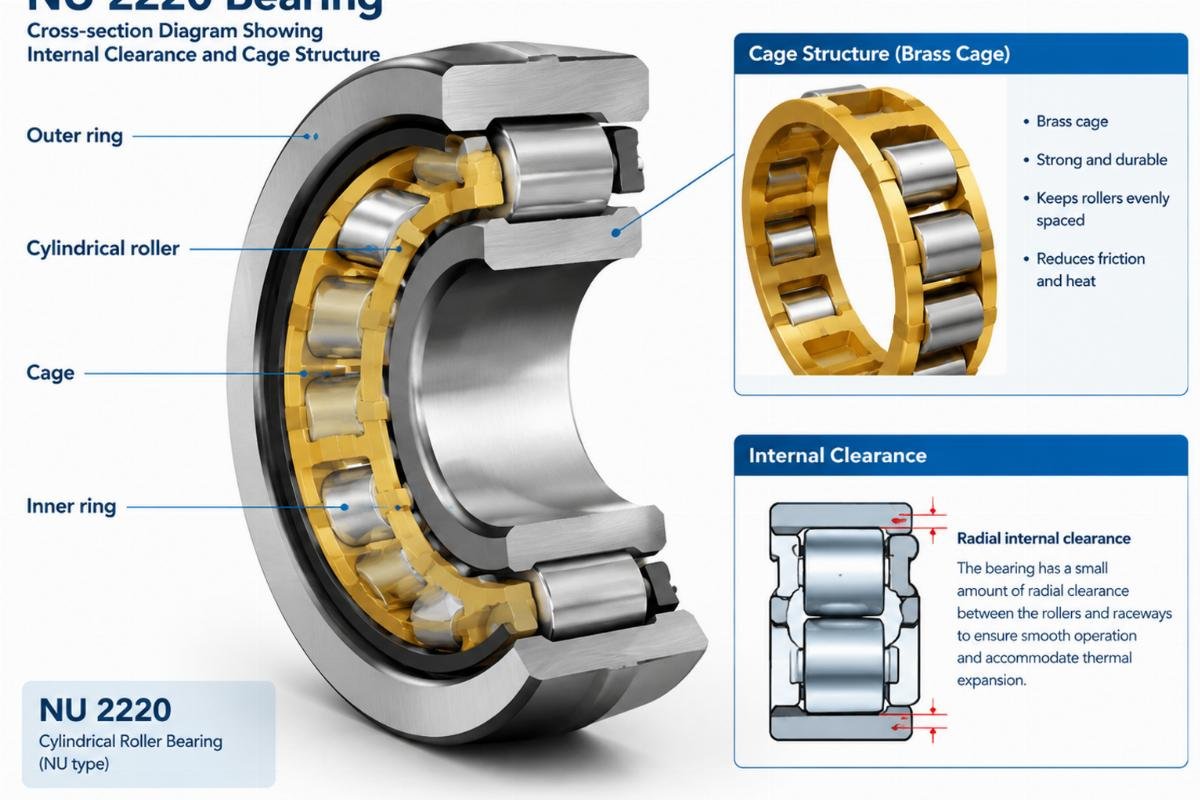
When procurement teams request a NU 2220, they are asking for a specific geometric envelope. The bore is 100 mm, the outside diameter is 180 mm, and the width is 46 mm. These dimensions are standardized globally under ISO norms. [NEED_CITE: ISO standards for cylindrical roller bearing dimensions] The “NU” designation is critical. It means the outer ring has two integral flanges, while the inner ring has no flanges. This design allows the inner ring and roller assembly to be installed separately from the outer ring. It also means the bearing can accommodate slight misalignment during installation, but it cannot sustain any axial force.
| Parameter | Specification Detail | Application Note |
|---|---|---|
| Bore Diameter | 100 mm | Standard shaft fit required |
| Outer Diameter | 180 mm | Housing bore tolerance critical |
| Width | 46 mm | Determines axial space in housing |
| Cage Type | Machined Brass or Steel | Brass preferred for high speed/shock |
| Clearance Class | C0 (Standard), C3, C4 | C3/C4 needed for high temp/gearboxes |
| Load Capacity | High Radial, Zero Axial | Must pair with angular contact bearing if axial load exists |
The basic dynamic load rating for this size class is substantial, allowing it to handle the heavy radial forces generated by gear teeth meshing. However, the static load rating is equally important during startup and shutdown phases when the oil film is not fully established. [NEED_CITE: calculation methods for bearing static safety factor] Many buyers focus solely on the dynamic rating, ignoring that gearbox failures often occur during transient states.
A common mistake is assuming all NU 2220 bearings are identical across brands. While the dimensions are standardized, the internal geometry—such as roller profile and cage guidance—varies. Premium manufacturers use optimized roller end profiles to reduce stress concentration. [NEED_CITE: impact of roller end profile on bearing fatigue life] This is not visible from the outside but significantly affects service life under fluctuating loads.
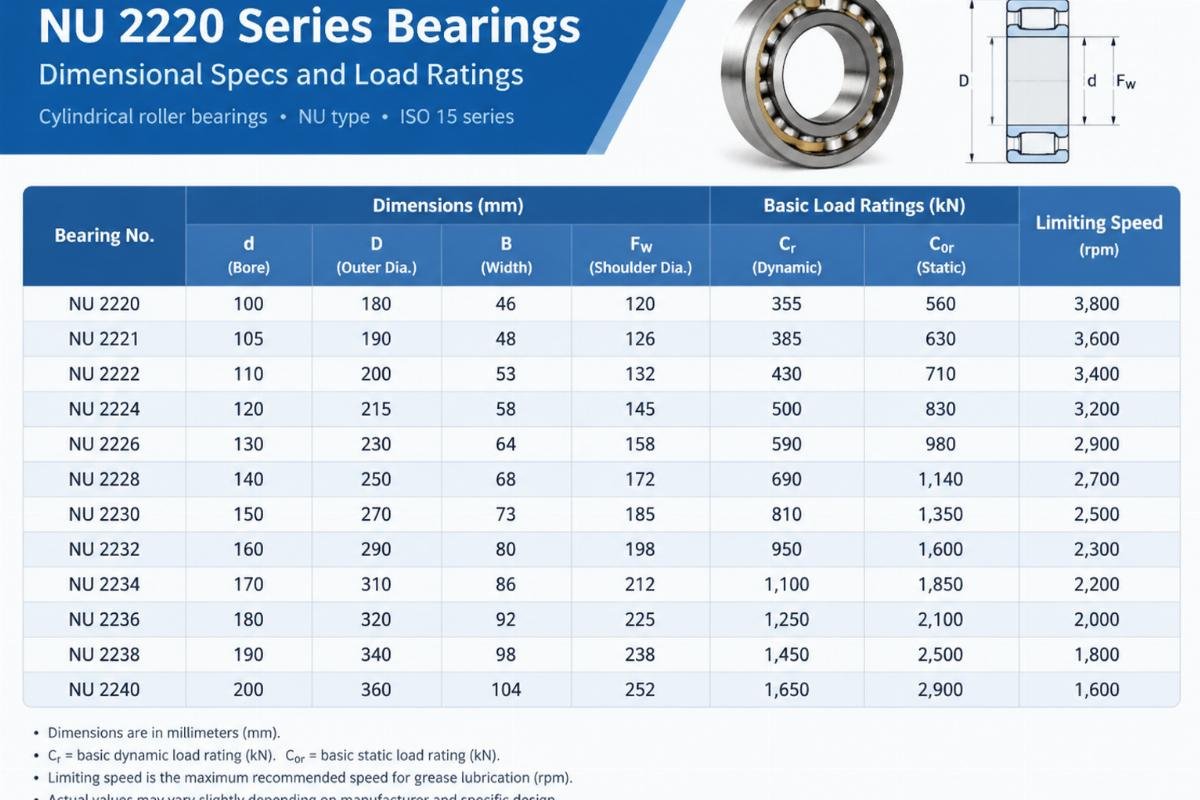
For a NU 2220 bearing wholesale supplier, providing the correct datasheet is only the first step. The buyer must understand that these numbers assume ideal conditions. Real-world gearboxes are rarely ideal.
Why Do NU 2220 Bearings Fail in Gearboxes?
Most premature failures in gearboxes are not due to material defects but to mismatched internal clearance and inadequate cage strength.
Gearboxes are harsh environments. They generate heat, vibration, and shock loads. A standard clearance (C0) NU 2220 bearing operates with a small internal gap. As the gearbox runs, the inner ring heats up and expands. If the bearing is mounted on a steel shaft with an interference fit, the shaft also expands, further reducing the internal clearance. In tropical climates or high-load applications, this thermal expansion can eliminate the clearance entirely. The rollers become preloaded, generating excessive heat, which leads to rapid seizure. [NEED_CITE: relationship between operating temperature and bearing clearance loss]
I have seen this pattern repeatedly in mining crushers and industrial reducers. The bearing looks fine upon removal, except for the discoloration indicating overheating. The root cause was never the brand. It was the clearance class.
Another frequent failure mode involves the cage. Standard NU 2220 bearings often come with stamped steel cages. These are cost-effective and sufficient for steady, moderate speeds. However, in gearboxes subject to frequent start-stop cycles or shock loads from uneven material feed, stamped steel cages can fatigue and crack. Once the cage fails, the rollers lose their spacing, collide, and destroy the bearing races. Machined brass cages offer superior strength and better emergency lubrication properties due to the material’s lower friction coefficient. [NEED_CITE: comparative performance of steel vs brass bearing cages]
| Failure Mode | Primary Cause | Visual Indicator |
|---|---|---|
| Thermal Seizure | Insufficient clearance (C0 used in hot env) | Blue/brown discoloration on rollers |
| Cage Fracture | Shock loads on stamped steel cage | Broken cage pieces, scattered rollers |
| Smearing | Poor lubrication or sliding | Surface material transfer on raceways |
| Fatigue Spalling | Normal end-of-life or overload | Pitting on raceway surfaces |
A European wind farm operator once reported repeated failures in their gearbox intermediate shafts. They were using standard clearance bearings. After switching to C3 clearance units with machined brass cages, the mean time between failures increased noticeably. The change did not involve a different brand, just a different specification within the same part number family.
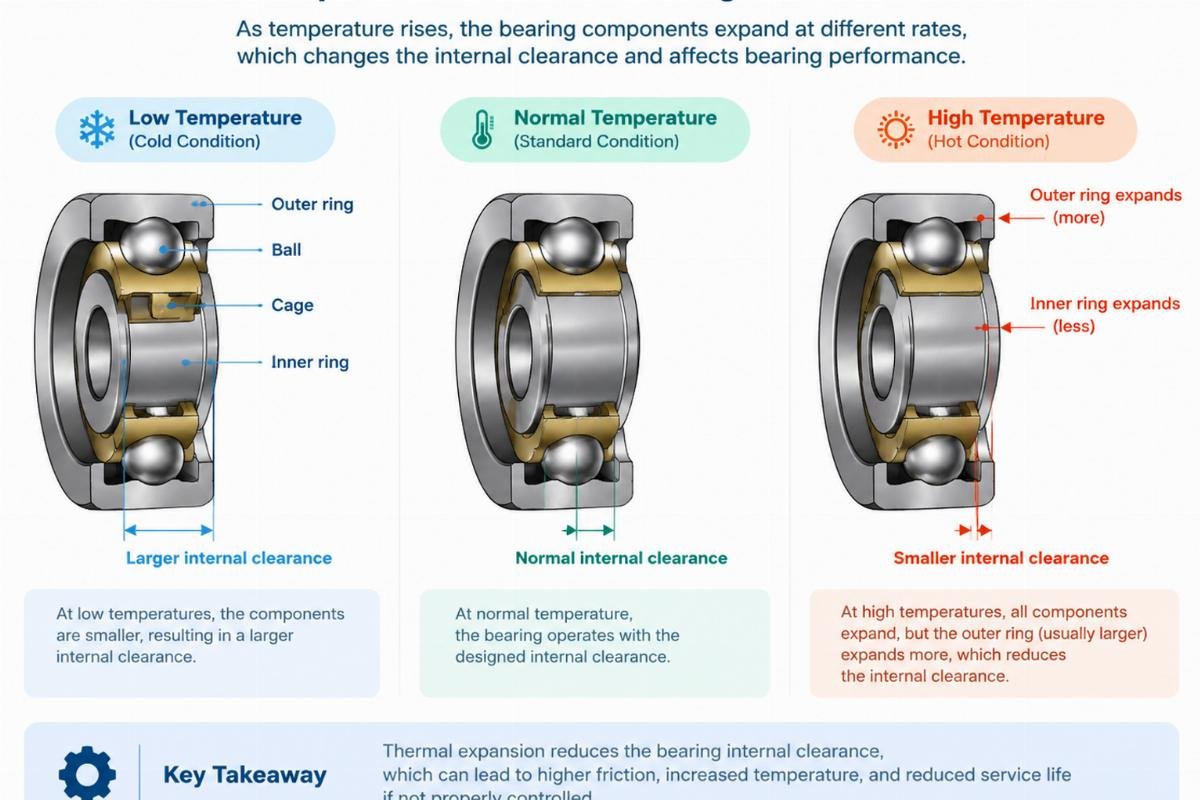
Understanding these failure modes helps buyers avoid costly downtime. It shifts the focus from price per unit to cost per operating hour.
How to Select the Right NU 2220 for Your Reducer?
Selecting the correct NU 2220 requires calculating the operating temperature rise and matching the cage material to the load profile.
Do not simply order a NU 2220. Order a NU 2220/C3 or NU 2220/C4 if your gearbox operates above ambient temperatures or has tight shaft fits. The choice between C3 and C4 depends on the expected temperature differential. For most industrial gearboxes running at elevated temperatures, C3 is the safe baseline. For very high temperatures or large shaft diameters, C4 may be necessary. [NEED_CITE: guidelines for selecting bearing clearance based on temperature]
The selection process should follow these steps:
- Assess Operating Temperature: Estimate the inner ring temperature during operation. If it exceeds 70°C above ambient, standard clearance is risky.
- Evaluate Shaft Fit: Interference fits reduce internal clearance. Calculate the reduction caused by the fit and subtract it from the initial clearance.
- Analyze Load Type: If the gearbox experiences shock loads or high acceleration, specify a machined brass cage. Avoid stamped steel cages in these conditions.
- Check Lubrication: Ensure the grease or oil viscosity is appropriate for the operating speed and temperature. Poor lubrication accelerates wear regardless of bearing quality.
A Middle East steel mill faced continuous failures in their rolling mill reducers. They were using standard clearance bearings with stamped steel cages. The combination of high ambient heat, heavy loads, and shock from the rolling process was too much. Switching to C3 clearance bearings with machined brass cages resolved the issue. The upfront cost was higher, but the reduction in unplanned downtime paid for the difference many times over.
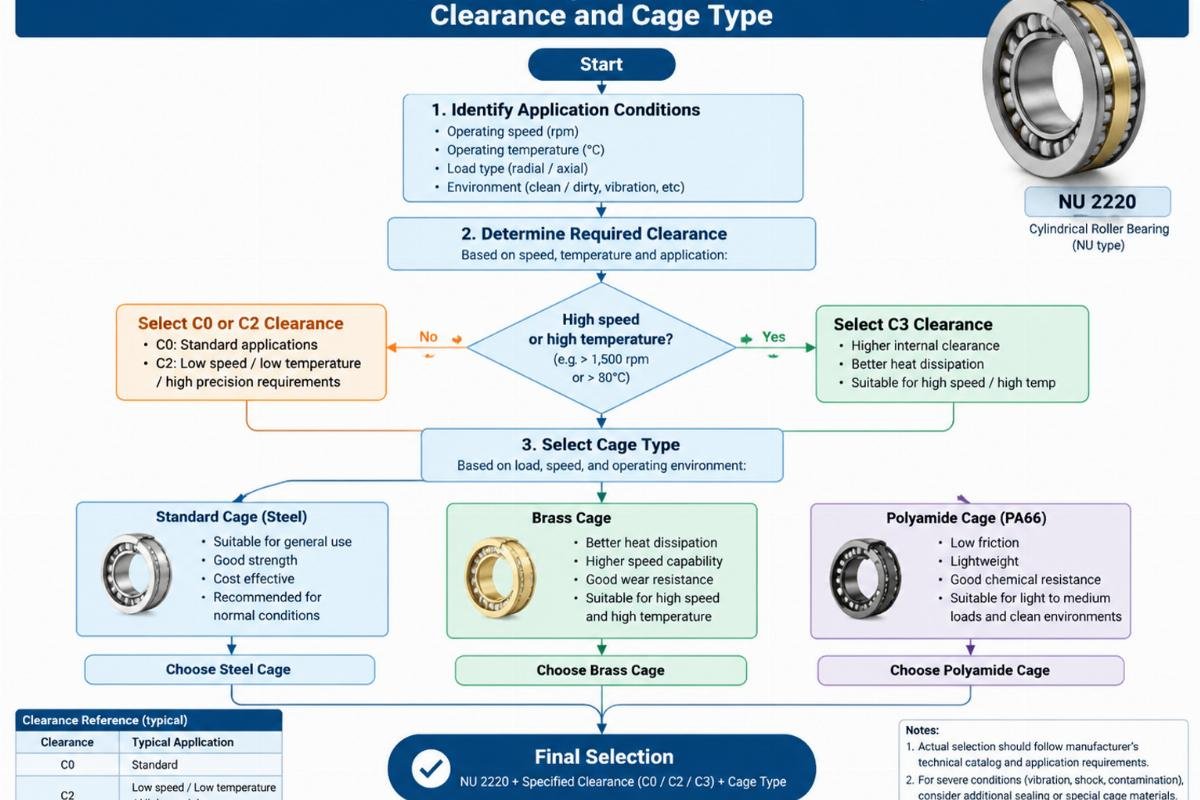
When sourcing from a NU 2220 bearing wholesale supplier, ask for the specific clearance class and cage material. Do not assume. Verify these details on the packaging and the certificate of conformity.
Genuine vs. Substandard: How to Verify Quality?
Counterfeit or substandard NU 2220 bearings often look identical to genuine ones but fail due to poor steel purity and inconsistent heat treatment.
The market is flooded with bearings that carry famous brand logos but lack the metallurgical quality. These units may pass initial dimensional checks but fail prematurely under load. The difference lies in the steel cleanliness and heat treatment consistency. Premium brands use vacuum-degassed steel with low inclusion content, which resists fatigue cracking. [NEED_CITE: impact of steel cleanliness on bearing fatigue life] Substandard units often use cheaper steel with higher impurity levels, leading to early spalling.
Verifying authenticity requires more than checking the logo. Look for:
- Traceability Codes: Genuine bearings have laser-etched codes that can be traced back to the production batch.
- Packaging Quality: Authentic packaging uses high-quality materials with precise printing. Counterfeit boxes often have blurry text or poor glue joints.
- Surface Finish: Genuine bearings have a smooth, uniform finish. Substandard units may show tool marks or uneven grinding patterns.
- Cage Precision: Machined brass cages in genuine bearings have precise, smooth edges. Counterfeit cages may have rough edges or inconsistent dimensions.
A buyer in Southeast Asia purchased a batch of NU 2220 bearings at a significantly lower price. They looked perfect. However, within months, multiple units failed due to raceway spalling. Laboratory analysis revealed high inclusion content in the steel, confirming they were not genuine. The savings on purchase price were negligible compared to the cost of replacing the damaged gearbox components.

Working with a reputable NU 2220 bearing wholesale supplier who provides full documentation and traceability is the best defense against counterfeits. Do not compromise on verification for critical applications.
Conclusion
Correct specification matters more than brand name alone for NU 2220 bearing reliability.
Success in gearbox applications depends on matching internal clearance to thermal conditions and selecting robust cage materials for shock loads. Buyers must look beyond dimensions to ensure operational longevity. Partnering with a knowledgeable supplier ensures these technical nuances are addressed before installation.
Tags

About the author
author
Editor covering global sourcing, supplier verification, and industrial product knowledge. Content is compiled from manufacturer specifications, industry standards, and hands-on experience with international B2B buyers. Every article is fact-checked before publishing to help procurement professionals make informed decisions.
More articles by author

