Spherical Roller Bearings: Premium vs Value for Mills Wholesale Supplier
Choosing between premium and value spherical roller bearings for mills requires balancing unit price against total cost of ownership. Critical applications demand premium metallurgy to prevent costly downtime, while auxiliary systems can safely use value brands. Implement a mixed-brand strategy to optimize procurement budgets without compromising production reliability.
 Written by
author
- Published on
- 7 min read
- Updated

Spherical Roller Bearings: Premium vs Value for Mills Wholesale Supplier
The cheapest bearing on the invoice is often the most expensive component in your annual maintenance budget.
Choosing between premium and value spherical roller bearings for steel mills is not a decision based on unit price, but on total cost of ownership driven by harsh operating conditions and the catastrophic financial impact of unplanned downtime. While value brands offer immediate procurement savings, they frequently lack the material purity and heat treatment consistency required to survive thermal shock in critical applications like continuous casters, leading to premature cage failure that costs multiples of the initial price difference in emergency logistics and lost production.
Having managed warehouse operations and order fulfillment from a bustling industrial hub in Dongguan, I have seen the direct consequences of mismatched bearing selection. Early in my career, I facilitated a shipment of domestic alternative spherical roller bearings to a steel plant in Turkey. The client opted for a cost-effective solution for the fan section of their continuous caster, prioritizing upfront savings. Within months, the high-temperature environment caused the cages in these value-brand units to fracture. The resulting stoppage forced them to air-freight original equipment manufacturer replacements at a cost that dwarfed the entire initial order value. This incident was not merely a supply chain hiccup; it was a stark lesson in how the distinction between premium and value options is defined by survival under extreme load, not just catalog specifications.
What Really Drives the Price Gap in Mill Bearings?
Material purity and heat treatment consistency dictate extreme load survival, not just brand premiums.
The visible price difference between global premium brands and reliable domestic lines often confuses buyers who assume they are paying for a logo. In reality, the gap reflects fundamental differences in metallurgical engineering. Premium manufacturers invest heavily in vacuum degassing processes that significantly reduce non-metallic inclusions in the steel. These microscopic impurities act as stress concentrators under the heavy radial and axial loads typical in mill environments. When a bearing rotates under such stress, an inclusion can initiate a subsurface crack that leads to spalling long before the rated L10 life is reached [NEED_CITE: influence of steel cleanliness on bearing fatigue life].
Heat treatment is another critical differentiator. Consistent hardening ensures that the raceways and rolling elements maintain their dimensional stability even when subjected to the thermal cycling common in steel production. Value brands may meet basic hardness standards, but batch-to-batch variability can result in soft spots or excessive brittleness. This inconsistency is rarely visible during incoming inspection but becomes apparent under operational stress. For a mills wholesale supplier, understanding these invisible quality markers is essential when advising clients who operate in unforgiving conditions.
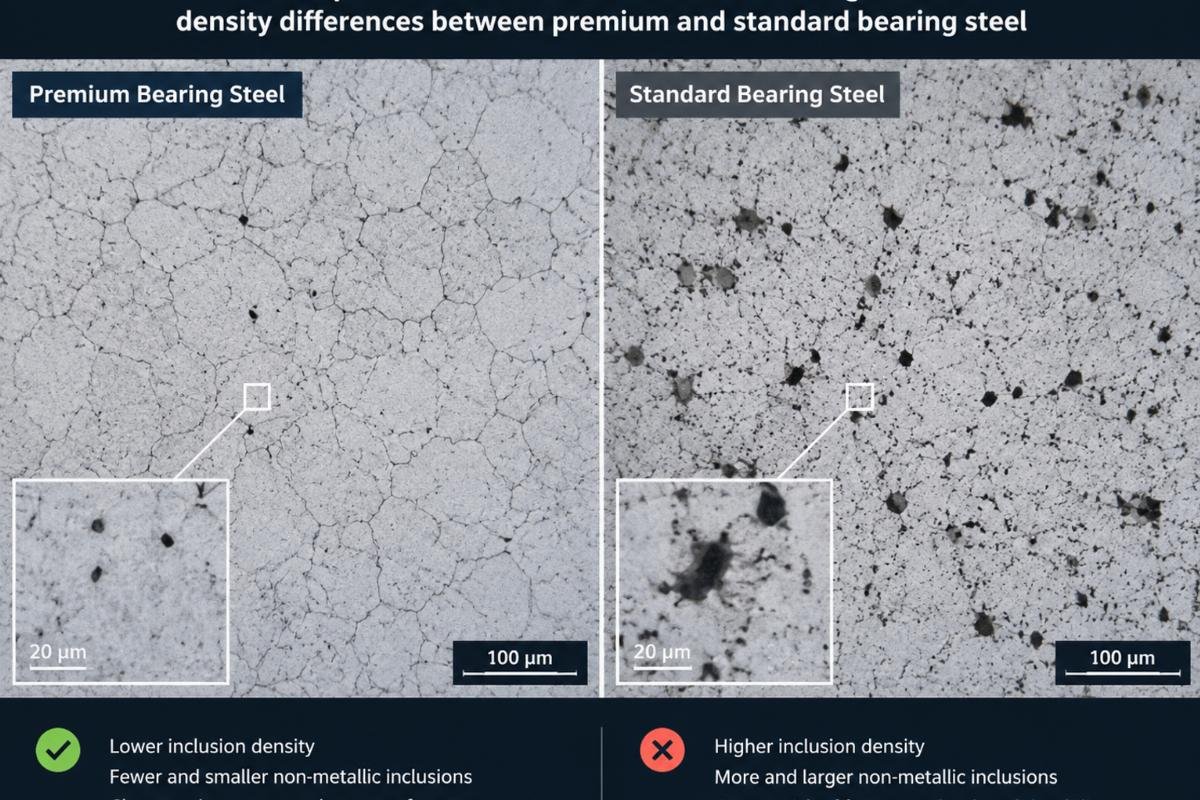
The manufacturing precision also plays a role. While both categories may claim compliance with ISO standards, premium brands often hold tighter internal tolerances for geometric accuracy. This reduces internal friction and heat generation, which is vital for maintaining lubricant integrity in sealed or semi-sealed applications. When evaluating spherical roller bearings, buyers must look beyond the part number and consider the metallurgical pedigree that supports it.
How Do Value Brands Perform Under Extreme Mill Conditions?
Standard value brands fail prematurely in high-thermal-shock zones like continuous casters.
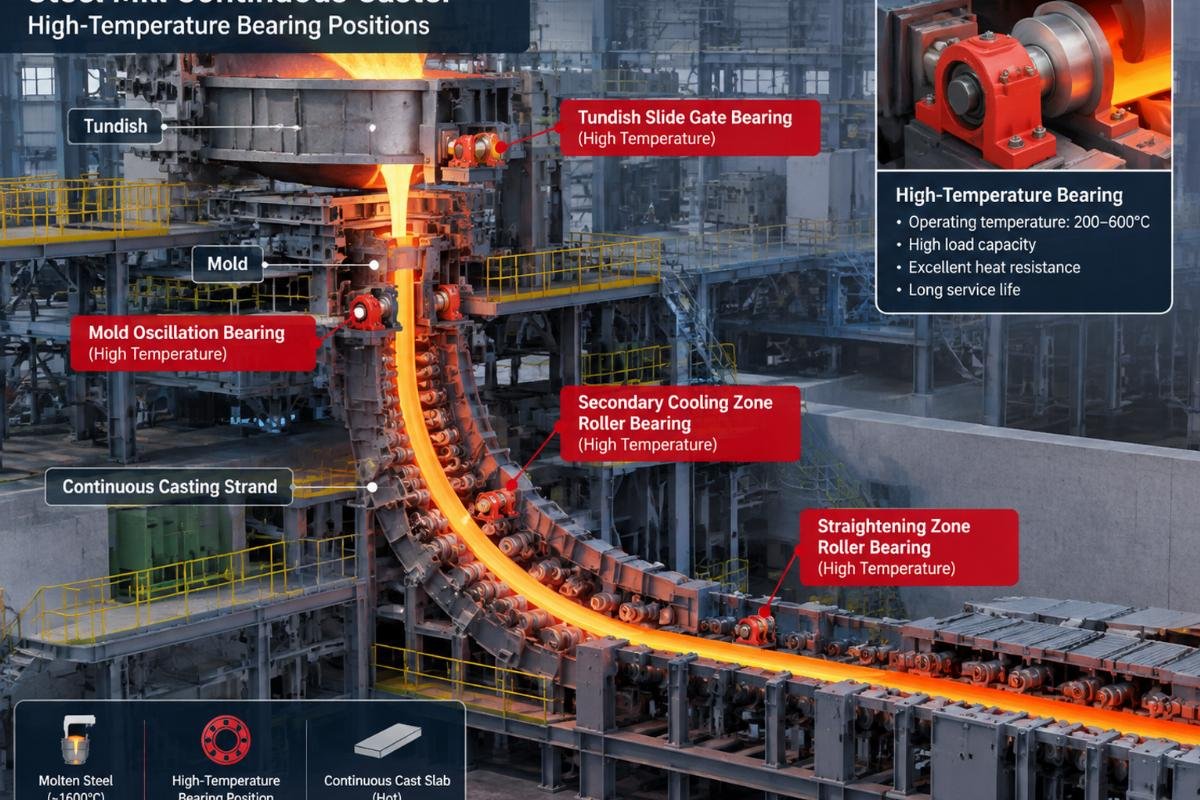
Not all applications within a steel mill are created equal. The environment inside a continuous caster’s fan section or main drive subjects bearings to severe thermal shock, heavy contamination, and constant vibration. In these zones, the structural integrity of the cage becomes the weak link. Many value brands utilize stamped steel cages that are sufficient for moderate loads but lack the robustness required for high-speed, high-temperature operations. When exposed to sudden temperature changes, these cages can expand unevenly or lose tensile strength, leading to catastrophic fragmentation.
I recall a case where a regional distributor supplied value-brand spherical roller bearings for a main drive application in a Southeast Asian mill. The bearings performed adequately for a short period, but the combination of heavy load and inadequate heat resistance led to rapid cage wear. The resulting debris contaminated the lubricant, accelerating damage to the rollers and raceways. This type of failure is not uncommon when the operational envelope exceeds the design limits of cost-optimized components [NEED_CITE: failure modes of bearing cages under thermal stress].
| Application Zone | Load Profile | Thermal Condition | Recommended Bearing Tier |
|---|---|---|---|
| Continuous Caster Main Drive | Extreme | High Thermal Shock | Premium |
| Reheating Furnace Rollers | Heavy | Extreme Heat | Premium |
| Primary Crusher | Heavy | Moderate | Premium/High-End Value |
| Auxiliary Conveyors | Light/Moderate | Ambient | Value |
| Cooling Bed Rollers | Moderate | Variable | Value/Premium Mix |
In contrast, auxiliary systems such as non-critical conveyors or low-load rollers operate in more stable environments. Here, value brands can perform reliably for extended periods, offering a viable opportunity to optimize procurement budgets without compromising overall plant reliability. The key is mapping the criticality of each application against the performance capabilities of the bearing tier.
How to Calculate the True Cost of Bearing Failure?
TCO models prove that emergency freight and lost production dwarf initial procurement savings.
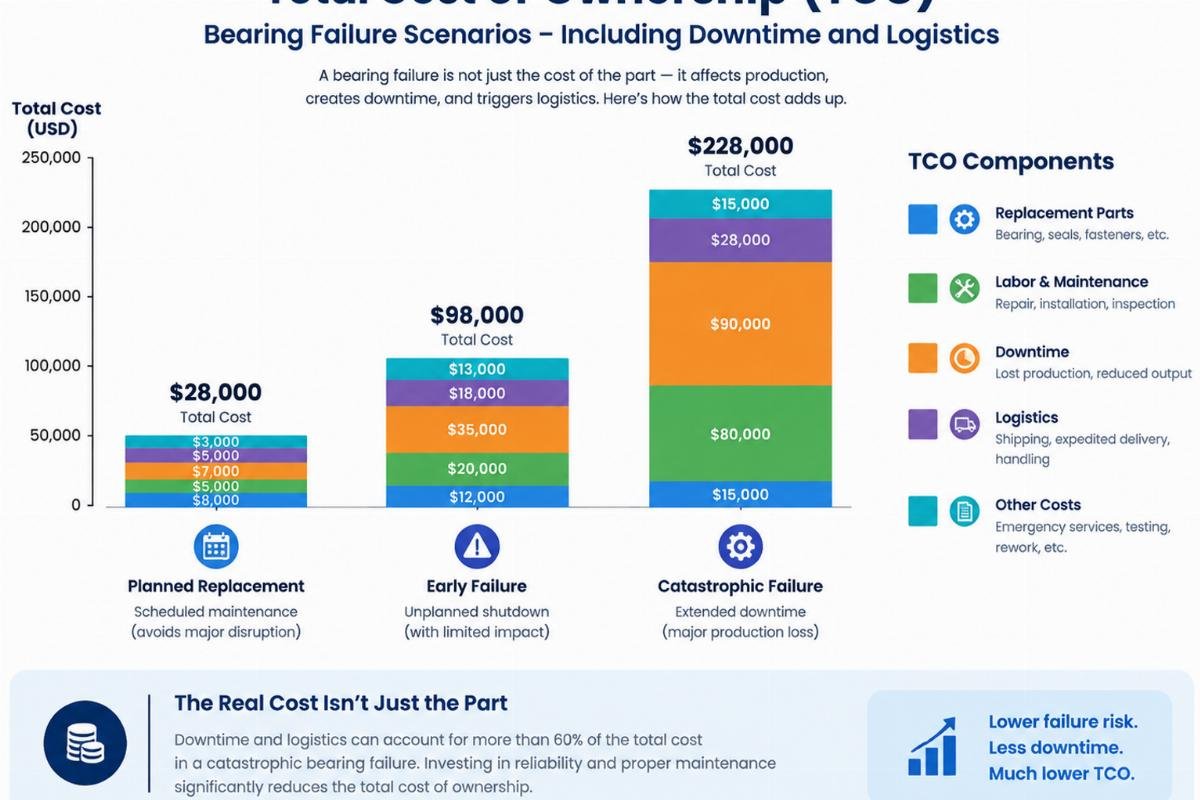
Procurement decisions often focus on the purchase order value, ignoring the downstream costs associated with failure. A comprehensive Total Cost of Ownership (TCO) analysis reveals that the initial price of a bearing is a minor fraction of its lifecycle cost. When a critical bearing fails unexpectedly, the immediate expense includes the replacement unit, but the hidden costs are far more significant. Emergency air freight can multiply the logistics cost by a factor of ten or more compared to standard sea shipping. Furthermore, the loss of production during unplanned downtime can amount to a mid-six-figure loss per day for large integrated mills.
Consider the scenario of a mill operator who saved a small percentage by choosing a value brand for a critical fan assembly. When the bearing failed, the plant had to halt production while waiting for a replacement. The cost of the expedited shipping, combined with the lost tonnage of steel production, resulted in a financial impact that was many times higher than the savings achieved on the initial purchase. This reality underscores why downtime risk must be quantified when selecting bearing suppliers [NEED_CITE: economic impact of unplanned downtime in heavy industry].
A proper TCO calculation includes:
- Initial procurement cost
- Installation labor and time
- Expected service life under specific conditions
- Probability of premature failure
- Cost of emergency logistics
- Value of lost production during downtime
By integrating these factors, buyers can see that investing in premium spherical roller bearings for critical paths is often the more economical choice. The reliability of these components minimizes the risk of disruptive failures, ensuring steady production flow and predictable maintenance schedules.
Which Applications Can Safely Use Value Brands?
Auxiliary conveyors and low-load rollers can use value brands to optimize overall procurement budgets.
While premium brands are essential for critical drives, a mixed-brand sourcing strategy allows mills to balance performance and cost effectively. Not every bearing in a facility operates under extreme stress. Auxiliary conveyors, cooling bed rollers, and other non-critical applications often run at lower speeds and loads, with less exposure to thermal shock. In these scenarios, reliable domestic Chinese bearing lines can provide satisfactory performance at a fraction of the cost of premium international brands.
Implementing a strategic mix requires a thorough audit of the plant’s equipment. Critical-path assets, where failure would cause immediate production stoppage, should be equipped with genuine premium brands such as SKF, FAG, or TIMKEN. These components offer the highest level of reliability and technical support. For auxiliary-path assets, where failure might cause minor inconvenience but not total shutdown, value brands from reputable manufacturers like ZWZ, HRB, or LYC can be used. This approach can lead to noticeable cost savings across the entire maintenance budget without increasing operational risk.
A European wind farm operator once adopted this strategy for their gearbox auxiliary systems, reserving premium bearings for the main shaft and generator. By using verified value brands for less critical internal components, they reduced their annual spare parts expenditure significantly while maintaining high availability for power generation. This demonstrates that smart selection, rather than blanket premium sourcing, is the hallmark of mature maintenance management [NEED_CITE: optimization strategies for multi-brand bearing inventory].
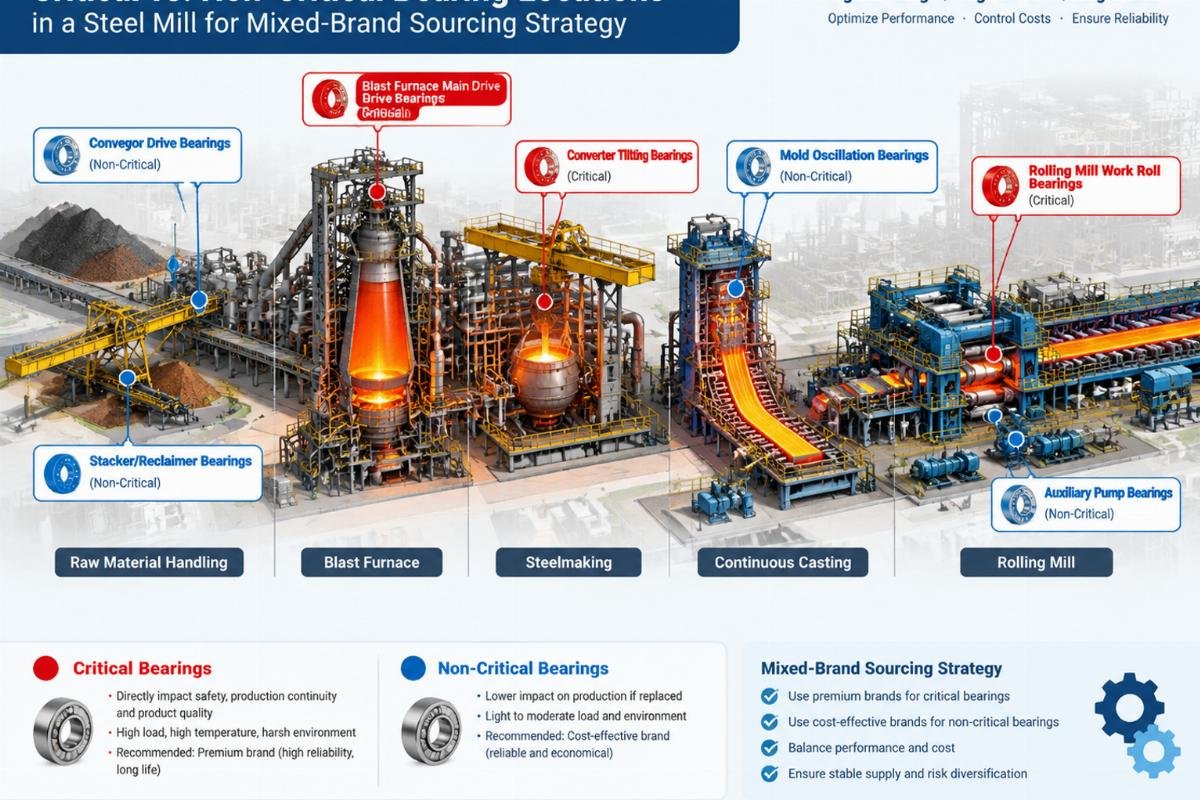
For distributors and MRO buyers, offering this nuanced advice adds significant value. It moves the conversation from simple price comparison to strategic asset management. By supplying genuine premium brands for critical paths and reliable domestic lines for auxiliary applications, supported by technical selection guidance, suppliers can help their clients achieve optimal operational efficiency. This approach aligns with the needs of regional industrial bearing distributors who require flexible MOQs and mixed-brand consolidation for their local markets.
Conclusion
Smart bearing selection balances initial cost with downtime risk through strategic application mapping.
The choice between premium and value spherical roller bearings is not binary but contextual. Critical applications demand the metallurgical superiority and consistency of premium brands to prevent costly failures, while auxiliary systems can safely utilize value options to optimize budgets. Understanding the true cost of ownership, including downtime and logistics, enables buyers to make informed decisions that protect production continuity. A mixed-brand strategy, supported by technical expertise and reliable supply chains, offers the best path forward for modern industrial operations.
Tags

About the author
author
Editor covering global sourcing, supplier verification, and industrial product knowledge. Content is compiled from manufacturer specifications, industry standards, and hands-on experience with international B2B buyers. Every article is fact-checked before publishing to help procurement professionals make informed decisions.
More articles by author

