Cold Climate Grease Brands: Wholesale Supplier for Bulk Orders
Selecting the right Grease Brands for Cold Climates prevents bearing seizure caused by startup starvation and churning. Prioritize synthetic base oils and verify ASTM low-temperature torque data to ensure pumpability in extreme cold. Compare premium and regional options to balance performance with wholesale cost efficiency.
 Written by
author
- Published on
- 7 min read
- Updated

Cold Climate Grease Brands: Wholesale Supplier for Bulk Orders
Thicker grease does not protect better in the cold; it causes churning and overheating.
Selecting the right low-temperature grease is critical for preventing bearing seizure in extreme cold. Comparing brands based on pumpability and dropping point ensures equipment reliability, rather than relying on generic viscosity ratings alone.
I still remember the silence of a high-altitude mining site in the Andes during a winter night. The temperature had dropped significantly below freezing, and the standard lithium grease we had specified for the crusher bearings had solidified into a hard, waxy block. When the morning shift attempted to start the equipment, the startup torque spiked immediately. The bearings did not rotate; they seized. That batch of equipment was scrapped, not because the steel was flawed, but because the lubricant failed to flow. [NEED_CITE: impact of low temperature on lubricant viscosity and pumpability]. This failure shifted my focus from merely sourcing bearings to understanding the chemistry of the lubricants that keep them running. In cold climates, the base oil viscosity and the thickener structure determine survival, not just the brand name on the tub.
For buyers managing MRO operations in harsh environments, the search for reliable Grease Brands for Cold Climates often leads to confusion between marketing claims and technical reality. The key is not finding the “coldest” rated product, but the one that maintains fluidity during the critical startup phase.
Why Do Standard Greases Fail in Extreme Cold?
Conventional lithium greases solidify below moderate freezing points, causing fatal bearing starvation during cold startups.
Most procurement teams assume that if a grease is labeled “all-season,” it will perform in sub-zero conditions. This is a dangerous misconception. Standard lithium complex greases, while excellent for general industrial use, rely on soap thickeners that can crystallize or harden when temperatures drop. When the base oil separates or becomes too viscous to flow, the bearing raceways are left dry. [NEED_CITE: ASTM D1473 testing methods for low temperature torque].
The failure mode is rarely immediate wear. It is startup starvation. When a machine sits idle in the cold, the grease settles. Upon ignition, the motor applies torque to overcome the static friction of the hardened grease. If the grease does not pump quickly enough to the contact zones, the metal-to-metal contact generates heat rapidly, leading to micro-welding and eventual seizure. I have seen this happen with roller bearings in wind turbines where the ambient temperature fluctuated wildly between day and night. The grease could not recover its structure fast enough, leading to premature fatigue.
Another counter-intuitive fact is that thicker grease, often chosen for its perceived protective quality, exacerbates the problem in cold weather. High-consistency greases create significant churning resistance. Once the machine is running, this churning generates internal heat, which can degrade the oil faster than external cold would. The goal is not thickness, but appropriate NLGI consistency that allows for easy pumping at low temperatures. [NEED_CITE: NLGI consistency grades and their effect on pumpability].

What Defines a True Low-Temperature Grease Brand?
Reliable brands prioritize synthetic base oils and complex soap thickeners for superior pumpability and low-temperature torque.
When evaluating Grease Brands for Cold Climates, the first specification to check is the base oil type. Mineral oils, derived from crude oil, contain waxes that naturally solidify in the cold. Synthetic base oils, such as polyalphaolefins (PAO) or esters, have a much lower pour point and maintain viscosity stability across a wider temperature range. [NEED_CITE: base oil viscosity index and low temperature performance].
The thickener system is equally critical. Lithium complex thickeners are common, but for extreme cold, polyurea or specialized synthetic thickeners often perform better. They do not rely on the same crystalline structures that can lock up in freezing conditions. A true low-temperature brand will provide data on the Low Temperature Torque, measured by ASTM D1478. This test measures the torque required to start and run a ball bearing at low temperatures. A lower starting torque indicates that the grease will not resist the initial movement of the bearing, preventing the startup damage I witnessed in the mining sector.
Furthermore, the dropping point is not the primary indicator of cold performance, but it does indicate thermal stability. However, for cold climates, the focus must remain on the lower end of the spectrum. Brands that offer detailed technical data sheets including these specific ASTM tests are more trustworthy than those that only list general ISO VG grades. [NEED_CITE: ASTM D2265 testing methods for dropping point].

How Do Top Grease Brands Compare for Cold Climates?
A matrix comparing premium international and reliable domestic brands reveals the best cost-performance ratios for extreme cold.
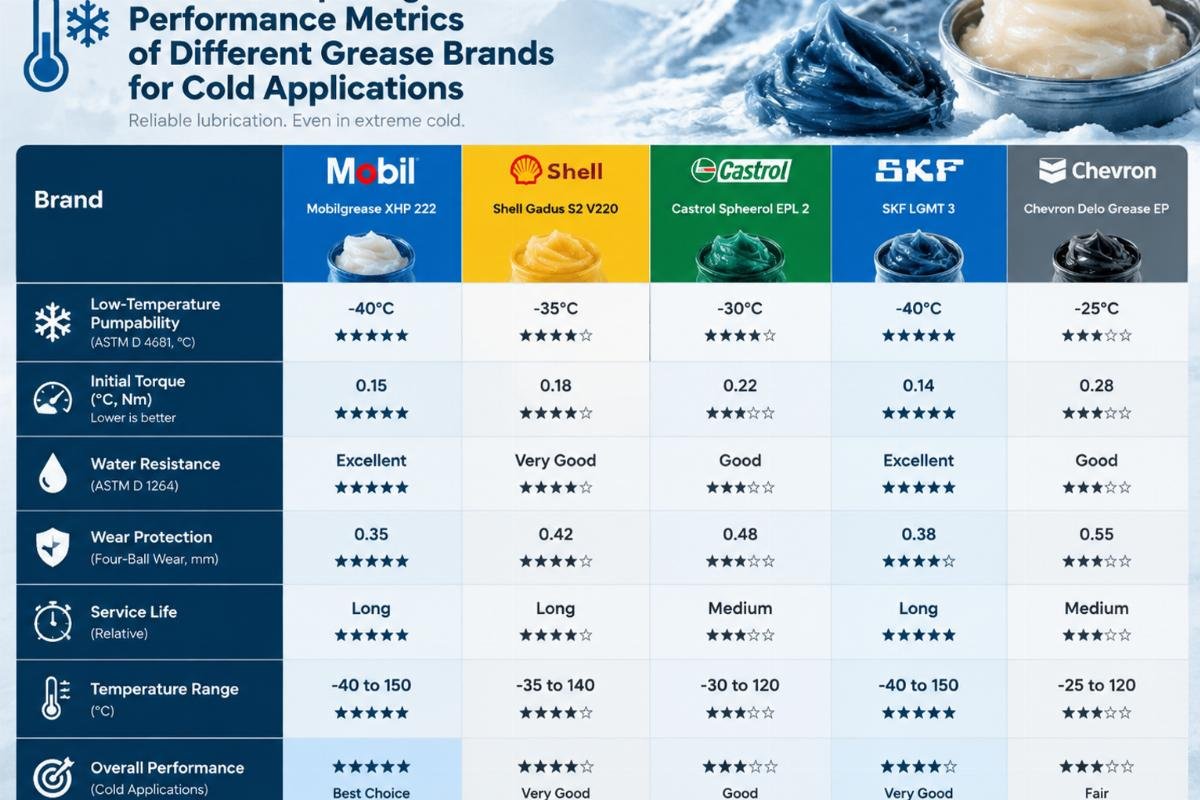
Choosing among Grease Brands for Cold Climates requires balancing performance with availability and cost. While global giants offer consistent quality, regional suppliers often provide competitive alternatives that meet the same technical standards. The following comparison highlights the key differentiators for buyers sourcing in bulk.
| Feature | Premium International Brands | Reliable Domestic/Regional Brands |
|---|---|---|
| Base Oil Type | Primarily Synthetic PAO/Ester | Mixed Mineral and Synthetic Blends |
| Thickener Technology | Advanced Polyurea/Lithium Complex | Standard Lithium Complex |
| Low Temp Torque Data | Widely Available (ASTM D1478) | Often Limited or Self-Reported |
| Consistency Stability | High Batch-to-Batch Uniformity | Variable, Requires Verification |
| Cost Profile | Higher Premium | Competitive Wholesale Pricing |
| Availability | Global Distribution Networks | Regional Stock, Faster Local Delivery |
Premium brands often invest heavily in R&D to ensure that their synthetic formulations remain stable over long periods. This consistency is crucial for OEMs who need to guarantee machine performance across multiple units. However, for MRO operators managing large fleets, the cost difference can be substantial. Reliable domestic brands have improved significantly, offering synthetic options that meet the basic requirements for cold climate operation. [NEED_CITE: comparative analysis of synthetic grease performance in cold climates].
The risk with lower-cost alternatives lies in batch consistency. A grease that performs well in one batch may have slight variations in thickener concentration in the next, affecting its low-temperature pumpability. This is why verifying the source and requesting sample testing is essential. In my experience, mixing brands without proper compatibility testing can lead to softening or hardening of the grease, negating any cold-weather benefits. [NEED_CITE: grease compatibility guidelines and risks].
When sourcing these lubricants alongside bearings, it is beneficial to work with a supplier who understands the interplay between the two. For instance, pairing a high-precision SKF or FAG bearing with an incompatible grease can void warranties or reduce service life. Our approach involves providing technical selection support to ensure that the grease recommended matches the bearing’s design and the operating environment. This holistic view prevents the mismatched components that often lead to early failure.
How to Verify Low-Temp Grease Performance Before Bulk Purchase?
Requesting ASTM test reports and conducting small-batch field trials prevents costly winter equipment failures.
Before committing to a large order of Grease Brands for Cold Climates, verification is non-negotiable. Relying solely on product brochures is insufficient for critical applications. The first step is to request the actual ASTM test reports for Low Temperature Torque and Pumpability. These documents provide objective data rather than marketing claims. [NEED_CITE: importance of verifying ASTM test data for industrial lubricants].
Next, conduct a small-batch field trial. Select a few non-critical machines in your operation and apply the new grease. Monitor the startup behavior during the coldest part of the day. Look for signs of high torque, unusual noise, or delayed lubrication distribution. This real-world data is invaluable. I once advised a client in a northern region to test a new synthetic grease on a single excavator before rolling it out to their entire fleet. The trial revealed that while the grease performed well in the lab, it separated slightly after prolonged static periods in the field. This insight allowed them to adjust their maintenance schedule to include periodic manual rotation, preventing potential damage.
Additionally, check for compatibility with existing greases if a full purge is not possible. Incompatible greases can form sludge that blocks lubrication channels. Simple compatibility tests, such as mixing small samples and observing for separation or hardening, can save significant cleanup costs later. [NEED_CITE: methods for testing grease compatibility].

Conclusion
Preventing bearing seizure in extreme cold requires selecting grease based on pumpability, not just brand reputation.
Understanding the technical specifications of Grease Brands for Cold Climates allows buyers to make informed decisions that protect their assets. By focusing on synthetic base oils, verifying ASTM test data, and conducting field trials, operators can ensure reliability during the harshest winter conditions. Proper lubrication selection is as critical as the bearing itself in maintaining operational continuity.
Tags

About the author
author
Editor covering global sourcing, supplier verification, and industrial product knowledge. Content is compiled from manufacturer specifications, industry standards, and hands-on experience with international B2B buyers. Every article is fact-checked before publishing to help procurement professionals make informed decisions.
More articles by author

