Relubricating Conveyor Bearings in Underground Mines: Wholesale Supplier
Master relubricating conveyor bearings in underground mines to prevent dust ingress and premature failure. Learn precise grease selection, purge volume calculations, and dynamic scheduling based on operating hours. Avoid over-greasing mistakes that cause overheating and extend bearing life with proven maintenance procedures.
 Written by
author
- Published on
- 7 min read
- Updated

Relubricating Conveyor Bearings in Underground Mines: Wholesale Supplier
More grease is not better; over-greasing causes churning and overheating.
Proper relubrication of underground conveyor bearings requires correct grease selection, precise injection techniques, and strict schedules to prevent dust ingress and premature failure. This process is not merely about adding lubricant but involves calculating purge volumes, selecting water-resistant high-load greases, and ensuring compatibility with existing seals to extend bearing life in harsh mining environments.
I still remember the silence in a Yantai mine tunnel after a conveyor shutdown. It was not the quiet of efficiency but the heavy silence of a halted production line. Years ago, I sourced deep groove ball bearings based solely on brand reputation and price, ignoring the specific maintenance realities of the underground environment. The bearings had standard seals, and the dust in that tunnel was so fine it bypassed the initial barriers. When the maintenance team tried to inject grease, the pressure built up without displacing the old, contaminated lubricant. Within two months, the entire fleet seized. That failure taught me that a bearing is only as good as its ability to be maintained in the dark, dusty confines of a mine. Now, when discussing Relubricating Conveyor Bearings in Underground Mines, I start by asking if the grease nipple is accessible and if the seal design allows for proper purging.
Understanding the mechanics behind this maintenance task is critical for minimizing unplanned downtime. The following sections detail why these components fail, how to select the right materials, the precise steps for application, and how to schedule these interventions effectively.
Why Do Underground Conveyor Bearings Fail Prematurely?
Dust ingress and inadequate lubrication are the primary culprits.
In underground mining, the environment is hostile. The air is thick with particulate matter, moisture is pervasive, and loads are often shock-intensive. Standard sealed bearings, which might perform adequately in a clean factory setting, often fail faster in these conditions because they cannot be cleaned or refreshed. Once contaminants breach the seal, they act as an abrasive paste, grinding away the raceways and rolling elements. [NEED_CITE: common failure modes in mining conveyor systems per ISO 15243]
A common misconception is that a higher grade of steel alone can solve this. While material quality matters, the sealing system and the ability to replenish lubricant are far more decisive. In a high-dust tunnel scenario, switching to relubricable bearings with extended grease nipples allowed maintenance teams to flush out contaminants regularly. This change reduced replacement frequency noticeably. The key is the purge effect. When new grease is injected, it must push the old, contaminated grease out through the seal relief or gap. If the seal is too tight or the grease channel is blocked, the new lubricant churns inside, generating heat rather than protecting the metal.
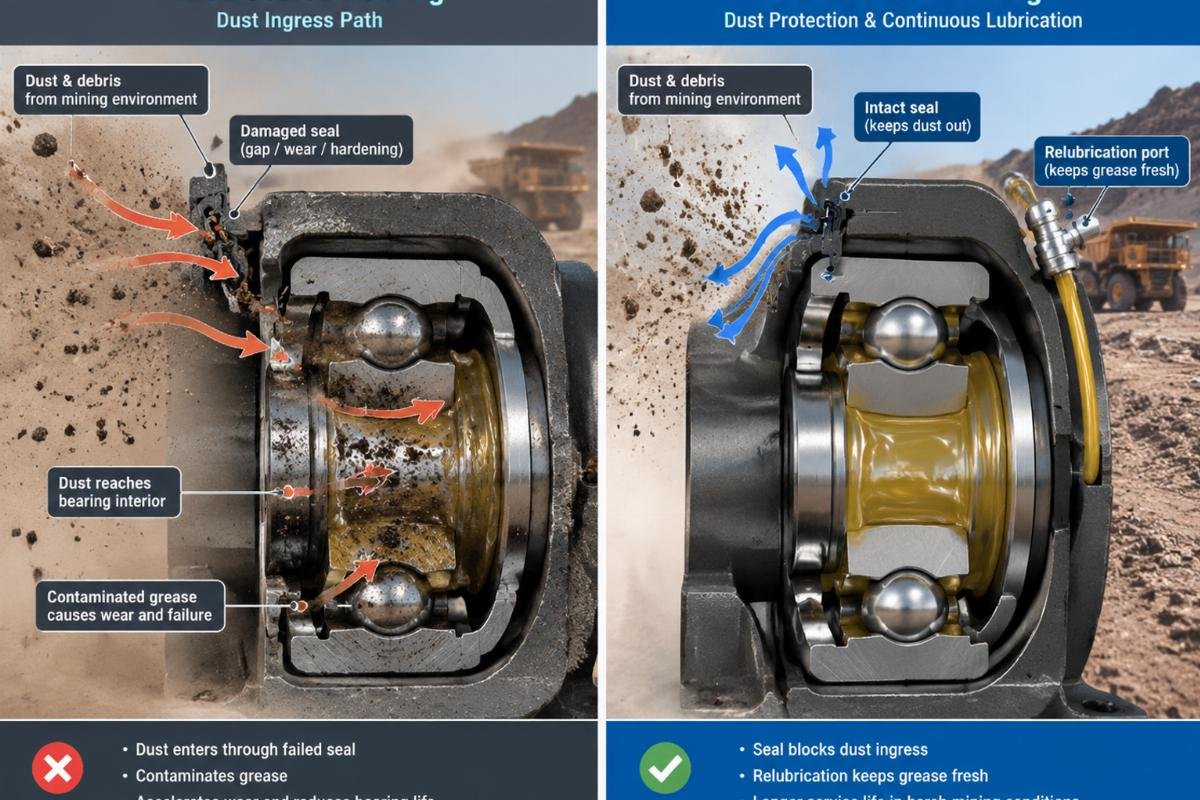
For MRO managers, recognizing the signs of early failure is vital. Overheating is a primary indicator, often caused by over-greasing or incompatible lubricants mixing to form a stiff compound. Vibration analysis can detect these issues before catastrophic seizure, but only if the baseline data is accurate. The root cause is rarely just wear; it is usually a maintenance procedure that did not account for the specific environmental severity of the underground site.
How to Choose the Right Grease for Harsh Mine Conditions?
Selecting water-resistant, high-load greases compatible with existing seals is non-negotiable.
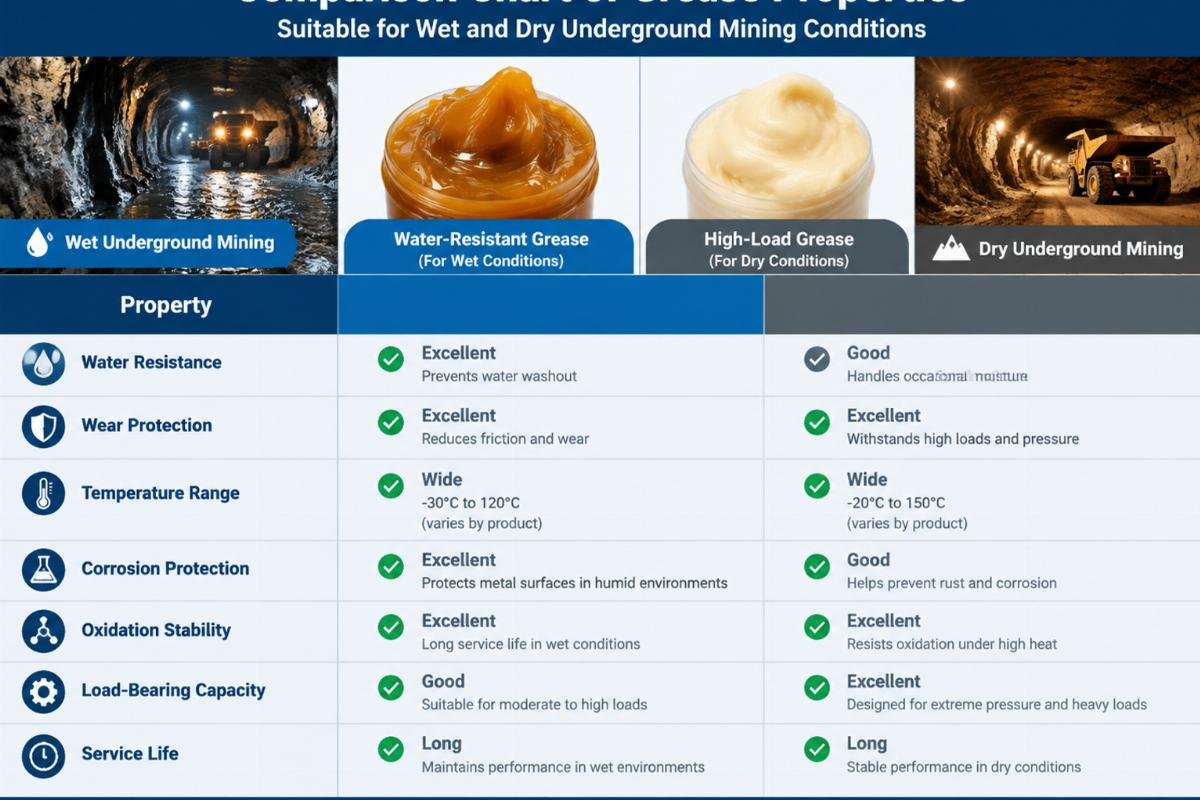
Not all greases are created equal, and mixing them can be disastrous. In a mixed-brand fleet, standardizing grease types across different equipment is essential to avoid chemical incompatibility. [NEED_CITE: grease compatibility chart guidelines from major bearing manufacturers] Some thickeners, such as lithium complex and polyurea, may be compatible, while others, like calcium sulfonate and clay-based thickeners, can react to form a solid block that stops the bearing entirely.
When evaluating options for Relubricating Conveyor Bearings in Underground Mines, consider the operating temperature and load. High-load inclines generate significant heat, requiring greases with high dropping points and excellent mechanical stability. Water resistance is equally critical due to the damp conditions in many mines. A grease that washes out easily will leave the bearing unprotected, leading to rapid corrosion and spalling.
| Grease Property | Requirement for Underground Mining | Reason |
|---|---|---|
| Base Oil Viscosity | High | To maintain film strength under heavy loads |
| Thickener Type | Lithium Complex or Polyurea | For high-temperature stability and water resistance |
| Additives | Extreme Pressure (EP) | To prevent welding under shock loads |
| Consistency | NLGI 2 or 3 | To stay in place and resist washout |
A European mining operator once faced repeated failures on a wet incline conveyor. They were using a standard lithium grease that could not handle the constant water spray. Switching to a calcium sulfonate complex grease, which offers superior water resistance and rust protection, extended the service life meaningfully. However, this switch required a complete flush of the old grease to prevent incompatibility issues. This highlights the importance of consulting technical datasheets and, when necessary, seeking support for grease selection from suppliers who understand these chemical nuances.
What is the Step-by-Step Relubrication Procedure?
Cleaning nipples, calculating purge volume, injecting slowly, and wiping excess are the core steps.
The act of greasing is often rushed, leading to errors that cause more harm than good. A proper procedure ensures that the new lubricant does its job without creating new problems. First, clean the grease nipple thoroughly. Any dirt on* acting as an abrasive. Use a lint-free cloth and a suitable cleaner.
Next, calculate the purge volume. This is the amount of grease required to fill the bearing cavity and push out the old lubricant. Over-greasing is a frequent mistake. Excess grease causes churning, which increases operating temperature and can degrade the lubricant rapidly. [NEED_CITE: calculation methods for bearing relubrication intervals and volumes] Ultrasonic lubrication monitoring can help determine the exact point at which the bearing is fully lubricated, preventing both under- and over-greasing.
- Clean: Wipe the grease nipple and surrounding area to remove dust and debris.
- Inspect: Check the nipple for damage or blockage. Replace if necessary.
- Inject: Attach the grease gun and inject the calculated amount of grease slowly. Rapid injection can damage seals.
- Purge: Allow the old grease to escape through the seal relief. Watch for fresh grease appearing at the exit point.
- Wipe: Clean any excess grease from the exterior to prevent it from attracting more dust.
In a high-load incline case, adjusting the relubrication intervals based on operating hours and temperature prevented overheating. The maintenance team used ultrasonic tools to listen to the bearing noise. A quiet bearing indicated proper lubrication, while a rising noise level signaled the need for more grease or a check for contamination. This data-driven approach replaced guesswork and significantly improved reliability.

How to Establish an Optimal Relubrication Schedule?
Basing intervals on operating hours, load, and environmental severity is essential.
There is no one-size-fits-all schedule for Relubricating Conveyor Bearings in Underground Mines. A fixed calendar-based approach often leads to either over-maintenance or neglect. Instead, intervals should be dynamic, reflecting the actual operating conditions. Factors such as speed, load, temperature, and contamination levels must be considered. [NEED_CITE: industry standards for bearing maintenance scheduling in heavy industry]
For example, a conveyor running continuously at high speed in a dry, clean section of the mine may require less frequent attention than one operating intermittently under heavy load in a wet, dusty area. Monitoring technologies, such as vibration analysis and thermography, can provide real-time data to adjust these schedules. If a bearing shows signs of increased vibration or temperature, the interval should be shortened. Conversely, if conditions are stable and monitoring data is normal, intervals can be extended to reduce labor costs and waste.
Standardizing these practices across a mixed-brand fleet simplifies management. By using genuine multi-brand bearings with optimal seal designs, maintenance teams can apply consistent procedures regardless of the equipment manufacturer. This uniformity reduces training time and minimizes the risk of error. Technical support for grease selection and interval determination can further refine these schedules, ensuring that each bearing receives the right amount of lubrication at the right time.

Conclusion
Precision in maintenance outweighs the cost of premium components.
Relubricating Conveyor Bearings in Underground Mines is a critical task that demands attention to detail, from grease selection to injection technique. By understanding the causes of failure, choosing compatible materials, following strict procedures, and adapting schedules to real-world conditions, mining operations can significantly extend bearing life and reduce unplanned downtime. The goal is not just to keep the conveyor moving but to ensure it moves reliably, safely, and efficiently in one of the most challenging industrial environments on earth.
Tags

About the author
author
Editor covering global sourcing, supplier verification, and industrial product knowledge. Content is compiled from manufacturer specifications, industry standards, and hands-on experience with international B2B buyers. Every article is fact-checked before publishing to help procurement professionals make informed decisions.
More articles by author

